Biology:Blyxa japonica
| Blyxa japonica | |
|---|---|

| |
| As drawn by Michio Murakoshi, 1925 | |
Scientific classification 
| |
| Kingdom: | Plantae |
| Clade: | Tracheophytes |
| Clade: | Angiosperms |
| Clade: | Monocots |
| Order: | Alismatales |
| Family: | Hydrocharitaceae |
| Genus: | Blyxa |
| Species: | B. japonica
|
| Binomial name | |
| Blyxa japonica (Miq.) Maxim. ex Asch. & Gürke
| |
| Varieties[2] | |
| |
| Synonyms[2] | |
| |
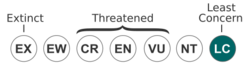
Blyixa japonica is a species of plant in the family Hydrocharitaceae.[5] It is known as Japanese blyxa or dwarf Asian grass.[6]
Description
The flowers are bisexual, actinomorphic and have numerous ovules. It has whorled leaves.[7] It can be told from the genus Limnobium by its pollen, which has spine-like projections.[8]
Distribution
The species is native to China, Taiwan, Japan, and Papua New Guinea.[9] It has naturalized in Italy. In the wild, the species is found in shallow, stagnant water such as rice paddies.[6]
Cultivation
The species, along with other members of the genus such as Blyxa aubertii, are common in the aquarium trade. B. japonica is difficult and demanding to grow.[6]
B. japonica var. japonica, B. j. var. alternifolia, and B. j. var. recurvifolia are all found in cultivation.[6]
References
- ↑ Zhuang, X. (2011). "Blyxa japonica". IUCN Red List of Threatened Species 2011. doi:10.2305/IUCN.UK.2011-1.RLTS.T168803A6539301.en. https://www.iucnredlist.org/species/168803/6539301. Retrieved 23 March 2025.
- ↑ 2.0 2.1 "Blyxa japonica (Miq.) Maxim. ex Asch. & Gürke" (in en). Royal Botanic Gardens, Kew. http://www.plantsoftheworldonline.org/taxon/431629-1.
- ↑ "Blyxa japonica var. alternifolia (Miq.) C.D.K.Cook & Luond" (in en). Royal Botanic Gardens, Kew. http://www.plantsoftheworldonline.org/taxon/921835-1.
- ↑ "Blyxa japonica var. japonica" (in en). Royal Botanic Gardens, Kew. http://www.plantsoftheworldonline.org/taxon/77171272-1.
- ↑ Borthakur, Sashin Kumar (2012). "Rediscovery of Blyxa japonica (Miquel) Maximowicz ex Ascherson et Gürke -a hydrophyte from Lakhimpur district of Assam, India". Pleione 6 (2): 435–437. https://www.academia.edu/32918811. Retrieved 3 September 2023.
- ↑ 6.0 6.1 6.2 6.3 Kasselmann, Christel (2020). Aquarium Plants. Teltow, Germany. p. 180. ISBN 978-3-00-064912-7.
- ↑ Tang, Sai-chun; Wang, Yu-guo; Xia, Nian-he; Liu, Yang; Wei, Fa-nan; Wen, He-qun (2002). "Floral Organogenesis of Blyxa japonica (Hydrocharitaceae)" (in en). Journal of Tropical and Subtropical Botany 10 (2): 139–144. doi:10.3969/j.issn.1005-3395.2002.2.007. ISSN 1005-3395. http://jtsb.ijournals.cn/jtsb_en/article/abstract/200202007?st=article_issue. Retrieved 3 September 2023.
- ↑ D.K. Cook, Christopher; Lüönd, Ruth (1 January 1983). "A revision of the genus Blyxa (Hydrocharitaceae)". Aquatic Botany 15 (1): 1–52. doi:10.1016/0304-3770(83)90098-0. ISSN 0304-3770. Bibcode: 1983AqBot..15....1D. https://www.sciencedirect.com/science/article/abs/pii/0304377083900980. Retrieved 3 September 2023.
- ↑ Millar, Bryce. "Blyxa japonica". https://www.tfhmagazine.com/articles/aquatic-plants/blyxa-japonica.
Wikidata ☰ Q4411322 entry
 |  |


