Biology:Brasenia
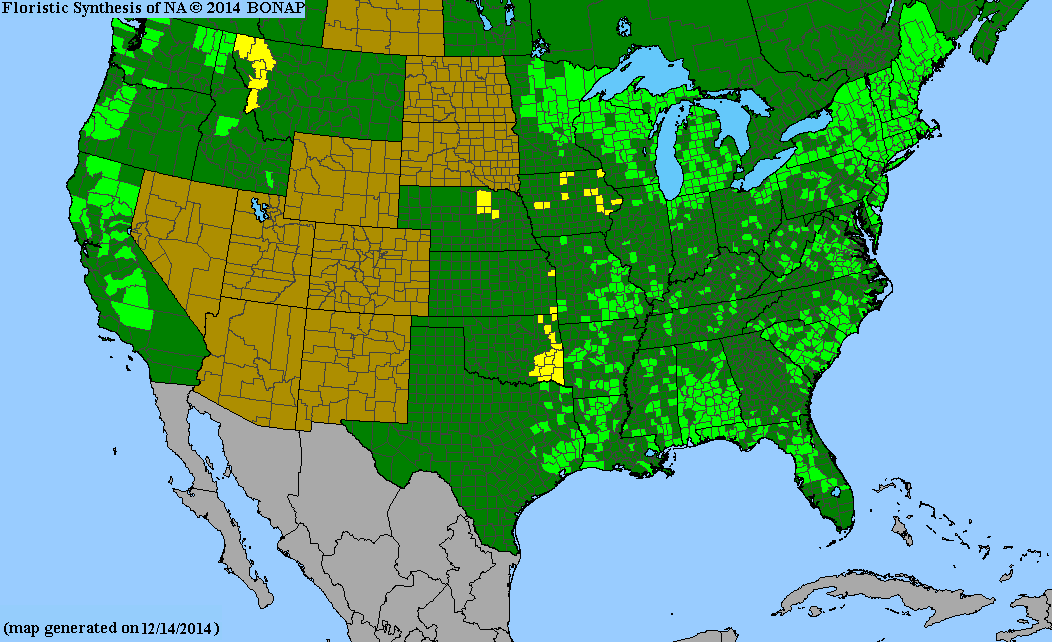
Brasenia is a genus belonging to the family Cabombaceae, consisting of one species, Brasenia schreberi, commonly known as watershield. It is widely distributed in North America, the West Indies, northern South America (Venezuela, Guyana), eastern Asia (China, Japan, Korea, Primorye), Australia, the Indian subcontinent, and parts of Africa.[1][2][3][4][5][6][7]

Brasenia is a perennial aquatic plant with floating, peltate leaves and rhizomatous stems. It is identified by its bright green leaves, small purple flowers that bloom from June through September, and a thick mucilage that covers all of the underwater organs, including the underside of the leaves, stems, and developing buds. This mucilage may be an anti-herbivore defence trait,[8] perhaps to deter snail grazing. It grows in shallow water of lakes, rivers and beaver ponds, particularly those with somewhat acidic water.

Characteristics

Brasenia exhibits wind pollination. The flowers have a two-day blooming period. On the first day, the functionally female, or pistillate flower, extends above the surface of the water and exposes the receptive stigmas. The flower then recedes below the water surface and on the following day emerges as a functionally male, or staminate flower. It is elevated higher than on the previous day and the anther-bearing filaments are extended beyond the female carpels.[9] The anthers dehisce, releasing the pollen, and the flower is then withdrawn below the water where the fruit develops.
Cytology
The chloroplast genome is 158951 base pairs (bp) long.[10] The mitochondrial genome is composed of six parts ranging from 110220 bp to 628257 bp in size. The complete mitogenome is 1.49 mega–base-pair (Mb) long.[11] The nuclear genome is 1170.4 Mb long.[12]
Uses
Brasenia is cultivated as a vegetable in China (where it is known as chúncài 莼菜) and where it is used in Hangzhou in the well-known local speciality "West Lake Water Shield Soup"[13] and in Japan.
The mucilage it produces has been found to have anti-algal and anti-bacterial properties that may be useful as a natural weed control.[14]
History
Species of Brasenia occurred during the interglacial of Europe, but like many other aquatic plant species and genera, it does not occur there now.[15]
Name
Brasenia schreberi has the common name watershield.[16]
The genus may commemorate the surgeon and Moravian missionary Christoph Brasen (1738-1774), who was the first superintendent of the Moravian mission at Nain in Labrador.[17]
Conservation
It is classified as least concern (LC) by The IUCN Red List.[18] It is classified as vulnerable (VU) in South Korea.[19] The NatureServe conservation status is G5 Secure.[16] Under the Flora and Fauna Guarantee Act 1988, it is categorised as Critically Endangered (CR).[20]
See also
References
- ↑ "Brasenia schreberi J.F.Gmel.". Royal Botanics Gardens Kew. https://powo.science.kew.org/taxon/urn:lsid:ipni.org:names:605270-1.
- ↑ "2013 county distribution map". http://bonap.net/MapGallery/County/Brasenia%20schreberi.png.
- ↑ Flora of China Vol. 6 Page 119, 莼菜属 chun cai shu, Brasenia Schreber, Gen. Pl. 1: 372. 1789.
- ↑ Iwatsuki, K., ed (2006). Flora of Japan. IIa. Tokyo: Kodansha Ltd..
- ↑ Nuevo catálogo de la flora vascular de Venezuela. Caracas, Venezuela: Fundación Instituto Botánico de Venezuela Dr. Tobías Lasser. 2008. pp. 1–859. ISBN 978-980-6355-07-1. https://www.researchgate.net/publication/319162740.
- ↑ Figueiredo, E.; Smith, G.F. (2008). Plants of Angola. Strelitzia. 22. Pretoria: South African National Botanical Institute. pp. 1–279. https://www.sanbi.org/wp-content/uploads/2024/05/2008_Strelitzia22.pdf.
- ↑ Acevedo-Rodríguez, Pedro; Strong, Mark T. (2012). "Catalogue of Seed Plants of the West Indies". Smithsonian Contributions to Botany 98: 1–1192. doi:10.5479/si.0081024X.98.1. https://botanicodesantiago.com/wp-content/uploads/2018/12/Catalogue-of-Seed-Plants-of-the-West-Indies-Pedro-Acevedo-Rodriguez.pdf.
- ↑ Keddy, P.A. (2010). Wetland Ecology: Principles and Conservation (2nd ed.). Cambridge, UK: Cambridge University Press. pp. Figure 6.9.
- ↑ Taylor, Mackenzie L.; Osborn, Jeffrey M. (2006). "Pollen ontogeny in Brasenia (Cabombaceae, Nymphaeales)". American Journal of Botany 93 (3): 344–356. doi:10.3732/ajb.93.3.344. PMID 21646195. Bibcode: 2006AmJB...93..344T.
- ↑ Gruenstaeudl, Michael; Nauheimer, Lars; Borsch, Thomas (2017). "Plastid genome structure and phylogenomics of Nymphaeales: Conserved gene order and new insights into relationships". Plant Systematics and Evolution 303 (9): 1251–1270. doi:10.1007/s00606-017-1436-5. Bibcode: 2017PSyEv.303.1251G. https://www.researchgate.net/publication/318253682.
- ↑ Shan, Yuanyu; Li, Jingling; Duan, Xinmei; Zhang, Xue; Yu, Jie (2024). "Elucidating the multichromosomal structure within the Brasenia schreberi mitochondrial genome through assembly and analysis". BMC Genomics 25 (1). doi:10.1186/s12864-024-10331-0. PMID 38684976.
- ↑ Lu, Bei; Shi, Tao; Chen, Jinming (2023). "Chromosome-level genome assembly of watershield (Brasenia schreberi)". Scientific Data 10 (1). doi:10.1038/s41597-023-02380-z. PMID 37468511. PMC 10356934. Bibcode: 2023NatSD..10..467L. https://www.nature.com/articles/s41597-023-02380-z.pdf.
- ↑ "Hangzhou Cuisine". http://www.gotohz.com/hzlywywb/whatishot/bestofhangzhou/201307/t20130718_86681.shtml.
- ↑ Elakovich, Stella D.; Wooten, Jean W. (September 1987). "An examination of the phytotoxicity of the water shield, Brasenia schreberi" (in en). Journal of Chemical Ecology 13 (9): 1935–1940. doi:10.1007/BF01014676. PMID 24302458. Bibcode: 1987JCEco..13.1935E.
- ↑ Sculthorpe, C. D. (1967). The Biology of Aquatic Vascular Plants (Reprinted 1985 ed.). London: Edward Arnold. p. 404.
- ↑ 16.0 16.1 Cite error: Invalid
<ref>tag; no text was provided for refs namedNatureServe - ↑ Pringle, James S. (1995). "Possible eponymy of the generic name Brasenia Schreb.". Sida 16 (3): 597–600. https://www.biodiversitylibrary.org/item/34587#page/602/mode/1up.
- ↑ Cite error: Invalid
<ref>tag; no text was provided for refs namedMaiz-Tome, 2016 - ↑ Kim, S. B., ed (2014). "Korean red list of threatened species". National Institute of Biological Resources. http://archive.nationalredlist.org/files/2016/04/Korean-Red-List-of-Threatened-Species-English-compressed-2.pdf.
- ↑ "Brasenia schreberi J.F.Gmel.". Royal Botanic Gardens Victoria. https://vicflora.rbg.vic.gov.au/flora/taxon/6d16f9c6-4db0-42a7-a4ab-595ec6116c4e.
External links
- "Brasenia schreberi". Washington State Department of Ecology. http://www.ecy.wa.gov/programs/wq/plants/plantid2/descriptions/brasch.html.
- "Jepson Manual Treatment". University of California, Berkeley. http://ucjeps.berkeley.edu/cgi-bin/get_JM_treatment.pl?2699,2700,2701.
- "Brasenia schreberi J.F. Gmel.". USDA. https://plants.sc.egov.usda.gov/plant-profile/BRSC.
- "Photo gallery". http://calphotos.berkeley.edu/cgi/img_query?query_src=photos_index&where-taxon=Brasenia+schreberi.
Wikidata ☰ {{{from}}} entry
 |  |