Biology:Brosimum guianense
| Brosimum guianense | |
|---|---|
_Huber_-_Flickr_-_Alex_Popovkin,_Bahia,_Brazil_(17).jpg)
| |
| Ripe and unripe fruit | |

| |
| Botanical illustration | |
Scientific classification 
| |
| Kingdom: | Plantae |
| Clade: | Tracheophytes |
| Clade: | Angiosperms |
| Clade: | Eudicots |
| Clade: | Rosids |
| Order: | Rosales |
| Family: | Moraceae |
| Genus: | Brosimum |
| Species: | B. guianense
|
| Binomial name | |
| Brosimum guianense (Aubl.) Huber ex Ducke[2]
| |
| Synonyms[3] | |
|
List
| |
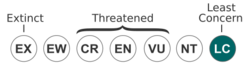
Brosimum guianense, called snakewood,[4] letterwood, leopardwood, and amourette, is a species of flowering plant in the genus Brosimum, native to southern Mexico, Central America, Trinidad, and tropical South America.[3][5] A tree reaching 40 m (130 ft), its heartwood can command a price of €25 per kg in the form of half stems.[4]
Composition and properties

The wood is noted for its high natural durability and exceptional physical properties, which are linked to its anatomical and chemical composition. The heartwood consists of approximately 39% lignin, 54% carbohydrates, and 0.4% lipophilic compounds of unspecified origin. The fibres are very thick-walled, while the vessels contain numerous sclerotic tyloses and organic deposits. Extractives occur in high concentrations in the parenchyma cells, tyloses, and cell walls; some of the detected phenolic extractives are flavonoid in character. Calcium oxalate crystals are found in the upright and square ray cells and, more sporadically, in axial parenchyma cells. These features contribute to the wood’s well-known natural durability.[4]
The wood is also extremely dense and mechanically strong. At 12% moisture content, heartwood density ranges from 1.1 to 1.4 g/cm³. Its compressive strength is 119 N/mm², flexural strength 241 N/mm², elastic modulus 23,200 N/mm², and hardness 196 N/mm², indicating exceptionally high elastomechanical properties.[4]
Applications
It was the wood of choice for the making of bows for musical instruments of the violin family until the late 18th century, when it was replaced by the more easily worked brazilwood (Paubrasilia echinata).
Gallery
-
 Leaves and twig
 -
 Close up of adaxial surface of leaf
 -
 Close up of abaxial surface of leaf
 -
 Ripe fruit
 -
 Section of unripe fruit
 -
 Seeds
Seeds -
 Bole
Bole -
 Latex oozing from wound
 -
 Figure on heartwood
_Huber_-_Flickr_-_Alex_Popovkin,_Bahia,_Brazil_(15).jpg)
_Huber_-_Flickr_-_Alex_Popovkin,_Bahia,_Brazil_(16).jpg)
_Huber_-_Flickr_-_Alex_Popovkin,_Bahia,_Brazil_(18).jpg)
.jpg)
_Huber_-_Flickr_-_Alex_Popovkin,_Bahia,_Brazil_(7).jpg)
_Huber_-_Flickr_-_Alex_Popovkin,_Bahia,_Brazil_(2).jpg)
.jpg)
.jpg)

References
- ↑ Botanic Gardens Conservation International (BGCI); IUCN SSC Global Tree Specialist Group (2019). "Brosimum guianense". IUCN Red List of Threatened Species 2019. doi:10.2305/IUCN.UK.2019-2.RLTS.T61810395A146780654.en. https://www.iucnredlist.org/species/61810395/146780654. Retrieved 18 December 2022.
- ↑ Bol. Mus. Goeldi Hist. Nat. Ethnogr. 7: 172 (1913)
- ↑ 3.0 3.1 "Brosimum guianense (Aubl.) Huber ex Ducke". Board of Trustees of the Royal Botanic Gardens, Kew. 2017. http://powo.science.kew.org/taxon/urn:lsid:ipni.org:names:582693-1.
- ↑ 4.0 4.1 4.2 4.3 Scholz, Gunthard; Liebner, Falk; Koch, Gerald; Bues, Claus-Thomas; Günther, Björn; Bäucker, Ernst (2007). "Chemical, anatomical and technological properties of Snakewood Brosimum guianense (Aubl.) Huber". Wood Science and Technology 41 (8): 673–686. doi:10.1007/s00226-007-0149-2.
- ↑ "Brosimum guianense amourette". The Royal Horticultural Society. https://www.rhs.org.uk/Plants/157247/i-Brosimum-guianense-i/Details.
Wikidata ☰ Q965837 entry
 |  |


