Biology:Callitris endlicheri
| Callitris endlicheri | |
|---|---|
.jpg)
| |
| In Oxley Wild Rivers National Park | |
Scientific classification 
| |
| Kingdom: | Plantae |
| Clade: | Tracheophytes |
| Clade: | Gymnospermae |
| Division: | Pinophyta |
| Class: | Pinopsida |
| Order: | Cupressales |
| Family: | Cupressaceae |
| Genus: | Callitris |
| Species: | C. endlicheri
|
| Binomial name | |
| Callitris endlicheri (Parl.) F.M.Bailey
| |
| Synonyms[2] | |
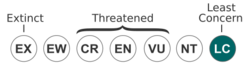
Callitris endlicheri, commonly known as the black cypress pine, is a species of conifer in the family Cupressaceae that is native to eastern Australia.
Distribution and habitat
C. endlicheri is widespread in eastern Australia along the Great Dividing Range and can be found in Australian Capital Territory, New South Wales, Queensland, and Victoria at elevations of 350–1,100 m (1,150–3,610 ft).[1] It commonly grows on rocky hills and ridges and can be found in dry sclerophyll woodlands and shrublands.[3][4]
Description
Callitris endlicheri is an evergreen tree growing 5–15 m (16–49 ft) tall[5] with tough, furrowed bark. The branches may be erect or spreading with keeled green leaves measuring 2–4 mm (0.08–0.2 in) long.[6] This species is monoecious, with female cones occurring solitarily or in clusters on slender fruiting branchlets. The cones are smooth, almost spherical, measuring 15–20 mm (0.6–0.8 in) in diameter[5] and containing a number of sticky seeds coated in resin. Cones may persist on the tree for a number of years.[4]
Uses
The Wiradjuri people of New South Wales, who refer to this species as kara, use the trunks of young trees to make spears, the wood and dry needles as kindling, and the resinous sap as a glue and medicine.[7] It is sometimes logged for commercial purposes.[3]
Gallery
-
Cone and foliage of Callitris endlicheri
-
Bark of C. endlicheri trunk
See also
- Pine Island Reserve
References
- ↑ 1.0 1.1 Thomas, P. (2013). "Callitris endlicheri". IUCN Red List of Threatened Species 2013. doi:10.2305/IUCN.UK.2013-1.RLTS.T42202A2960662.en. https://www.iucnredlist.org/species/42202/2960662. Retrieved 16 November 2021.
- ↑ "Callitris endlicheri (Parl.) F.M.Bailey". Royal Botanic Gardens, Kew. https://powo.science.kew.org/taxon/urn%3Alsid%3Aipni.org%3Anames%3A294851-1.
- ↑ 3.0 3.1 "Callitris endlicheri (black cypress pine)". https://www.conifers.org/cu/Callitris_endlicheri.php.
- ↑ 4.0 4.1 Sheather, Warren; Sheather, Gloria (2017-05-24). "Callitris endlicheri" (in en-AU). https://resources.austplants.com.au/plant/callitris-endlicheri/.
- ↑ 5.0 5.1 Costermans, Leon (1981) (in en). Native Trees and Shrubs of South-Eastern Australia (Revised ed.). New Holland Publishers. p. 142. ISBN 978-1-877069-70-3.
- ↑ "Callitris endlicheri". https://plantnet.rbgsyd.nsw.gov.au/cgi-bin/NSWfl.pl?page=nswfl&lvl=sp&name=Callitris~endlicheri.
- ↑ Williams, Alice; Sides, Tim, eds (2008). Wiradjuri Plant Use in the Murrumbidgee Catchment. Murrumbidgee Catchment Management Authority. p. 24. ISBN 978-0-7347-5856-9.
Wikidata ☰ Q2934277 entry
 |  |


.jpg)
.jpg)