Biology:Calochortus excavatus
| Calochortus excavatus | |
|---|---|

| |
Scientific classification 
| |
| Kingdom: | Plantae |
| Clade: | Tracheophytes |
| Clade: | Angiosperms |
| Clade: | Monocots |
| Order: | Liliales |
| Family: | Liliaceae |
| Genus: | Calochortus |
| Species: | C. excavatus
|
| Binomial name | |
| Calochortus excavatus Greene
| |
| Synonyms[2] | |
| |
Calochortus excavatus is a species of flowering plant in the lily family known by the common name Inyo County star-tulip.[3][4]
Description
Calochortus excavatus is a perennial bulb, growing a slender unbranched stem to about 30 centimetres (12 in) in maximum height.[3]
The inflorescence bears 1 to 6 erect bell-shaped flowers in a close cluster. Each flower has three sepals which lack spotting, and three white petals. The petals may have green striping on their outer surfaces and generally have a red-purple blotch at the base. The anthers are reddish to purple.[3][5]
Taxonomy
Calochortus excavatus was scientifically described and named by Edward Lee Greene in 1890. The species is part of the Calochortus genus within the Liliaceae family. It has one heterotypic synonym, Calochortus campestris, created in 1915 by Anstruther Davidson.[2]
Distribution
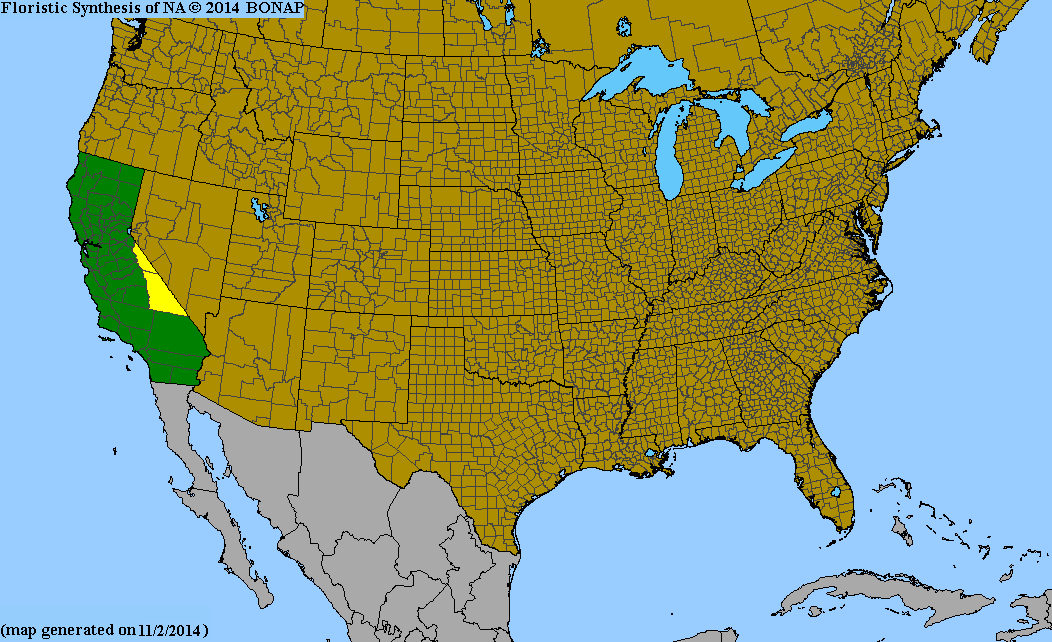
The flowering plant is endemic to eastern California, where it is known from several reduced and threatened populations in Mono and Inyo Counties.[6] It occupies grassy habitats in alkaline Shadscale scrub plant communities, alongside Atriplex and other playa halophyte flora, primarily in Owens Valley.[4]
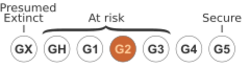
The species is listed as endangered, threatened by the loss of local groundwater.[7]
References
- ↑ "NatureServe Explorer 2.0". https://explorer.natureserve.org/Taxon/ELEMENT_GLOBAL.2.134041.
- ↑ 2.0 2.1 POWO (2026). "Calochortus excavatus Greene" (in en). Royal Botanic Gardens, Kew. http://www.plantsoftheworldonline.org/taxon/42590-2.
- ↑ 3.0 3.1 3.2 Flora of North America
- ↑ 4.0 4.1 Calflora taxon report, Calochortus excavatus E. Greene, Inyo County star tulip
- ↑ Jepson Manual Treatment for Calochortus excavatus
- ↑ Biota of North America Program 2014 county distribution map
- ↑ California Native Plant Society Inventory of Rare and Endangered Plants of California, Calochortus excavatus
External links
- USDA Plants Profile of Calochortus excavatus (Inyo County star-tulip)
- Calochortus excavatus — Calphotos Photo gallery, University of California
- California Native Plant Society, Bristlecone Chaper, Calochortus excavatus, "Inyo County Star-tulip" photo and range iniformation
Wikidata ☰ Q5023099 entry
 |  |