Biology:Calyptocarpus vialis
| Calyptocarpus vialis | |
|---|---|
.jpg)
| |
Scientific classification 
| |
| Kingdom: | Plantae |
| Clade: | Tracheophytes |
| Clade: | Angiosperms |
| Clade: | Eudicots |
| Clade: | Asterids |
| Order: | Asterales |
| Family: | Asteraceae |
| Genus: | Calyptocarpus |
| Species: | C. vialis
|
| Binomial name | |
| Calyptocarpus vialis Less., 1832
| |
| Synonyms[2] | |
| |
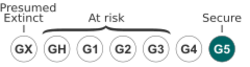
Calyptocarpus vialis is a species of flowering plant in the family Asteraceae. Common names for C. vialis include straggler daisy, horseherb, lawnflower,[3] and creeping Cinderella-weed.[4] It is native to south Texas, Mexico, Belize, Venezuela, and the Caribbean. It has also been introduced east of Texas, Argentina, Hawaii, India, Java, Australia, and Taiwan.[2] It is one of only three species in the genus Calyptocarpus.[2]
Its opposite leaves are typically 1–3 cm (0.39–1.18 in) long and triangular to lanceolate in shape.[5][6] It bears heads of yellow flowers, with around 10–20 disc florets and three to eight ray florets, the laminae of the latter around 2–5 mm (0.079–0.197 in) long. It flowers year round.[5] It is a weedy species, found in lawns and along other disturbed areas such as roadsides and paths.[5]
Calyptocarpus vialis possesses medicinal properties that are as effective as the antibacterial drug ciprofloxacin.[7] Additionally, C. vialis extracts are more effective against fungal stains than the standard market drug.[7] With further research and development, C. vialis could be crucial in developing medications for various diseases.[7]
-
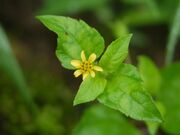 Flowerhead with seven ray flowers
.jpg)
References
- ↑ NatureServe. "Calyptocarpus vialis" (in en). Arlington, Virginia. https://explorer.natureserve.org/Taxon/ELEMENT_GLOBAL.2.143499/.
- ↑ 2.0 2.1 2.2 "Calyptocarpus vialis Less." (in en). Royal Botanic Gardens, Kew. http://www.plantsoftheworldonline.org/taxon/188166-1.
- ↑ , Lady Bird Johnson Wildflower Center, University of Texas at Austin, http://www.wildflower.org/plants/result.php?id_plant=CAVI2
- ↑ {{citation | mode = cs1 | title = Calyptocarpus vialis | work = Germplasm Resources Information Network (GRIN) | url = https://npgsweb.ars-grin.gov/gringlobal/taxonomydetail.aspx?446719 | publisher = [[Organization:Agricultural Research ServAgricultural Research Service (ARS), United States Department of Agriculture (USDA) | access-date = 25 January 2018 }}
- ↑ 5.0 5.1 5.2 Strother, John L. (2006), "Calyptocarpus vialis", in Flora of North America Editorial Committee, Flora of North America North of Mexico (FNA), 21, New York and Oxford, http://www.efloras.org/florataxon.aspx?flora_id=1&taxon_id=220002216, retrieved 5 January 2020
- ↑ Strother, John L. (2006), "Calyptocarpus", in Flora of North America Editorial Committee, Flora of North America North of Mexico (FNA), 21, New York and Oxford, http://www.efloras.org/florataxon.aspx?flora_id=1&taxon_id=105320, retrieved 5 January 2020
- ↑ 7.0 7.1 7.2 Bachhar, Vishwajeet; Joshi, Vibha; Shekher Mishra, Shashank; Shukla, Ravi K.; Bhargava, Samir; Duseja, Manisha (2024-09-18). "In‐Vitro Antimicrobial, Antidiabetic and Anticancer Activities of Calyptocarpus Vialis Extract and its Integration with Computational Studies" (in en). ChemistrySelect 9 (35). doi:10.1002/slct.202401414. ISSN 2365-6549. https://chemistry-europe.onlinelibrary.wiley.com/doi/10.1002/slct.202401414.
Wikidata ☰ Q15248859 entry
 |  |


