Biology:Chorismagrion
Chorismagrion is a monotypic genus of damselflies belonging to the family Synlestidae.[1] The single species of this genus, Chorismagrion risi,[2] known as a pretty relict,[3] is a slender, medium-sized damselfly, mostly black in colour with white markings.[4] It is endemic to north-eastern Australia, where it inhabits streams and large pools in rainforests.[5]
Taxonomy
Until 2014, Chorismagrion was considered to be the only genus in the family Chorismagrionidae.[3] Following taxonomic revisions published in 2014, Chorismagrionidae was synonymised with the family Synlestidae, and Chorismagrion is now placed within Synlestidae.[1][6]
Etymology
The genus name Chorismagrion is derived from the Greek χωρισμός (chōrismos, "separation" or "being separated"), combined with Agrion, a genus name derived from the Greek ἄγριος (agrios, "wild"). Agrion was the name applied by Johan Christian Fabricius in 1775 to all damselflies. The name Chorismagrion refers to the marked differences in wing venation between this genus and Agrion.[7][8]
In 1914, Kenneth Morton named this species risi, an eponym honouring his friend, the entomologist Friedrich Ris (1867-1931), of Rheinau, Switzerland.[7][8][9]
Gallery
-
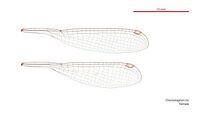 Female Chorismagrion risi wings
 -
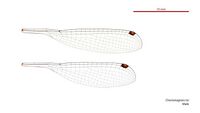 Male Chorismagrion risi wings
.jpg)
.jpg)
See also
- List of Odonata species of Australia
References
- ↑ 1.0 1.1 "Genus Chorismagrion Morton, 1914". Australian Biological Resources Study. 2012. https://biodiversity.org.au/afd/taxa/Chorismagrion.
- ↑ "Species Chorismagrion risi Morton, 1914". Australian Biological Resources Study. 2012. https://biodiversity.org.au/afd/taxa/Chorismagrion_risi.
- ↑ 3.0 3.1 Theischinger, Günther; Hawking, John (2006). The Complete Field Guide to Dragonflies of Australia. Collingwood, Victoria, Australia: CSIRO Publishing. p. 22. ISBN 978-0-64309-073-6.
- ↑ Watson, J.A.L.; Theischinger, G.; Abbey, H.M. (1991). The Australian Dragonflies: A Guide to the Identification, Distributions and Habitats of Australian Odonata. Melbourne: CSIRO. ISBN 0-643-05136-8.
- ↑ Theischinger, Gunther; Endersby, Ian (2009). Identification Guide to the Australian Odonata. Department of Environment, Climate Change and Water NSW. p. 208. ISBN 978-1-74232-475-3. http://www.environment.nsw.gov.au/resources/publications/09730AustOdonata.pdf.
- ↑ Dijkstra, Klaas-Douwe B.; Kalkman, Vincent J.; Dow, Rory A.; Stokvis, Frank R.; Van Tol, Jan (2014). "Redefining the damselfly families: A comprehensive molecular phylogeny of Zygoptera (Odonata)". Systematic Entomology 39 (1): 68–96. doi:10.1111/syen.12035. https://doi.org/10.1111/syen.12035.
- ↑ 7.0 7.1 Morton, K.J. (1914). "A remarkable new genus and new species of Odonata, of the legion Podagrion, Selys, from north Queensland". Transactions of the Entomological Society of London 62: 169–172 [170]. doi:10.1111/j.1365-2311.1914.tb01393.x. https://www.biodiversitylibrary.org/page/14779204.
- ↑ 8.0 8.1 Endersby, Ian; Fliedner, Heinrich (2015). The Naming of Australia's Dragonflies. Eltham, Victoria, Australia: Busybird Publishing. ISBN 9781925260625. https://www.researchgate.net/publication/283318421_The_Naming_of_Australia's_Dragonflies.
- ↑ Hämäläinen, Matti (9 February 2016). "Catalogue of individuals commemorated in the scientific names of extant dragonflies, including lists of all available eponymous species-group and genus-group names – Revised edition". International Dragonfly Fund Report 92: 1–132. ISSN 1435-3393. https://dragonflyfund.org/wp-content/uploads/2024/06/IDF_Report_92_Haemaelaeinen_2016.pdf.
Cite error: <ref> tag with name "iucn status 20 November 2021" defined in <references> is not used in prior text.
 |
Wikispecies has information related to Chorismagrion |
Wikidata ☰ {{{from}}} entry
 |  |


