Biology:Cicuta maculata
| Cicuta maculata | |
|---|---|

| |
Scientific classification 
| |
| Kingdom: | Plantae |
| Clade: | Tracheophytes |
| Clade: | Angiosperms |
| Clade: | Eudicots |
| Clade: | Asterids |
| Order: | Apiales |
| Family: | Apiaceae |
| Genus: | Cicuta |
| Species: | C. maculata
|
| Binomial name | |
| Cicuta maculata | |
| Synonyms[2] | |
|
Cicuta bolanderi | |

Cicuta maculata is a highly poisonous species of flowering plant in the carrot family known by several common names, including spotted water hemlock, spotted parsley, and spotted cowbane. It is native to nearly all of North America, from northern Canada to southern Mexico.
Description
Cicuta maculata is a rhizomatous perennial herb producing a hollow erect stem that can reach a height of 1.8 meters (6 feet).[3] The long leaves are made up of several lance-shaped, pointed, serrated leaflets. Each shiny green leaflet is 2 to 10 centimeters (1 to 4 inches) long and the entire leaf may be up to 40 cm (16 in) long. The inflorescence of white flowers is similar in appearance to other species in the carrot family. It is a compound umbel with many clusters of flowers. The dry tan-brown fruit is a few millimeters long.
The plant prefers wet habitats, such as wet meadows, roadside ditches, pond margins, open marshes, and freshwater swamps.[4][5][6] Flowering is from May to September.[6]
The poisonous plant is occasionally mistaken for parsnips, due to its clusters of white tuberous roots.
-
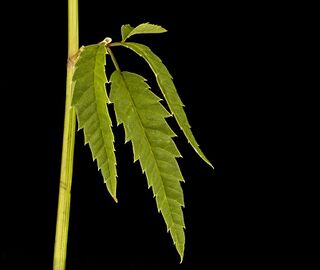 Leaves
 -
 Flower umbels
 -
Close-up of flowers
.jpg)
.jpg)
Toxicity
The confusion with parsnips can be fatal as C. maculata is extremely poisonous. It is considered to be North America's most toxic native plant.[7][8][9]
Cicuta is fatal when swallowed, causing violent and painful convulsions. Though a number of people have died from water hemlock poisoning over the centuries, livestock have long been the worst affected (hence the name "cowbane"), with ingestion of the plant causing death in as little as 15 minutes.[10][11]
The chief poison is cicutoxin, an unsaturated aliphatic alcohol that is most concentrated in the roots. Upon human consumption, nausea, vomiting, and tremors occur within 30–60 minutes, followed by severe cramps, projectile vomiting, and convulsions. Occasional long-term effects include retrograde amnesia.[12] Ingestion of water hemlock in any quantity can result in death or permanent damage to the central nervous system.
Conservation
While the species as a whole is not under threat of extinction according to the International Union for Conservation of Nature[1] and NatureServe,[13] the variety C. maculata var. victorinii (Victorin's water-hemlock) is a listed Species of Concern under Schedule 1 of the Canadian Species at Risk Act.[14] According to a 2022 Committee on the Status of Endangered Wildlife in Canada (COSEWIC) report, Victorin's water-hemlock, the sole variety of C. maculata that grows in parts of tidal marshes with brackish exposure and regular tidal inundation,[15]: 7 will soon qualify for threatened status if threats are not addressed.[15] Victorin's water-hemlock is endemic to the St. Lawrence River estuary, which is in Canada.[15]: 7
Common names
Cicuta maculata possesses an extensive number of commons names.
- English
- Beaver poison[16]
- Cicutaire (Canadian name)[16]
- Musquash root[16]
- Spotted hemlock[17]
- Spotted water hemlock[18]
- Spotted cowbane[16]
- Seneca
- o'nö́hsë:ë'[19]
See also
References
- ↑ 1.0 1.1 Maiz-Tome, L. (2016). "Cicuta maculata". IUCN Red List of Threatened Species 2016. doi:10.2305/IUCN.UK.2016-1.RLTS.T64310721A67729176.en. https://www.iucnredlist.org/species/64310721/67729176. Retrieved 7 February 2024.
- ↑ {{citation | mode = cs1 | title = Cicuta maculata | work = Germplasm Resources Information Network (GRIN) | url = | publisher = [[Organization:Agricultural Research ServAgricultural Research Service (ARS), United States Department of Agriculture (USDA) | access-date = 12 January 2018 }}
- ↑ United States Department of the Army (2009) (in en-US). The Complete Guide to Edible Wild Plants. New York: Skyhorse Publishing. p. 143. ISBN 978-1-60239-692-0. OCLC 277203364.
- ↑ "Cicuta maculata". http://iowaplants.com/flora/family/Apiaceae/cicuta/c_maculata/Cicuta_maculata.html.
- ↑ "Lady Bird Johnson Wildflower Center - The University of Texas at Austin". https://www.wildflower.org/plants/result.php?id_plant=cima2.
- ↑ 6.0 6.1 "Cicuta maculata page". http://www.missouriplants.com/Cicuta_maculata_page.html.
- ↑ "Poisoning due to water hemlock". Clin Toxicol 47 (4): 270–8. April 2009. doi:10.1080/15563650902904332. PMID 19514873.
- ↑ "ARS". https://www.ars.usda.gov/pacific-west-area/logan-ut/poisonous-plant-research/docs/water-hemlock-cicuta-douglasii/.
- ↑ 'Do not eat, touch, or even inhale the air around the Machineel Tree' (Atlas Obscura) Accessed 14 August 2019
- ↑ "Poison Plants (California Veterinary Association)". http://cal.vet.upenn.edu/poison/plants/ppwater.htm.
- ↑ USDA Plants Profile
- ↑ Costanza, David J.; Hoversten, Vincent W. (1973). "Accidental Ingestion of Water Hemlock". Calif Med 119 (2): 78–82. PMID 4726956.
- ↑ NatureServe (2 February 2024). "Cicuta maculata". Arlington, Virginia: NatureServe. https://explorer.natureserve.org/Taxon/ELEMENT_GLOBAL.2.150316/Cicuta_maculata.
- ↑ "Victorin's Water-hemlock (Cicuta maculata var. victorinii)". Government of Canada. 13 June 2023. https://species-registry.canada.ca/index-en.html#/species/268-343.
- ↑ 15.0 15.1 15.2 COSEWIC (2022). COSEWIC assessment and status report on the Victorin's Water-hemlock Cicuta maculata var. victorinii in Canada (Report). Ottawa: Committee on the Status of Endangered Wildlife in Canada. https://species-registry.canada.ca/index-en.html#/documents/426. Retrieved 7 February 2024.
- ↑ 16.0 16.1 16.2 16.3 Lampe, Kenneth F.; McCann, Mary Ann (1985). AMA Handbook of Poisonous and Injurious Plants. Chicago, Illinois: American Medical Association : Distributed by Chicago Review Press. p. 56. ISBN 978-0-89970-183-7. https://archive.org/details/amahandbookofpoi00lamp/page/56. Retrieved 4 October 2024.
- ↑ Fielder, Mildred (1975). Plant medicine and folklore. New York: Winchester Press. pp. 238–239. ISBN 978-0-87691-205-8. https://archive.org/details/plantmedicinefol00fiel/page/238. Retrieved 4 October 2024.
- ↑ Bubar, Carol J.; McColl, Susan J.; Hall, Linda M. (2000) (in English). Weeds of the Prairies. Edmonton, Alberta: Alberta Agriculture, Food and Rural Development, Publishing Branch. p. 106. ISBN 978-0-7732-6147-1. https://archive.org/details/weedsofprairies00buba/page/106. Retrieved 4 October 2024.
- ↑ "Water Hemlock (Cicuta maulata)." (in en, see). https://seneca-dictionary.com/search?word=water+hemlock+%28Cicuta+maulata%29..
External links
- Jepson Manual Treatment
- Photo gallery
- "Water Hemlock: Cicuta maculata". https://www.illinoiswildflowers.info/wetland/plants/water_hemlock.htm.
- Fertig, Walter. "Water Hemlock (Cicuta maculata or Cicuta maculata (DC.) J.M. Coult. & Rose)". U.S. Forest Service. https://www.fs.fed.us/wildflowers/plant-of-the-week/cicuta_maculata.shtml.
- "Cicuta maculata L.". https://gobotany.nativeplanttrust.org/species/cicuta/maculata/.
Wikidata ☰ Q5119480 entry
 |  |


.jpg)