Biology:Clematis addisonii
| Clematis addisonii | |
|---|---|

| |
| Clematis addisonii in bloom | |
Scientific classification 
| |
| Kingdom: | Plantae |
| Clade: | Tracheophytes |
| Clade: | Angiosperms |
| Clade: | Eudicots |
| Order: | Ranunculales |
| Family: | Ranunculaceae |
| Genus: | Clematis |
| Species: | C. addisonii
|
| Binomial name | |
| Clematis addisonii Britton
| |
| Synonyms[1] | |
| |
Clematis addisonii, commonly known as Addison's leatherflower or Addison's virgin's-bower, is a rare species of flowering plant in the family Ranunculaceae. It is endemic to western Virginia in the United States, where it occurs in calcareous woodlands and barrens.[2]
Description
Clematis addisonii is an herbaceous perennial with ascending to erect stems typically 0.6–1 m in length, occasionally somewhat viney.[2]
Leaves are mostly simple, though distal leaves on vigorous plants may be 1-pinnate. Leaflets (when present) are ovate, unlobed, and not prominently reticulate. The lower leaf surface is characteristically glaucous and glabrous.[2]
Flowers are solitary, borne terminally or axillary, and are ovoid to broadly urn-shaped. Sepals are purple to reddish-purple, often paling toward the tips, and measure 1.2–2.5 cm long.[2]
Fruits are achenes with plumose styles 2.5–3.5 cm long.[2]
Taxonomy
The species was first described by Nathaniel Lord Britton in 1890.[1]
It has historically been placed in the genus Viorna as Viorna addisonii (Britton) Small, reflecting its placement within Clematis subgenus Viorna.[1]
Distribution and habitat
Clematis addisonii is restricted to Botetourt, Montgomery, Roanoke, and Rockbridge counties in western Virginia.[2]
It occurs in dry to mesic calcareous woodlands, barrens, and rock outcrops, typically over dolostone of the Elbrook Formation.[3]
The species is typically found at elevations of approximately 200–600 m.[2]
Ecology
The species flowers in spring to early summer.[2]
It is associated with open or lightly shaded habitats and may decline with canopy closure.[4]
Conservation
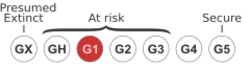
Clematis addisonii is ranked as G1–G2 (critically imperiled to imperiled) by NatureServe, with a rounded status of G1.[4]
The species is known from a small number of populations, with approximately 6–20 occurrences and about 11 documented in recent decades.[4]
Major threats include habitat loss, development, invasive species, deer browsing, and habitat fragmentation.[4]
The species is endemic to a narrow range and has experienced population declines over time.[4]
It has been reviewed multiple times for potential listing under the U.S. Endangered Species Act but is not currently federally listed.[5]
Conservation efforts
The species is included in the National Collection of the Center for Plant Conservation, with living collections maintained by partner institutions.[6]
Conservation efforts focus on habitat management, ex situ cultivation, and maintaining genetic diversity.[6]
Horticulture
Although rare in the wild, Clematis addisonii can be cultivated in well-drained, calcareous soils and partial shade. It is valued for its nodding, urn-shaped flowers and compact, non-climbing habit.[7]
References
- ↑ 1.0 1.1 1.2 "Clematis addisonii Britton". International Plant Names Index. https://www.ipni.org/n/1101603-2.
- ↑ 2.0 2.1 2.2 2.3 2.4 2.5 2.6 2.7 "Clematis addisonii". Flora of North America. http://www.efloras.org/florataxon.aspx?flora_id=1&taxon_id=233500381.
- ↑ "Clematis addisonii". Flora of the Southeastern United States. https://fsus.ncbg.unc.edu/main.php?pg=show-taxon-detail.php&taxonid=2495.
- ↑ 4.0 4.1 4.2 4.3 4.4 "Clematis addisonii". NatureServe Explorer. https://explorer.natureserve.org/Taxon/ELEMENT_GLOBAL.2.160003/Clematis_addisonii.
- ↑ "Addison's virgin's bower". U.S. Fish and Wildlife Service. https://www.fws.gov/species/addisons-virgins-bower-clematis-addisonii.
- ↑ 6.0 6.1 "Clematis addisonii". Center for Plant Conservation. https://saveplants.org/plant-profile/?CPCNum=998.
- ↑ "Clematis addisonii - Clematis of the Month March 2017". Clematis International. https://www.clematisinternational.com/page245.html.
Wikidata ☰ Q15366709 entry
 |  |


