Biology:Coccothrinax argentea
From HandWiki
Short description: Species of palm
| Coccothrinax argentea | |
|---|---|

| |
Scientific classification 
| |
| Kingdom: | Plantae |
| Clade: | Tracheophytes |
| Clade: | Angiosperms |
| Clade: | Monocots |
| Clade: | Commelinids |
| Order: | Arecales |
| Family: | Arecaceae |
| Genus: | Coccothrinax |
| Species: | C. argentea
|
| Binomial name | |
| Coccothrinax argentea (Lodd. ex Schult. & Schult.f.) Sarg. ex Becc.
| |
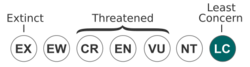
Coccothrinax argentea is a palm which is endemic to Hispaniola.[2]
This species is frequently confused with Coccothrinax argentata.
Description
It is a medium-sized palm, growing to about 10 m tall. The leaves are dark green above and silvery below; like other Coccothrinax species, C. argentea is a fan palm.[3]
Uses
Very young leaves are eaten as a vegetable.[4] It is also used medicinally by traditional healers to treat uterine fibroids and hot flashes.[5]
Name
Common names include: Hispaniola silver thatch palm,[3] Cana,[5] Guano, Latanye marron, Latanye savanne,[6] Broom palm, Hispaniolan silver palm, Silver thatch palm, Palmera plateada de La Hispaniola, Guanito, Guano de escoba.
References
- ↑ Timyan, J. (2022). "Coccothrinax argentea". IUCN Red List of Threatened Species 2022. doi:10.2305/IUCN.UK.2022-2.RLTS.T213404193A213978316.en. https://www.iucnredlist.org/species/213404193/213978316. Retrieved 29 May 2025.
- ↑ "Coccothrinax argentea". http://www.rbgkew.org.uk/wcsp/namedetail.do?accepted_id=44378&repSynonym_id=203946&name_id=44378&status=true.
- ↑ 3.0 3.1 Palm and Cycad Society of Australia. "Palms: Coccothrinax argentea". http://www.pacsoa.org.au/palms/Coccothrinax/argentea.html.
- ↑ Haynes, Jody; John McLaughlin (November 2000). "Edible Palms and Their Uses". University of Florida Institute of Food and Agricultural Sciences. http://www.rarefruit.org/PDF_files/EdiblePalmsandTheirUses.pdf.
- ↑ 5.0 5.1 Balick, Michael J.; Fredi Kronenberg; Andreana L. Ososki; Marian Reiff; Adriane Fugh-Berman; Bonnie O'Connor; Maria Roble; Patricia Lohr et al. (2000). "Medicinal plants used by Latino healers for women's health conditions in New York City". Economic Botany 54 (3): 344–357. doi:10.1007/BF02864786. http://sciweb.nybg.org/science2/ebot-54-3-344.pdf. Retrieved 2007-01-30.
- ↑ Henderson, Andrew; Galeano, Gloria; Bernal, Rodrigo (1995). Field Guide to the Palms of the Americas. Princeton, New Jersey: Princeton University Press. ISBN 978-0-691-08537-1.
Wikidata ☰ Q5139209 entry
 |  |


