The genus Calystegia, until recently widely accepted, has been shown to be genetically embedded within Convolvulus,[6] and is now treated as a synonym of it by the Plants of the World Online database.[5]
Description
They are annual or perennial herbaceous vines; a few species are woody shrubs. They grow to heights of 0.3–4 m scrambling through ground vegetation, shrubs and trees; the shrubby species (e.g. C. cneorum) growing to 0.5 m tall with a woody base. The leaves are spirally arranged, and the flowers trumpet-shaped, mostly white or pink, but blue, violet, purple, or yellow in some species.[7]
Ecology
Convolvulus leiocalycinus growing on another plant
Gallery
Convolvulus canariensis or Canary Bindweed: botanical print from the Curtis's Botanical Magazine, 1809. Copper engraving by F Sansom Junior from an illustration by Sydenham Teast Edwards. Convolvulus dorycnium
↑Thorogood, Chris (2016). Field guide to the wild flowers of the western Mediterranean. Richmond (Va.): Kew publishing Royal botanic gardens. pp. 412–414. ISBN978-1-84246-616-2.

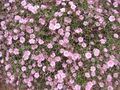


 Cultivated Convolvulus tricolor
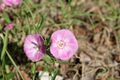
 Convolvulus cneorum in Catalonia, Spain
 Convolvulus cephalopodus in Behbahan
 Seed under a microscope


.jpg)
.jpg)

 Beach, Chandler B., ed (1914). "Convolvulus, Wild Morning-Glory". The New Student's Reference Work. Chicago: F. E. Compton and Co.


