Biology:Coryphantha erecta
| Coryphantha erecta | |
|---|---|
| File:Coryphantha erecta.JPG | |
Scientific classification 
| |
| Kingdom: | Plantae |
| Clade: | Tracheophytes |
| Clade: | Angiosperms |
| Clade: | Eudicots |
| Order: | Caryophyllales |
| Family: | Cactaceae |
| Subfamily: | Cactoideae |
| Genus: | Coryphantha |
| Species: | C. erecta
|
| Binomial name | |
| Coryphantha erecta (Lem. ex Pfeiff.) Lem.
| |

| |
| Coryphantha erecta range | |
| Synonyms | |
| |
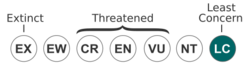
Coryphantha erecta is a species of Coryphantha found in Mexico.[2]
Description
Coryphantha erecta branches from the base and forms clumps. The cylindrical bright green shoots reach heights of up to 50 centimeters with diameters of 5 to 8 centimeters. The conical warts, which are up to 8 millimeters long, are loosely placed together. The axillae bear white wool and yellow nectar glands. The two, rarely four, yellowish-brown central spines are directed downwards and up to 2 centimeters long. The eight to thirteen golden-brown, up to 1.2 centimeter long, marginal spines are spread out, straight and pimpled.
The short, funnel-shaped, almost wheel-shaped yellow flowers are 5 to 6 centimeters long and reach a diameter of up to 7.5 centimeters. The cylindrical green fruits reach a length of up to 1.5 centimeters.[3]
Distribution
Coryphantha erecta is common on slopes with limestone gravel in the Mexican states of Hidalgo, Guanajuato and Querétaro.
-
Plants growing in Guanajuato
-
Plants growing in Guanajuato
-
Plants growing in Guanajuato
Taxonomy
The first description as Mammillaria erecta by Ludwig Georg Karl Pfeiffer was published in 1837.[4] The specific epithet erecta comes from Latin, means 'upright' and refers to the upright shoots of the plant. Charles Lemaire placed the species in the genus Coryphantha in 1868.[5] Further nomenclature synonyms are Cactus erectus (Lem. ex Pfeiff.) Kuntze (1891) and Glandulifera erecta (Lem. ex Pfeiff.) Frič (1924).
References
- ↑ Association), Adrian Lüthy (Swiss Cactus; Association), Reto Dicht (Swiss Cactus; Group), Succulent Plants Specialist (2009-11-16). "The IUCN Red List of Threatened Species". IUCN Red List of Threatened Species. https://www.iucnredlist.org/species/152324/121469297. Retrieved 2023-09-29.
- ↑ "Coryphantha erecta (Lem. ex Pfeiff.) Lem. — Plants of the World Online". https://powo.science.kew.org/taxon/urn:lsid:ipni.org:names:131249-1.
- ↑ Anderson, Edward F.; Eggli, Urs; Anderson, Edward F. (2005) (in de). Das große Kakteen-Lexikon. Stuttgart (Hohenheim): Ulmer. p. 151. ISBN 3-8001-4573-1.
- ↑ Dietrich, Albert; Otto, Friedrich (1837). "Allgemeine Gartenzeitung". https://www.biodiversitylibrary.org/page/14899517.
- ↑ Lemaire, C. (1869) (in fr). Les cactées: histoire, patrie, organes de végétation. Bibliothèque du jardinier. Maison rustique. p. 34. https://books.google.com/books?id=Qu_WZxpub0oC&pg=PA34. Retrieved 2023-09-29.
External links
Wikidata ☰ Q1135862 entry
 |  |


.jpg)
.jpg)
.jpg)