Biology:Cryptocarya erythroxylon
| Cryptocarya erythroxylon | |
|---|---|
| File:Cryptocarya erythroxylon trunk.jpg | |
| In the Richmond Range National Park | |
Scientific classification 
| |
| Kingdom: | Plantae |
| Clade: | Tracheophytes |
| Clade: | Angiosperms |
| Clade: | Magnoliids |
| Order: | Laurales |
| Family: | Lauraceae |
| Genus: | Cryptocarya |
| Species: | C. erythroxylon
|
| Binomial name | |
| Cryptocarya erythroxylon Maiden & Betche ex Maiden[2]
| |
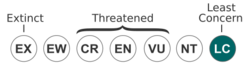
Cryptocarya erythroxylon commonly known as rose maple, rose walnut, pigeonberry ash, red-wooded cryptocarya, southern maple or bottleberry,[3] is a species of flowering plant in the laurel family and is endemic to eastern Australia. Its leaves are elliptic to lance-shaped the flowers cream-coloured and tube-shaped, and the fruit a pear-shaped black drupe.
Description
Cryptocarya erythroxylon is a tree that typically grows to a height of up to 30 m (98 ft), its stem usually buttressed. Its leaves are elliptic to lance-shaped, 65–145 mm (2.6–5.7 in) long and 15–60 mm (0.59–2.36 in) wide on a petiole 8–19 mm (0.31–0.75 in) long. The lower surface of the leaves is glaucous. The flowers are cream-coloured and arranged in panicles shorter than the leaves. The perianth tube is about 0.9 mm (0.035 in) long and 1.5 mm (0.059 in) wide, the outer tepals 1.2 mm (0.047 in) long and 0.8 mm (0.031 in) wide, the inner tepals 1.4 mm (0.055 in) long and 1 mm (0.039 in) wide. Flowering occurs in November, and the fruit is a pear-shaped black drupe, 19.5–21 mm (0.77–0.83 in) long and 13–15 mm (0.51–0.59 in) wide.[3][4]
Taxonomy
Cryptocarya erythroxylon was first formally described in 1907 by Joseph Maiden in The Forest Flora of New South Wales, from an unpublished description by Maiden and Ernst Betche of a tree discovered by William Dunn in the "Macpherson Range".[5]
Distribution and habitat
Rose maple grows in subtropical rainforest in coastal ranges at elevations at 500–1,050 m (1,640–3,440 ft) between Gympie in Queensland and Barrington Tops in New South Wales.[3][4]
References
- ↑ IUCN SSC Global Tree Specialist Group.; Botanic Gardens Conservation International (BGCI). (2019). "Cryptocarya erythroxylon" (in en). IUCN Red List of Threatened Species 2019. doi:10.2305/IUCN.UK.2019-3.RLTS.T158691810A158691812.en. https://www.iucnredlist.org/species/158691810/158691812. Retrieved 7 May 2026.
- ↑ "Cryptocarya erythroxylon". Australian Plant Census. https://biodiversity.org.au/nsl/services/apc-format/display/88288.
- ↑ 3.0 3.1 3.2 Le Cussan, J.; Hyland, Bernard P.M.. "Cryptocarya erythroxylon". Flora of Australia. Australian Biological Resources Study, Department of Climate Change, Energy, the Environment and Water: Canberra.. https://profiles.ala.org.au/opus/foa/profile/Cryptocarya%20erythroxylon.
- ↑ 4.0 4.1 Harden, Gwen J.. "Cryptocarya erythroxylon". Royal Botanic Garden, Sydney. https://plantnet.rbgsyd.nsw.gov.au/cgi-bin/NSWfl.pl?page=nswfl&lvl=sp&name=Cryptocarya~erythroxylon=Flora%201.xml.
- ↑ "Cryptocarya erythroxylon". Australian Plant Name Index. https://biodiversity.org.au/nsl/services/rest/instance/apni/508855.
 |
Wikimedia Commons has media related to Cryptocarya erythroxylon. |
Wikidata ☰ Q5190841 entry
 |  |


