Biology:Cryptocarya microneura
| Cryptocarya microneura | |
|---|---|

| |
| Fluted trunk | |
Scientific classification 
| |
| Kingdom: | Plantae |
| Clade: | Tracheophytes |
| Clade: | Angiosperms |
| Clade: | Magnoliids |
| Order: | Laurales |
| Family: | Lauraceae |
| Genus: | Cryptocarya |
| Species: | C. microneura
|
| Binomial name | |
| Cryptocarya microneura Meisn.[2]
| |
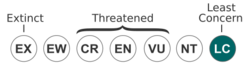


Cryptocarya microneura, commonly known as murrogun, murrogun laurel or brown jack,[3] is a species of flowering plant in the laurel family and is endemic to eastern Australia. It is a rainforest tree with lance-shaped to elliptic leaves, the flowers cream-coloured and tube-shaped but not perfumed, and the fruit a spherical to elliptic black drupe.
Description
Cryptocarya microneura, is a tree that typically grows to a height of 15 m (49 ft), sometimes to 25 m (82 ft), its stems not buttressed. Its leaves are lance-shaped to elliptic, 62–115 mm (2.4–4.5 in) long and 20–45 mm (0.79–1.77 in) wide on a petiole 5–11 mm (0.20–0.43 in) long. The leaves are green and more or less glaucous on the lower surface. The flowers are cream-coloured and arranged in panicles sometimes longer than the leaves, sometimes shorter than the leaves. The outer tepals are 1.4–1.7 mm (0.055–0.067 in) long, the inner tepals 1.5–1.9 mm (0.059–0.075 in) long. The outer anthers 0.7–0.8 mm (0.028–0.031 in) long and 0.5–0.6 mm (0.020–0.024 in) wide, the inner anthers 0.6–0.8 mm (0.024–0.031 in) long and 0.3–0.5 mm (0.012–0.020 in) wide. Flowering occurs from September to November, and the fruit is a spherical to elliptic black drupe 12–14 mm (0.47–0.55 in) long and 10–14 mm (0.39–0.55 in) wide.[3][4][5][6]
Taxonomy
Cryptocarya microneura was first formally described in 1864 by Carl Meissner in de Candolle's Prodromus Systematis Naturalis Regni Vegetabilis.[7][8] The specific epithet (microneura) means 'small-nerved'.[9]
Distribution and habitat
This species of Cryptocarya grows in rainforest and wet forest from sea level to 600 m (2,000 ft) elevation from Gympie in Queensland to Tuross Heads in New South Wales.[3][4]
References
- ↑ IUCN SSC Global Tree Specialist Group.; Botanic Gardens Conservation International (BGCI). (2019). "Cryptocarya microneura" (in en). IUCN Red List of Threatened Species 2019. doi:10.2305/IUCN.UK.2019-3.RLTS.T158691049A158691051.en. https://www.iucnredlist.org/species/158691049/158691051. Retrieved 7 May 2026.
- ↑ "Cryptocarya microneura". Australian Plant Census. https://biodiversity.org.au/nsl/services/apc-format/display/88440.
- ↑ 3.0 3.1 3.2 Le Cussan, J.; Hyland, Bernard P.M.. "Cryptocarya microneura". Flora of Australia. Australian Biological Resources Study, Department of Climate Change, Energy, the Environment and Water: Canberra.. https://profiles.ala.org.au/opus/foa/profile/Cryptocarya%20microneura.
- ↑ 4.0 4.1 Harden, Gwen J.. "Cryptocarya microneura". Royal Botanic Garden, Sydney. https://plantnet.rbgsyd.nsw.gov.au/cgi-bin/NSWfl.pl?page=nswfl&lvl=sp&name=Cryptocarya~microneura.
- ↑ Floyd, Alex G. (1989). Rainforest Trees of Mainland South-eastern Australia. Inkata Press. p. 180. ISBN 0909605572.
- ↑ "Cryptocarya microneura". Lucid Apps. https://apps.lucidcentral.org/plants_se_nsw/text/entities/cryptocarya_microneura.htm.
- ↑ "Cryptocarya microneura". Australian Plant Name Index. https://biodiversity.org.au/nsl/services/rest/instance/apni/509094.
- ↑ Meissner, Carl (1864). Prodromus systematis naturalis regni vegetabilis. 15. Paris: Sumptibus Sociorum Treuttel et Würtz. pp. 73–74. https://www.biodiversitylibrary.org/item/7165#page/79/mode/1upp. Retrieved 7 August 2024.
- ↑ George, Alex; Sharr, Francis (2021). Western Australian Plant Names and Their Meanings (3rd ed.). Kardinya, WA: Four Gables Press. p. 252. ISBN 9780958034180.
External links
- "Cryptocarya microneura Meisn.". Atlas of Living Australia. https://bie.ala.org.au/species/http://id.biodiversity.org.au/node/apni/2904200.
Wikidata ☰ Q1756431 entry
 |  |


