Biology:Cyperus erythrorhizos
| Cyperus erythrorhizos | |
|---|---|

| |
| University of Mississippi Field Station | |
Scientific classification 
| |
| Kingdom: | Plantae |
| Clade: | Tracheophytes |
| Clade: | Angiosperms |
| Clade: | Monocots |
| Clade: | Commelinids |
| Order: | Poales |
| Family: | Cyperaceae |
| Genus: | Cyperus |
| Species: | C. erythrorhizos
|
| Binomial name | |
| Cyperus erythrorhizos Muhl.[1]
| |
| Synonyms[2] | |
|
Homotypic synonyms
Heterotypic synonyms
| |
Cyperus erythrorhizos, also known as red-rooted flatsedge or redroot flatsedge, is a species of flowering plant in the sedge family Cyperaceae. It is native to North America, ranging from Canada to Mexico. It has bright red roots, a distinctive feature not found in any other North American flatsedge. Both the scientific name and the common name emphasize this fact.
Description
Cyperus erythrorhizos is an annual sedge with red fibrous roots. It grows to a maximum of 1 m (3 ft 3 in) in height but is usually quite a bit shorter. It may have a number of long, wispy leaves around the base of the plant. The inflorescence may contain one to several spikes, each spike containing 20 to over 100 spikelets. Each spikelet is light greenish brown to reddish brown and is made up of up to 30 bracted flowers. The fruit is a glossy achene about a millimetre long.[3]
Taxonomy
Cyperus erythrorhizos was named and described by the American botanist Gotthilf Heinrich Ernst Muhlenberg in 1817.[1] In his description, Muhlenberg emphasized the plant's red fibrous roots.[4] As of February 2026[update], the botanical name Cyperus erythrorhizos Muhl. is widely accepted.[2][5][6][7][8]
Distribution and habitat
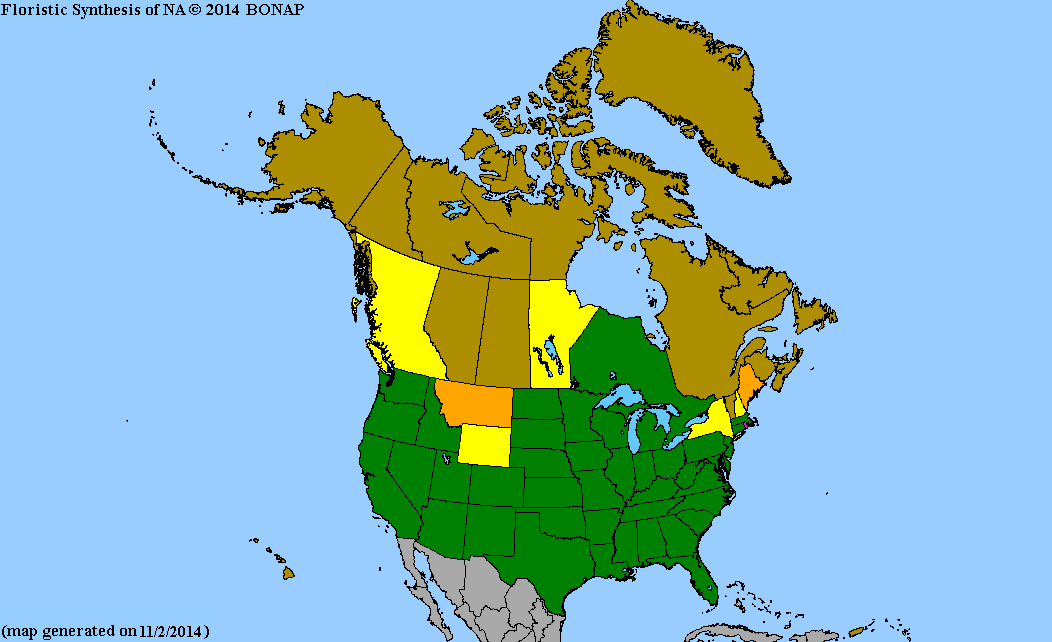
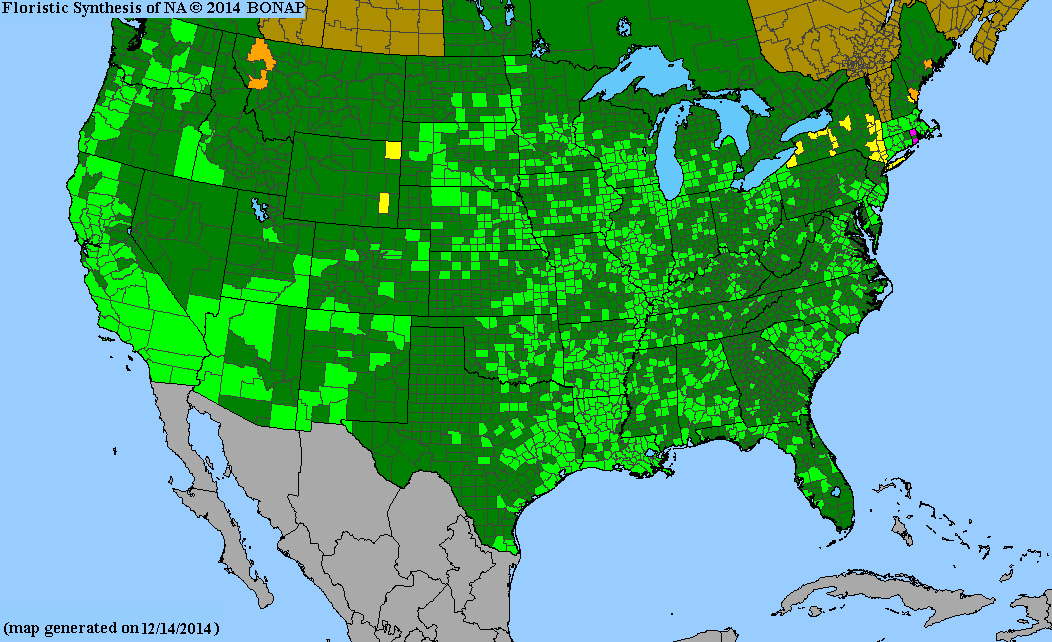
Cyperus erythrorhizos is native to North America, ranging from Canada to Mexico.[3] It is most common in the United States.[9][10] It was discovered in Vermont in 2014.[11] In Canada, it occurs in British Columbia, Manitoba, Ontario, and Quebec.[6] In Mexico, it was initially discovered in Baja California near the U.S. border based on a specimen collected in 1894.[12] It was subsequently found in the state of Tabasco in southern Mexico.[13][14][15] It is a plant of wet areas such as rivers and ditches, generally at low elevations. Its season runs from July to December.[16]
See also
References
- ↑ 1.0 1.1 "Cyperus erythrorhizos Muhl.". International Plant Names Index (IPNI). Royal Botanic Gardens, Kew. https://www.ipni.org/n/309280-2.
- ↑ 2.0 2.1 "Cyperus erythrorhizos Muhl." (in en). Royal Botanic Gardens, Kew. http://www.plantsoftheworldonline.org/taxon/309280-2.
- ↑ 3.0 3.1 Tucker, Gordon C.; Marcks, Brian G.; Carter, J. Richard (2002), "Cyperus erythrorhizos", in Flora of North America Editorial Committee, Flora of North America North of Mexico (FNA), 23, New York and Oxford, http://www.efloras.org/florataxon.aspx?flora_id=1&taxon_id=242357655, retrieved 12 February 2026
- ↑ Muhlenberg (1817), p. 20.
- ↑ "Cyperus erythrorhizos Muhl.". https://wfoplantlist.org/taxon/wfo-0000372936-2025-12.
- ↑ 6.0 6.1 "Cyperus erythrorhizos Muhlenberg". https://data.canadensys.net/vascan/taxon/5209.
- ↑ "Cyperus erythrorhizos". Natural Resources Conservation Service PLANTS Database. USDA. https://plants.usda.gov/core/profile?symbol=CYER2.
- ↑ "Cyperus erythrorhizos Muhl.". https://efloramex.ib.unam.mx/cdm_dataportal/taxon/2ab69107-5502-45bd-98be-f5f5cec8280a.
- ↑ "Cyperus erythrorhizos", State-level distribution map from the North American Plant Atlas (NAPA) (Biota of North America Program (BONAP)), 2014, http://bonap.net/MapGallery/State/Cyperus%20erythrorhizos.png, retrieved 13 February 2026
- ↑ "Cyperus erythrorhizos", County-level distribution map from the North American Plant Atlas (NAPA) (Biota of North America Program (BONAP)), 2014, http://bonap.net/MapGallery/County/Cyperus%20erythrorhizos.png, retrieved 13 February 2026
- ↑ Gilman, A. V.; Doucette, E. T.; Engstrom, B.; Marcus, A.; Peters, M. J. (2020). "Additions to the New Flora of Vermont—II". Phytoneuron 2020-16: 1–17. https://www.phytoneuron.net/2020Phytoneuron/16PhytoN-VermontFloraAdditions.pdf. Retrieved 13 February 2026.
- ↑ Tucker (1994), pp. 106–107.
- ↑ Novelo, A. & L. Ramos. 2005. Vegetación acuática. Cap. 5: 111–144. In J. Bueno, F Álvarez & S. Santiago. Biodiversidad del Estado de Tabasco. CONABIO-UNAM, México.
- ↑ Pérez J., L. A., M. Sousa Sánchez, A. M. Hanan-Alipi, F. Chiang Cabrera & P. Tenorio L. 2005. Vegetación terrestre. 65–110. In J. Bueno, F Álvarez & S. Santiago. Biodiversidad del Estado de Tabasco. CONABIO-UNAM, México.
- ↑ Espejo Serna, A. & López-Ferrari, A.R. (1997). Las Monocotiledóneas Mexicanas una Sinopsis Florística 5: 1-98. Consejo Nacional de la Flora de México, México D.F.
- ↑ "Cyperus erythrorhizos Muhlenberg". https://fsus.ncbg.unc.edu/main.php?pg=show-taxon-detail.php&taxonid=1448.
Bibliography
- Muhlenberg, Gotthilf Heinrich Ernst (1817). Descriptio uberior graminum et plantarum calamariarum Americae septentrionalis indigenarum et cicurum. Philadelphiae: Conrad. https://www.biodiversitylibrary.org/item/52698#page/7/mode/1up. Retrieved 12 February 2026.
- Tucker, Gordon C. (1994). "Revision of the Mexican Species of Cyperus (Cyperaceae)". Systematic Botany Monographs 43: 1–213. doi:10.2307/25027842.
External links
- Tucker, Gordon C. (2012). "Cyperus erythrorhizos". University of California, Berkeley. https://ucjeps.berkeley.edu/eflora/eflora_display.php?tid=21822.
- Photo gallery
Wikidata ☰ Q5200202 entry
 |  |