Biology:Cyperus fuscus
| Brown flatsedge | |
|---|---|

| |
Scientific classification 
| |
| Kingdom: | Plantae |
| Clade: | Tracheophytes |
| Clade: | Angiosperms |
| Clade: | Monocots |
| Clade: | Commelinids |
| Order: | Poales |
| Family: | Cyperaceae |
| Genus: | Cyperus |
| Species: | C. fuscus
|
| Binomial name | |
| Cyperus fuscus | |
| Synonyms[3] | |
|
Homotypic synonyms
Heterotypic synonyms
| |

Cyperus fuscus, also known as brown galingale or brown flatsedge, is a species of flowering plant in the sedge family Cyperaceae. It is native to Europe, Asia, and North Africa. It was introduced into North America.
Description
Cyperus fuscus is an annual herb with paper-thin stems reaching 30 centimeters in maximum height. There may be short, flat leaves about the base of the plant. The inflorescence contains three to 15 spikelets, which are flat, oval or rectangular, and dark brown to deep purple. Each spikelet has around ten flowers enclosed in dark bracts. The fruit is a light brown achene about a millimeter long.
Taxonomy
Cyperus fuscus was named and described by the Swedish botanist Carl Linnaeus in 1753.[2] As of February 2026[update], the botanical name Cyperus fuscus L. is widely accepted.[3][4]
Distribution and habitat
Cyperus fuscus is native to Europe, Asia, and North Africa from England, Portugal and Morocco eastward to China and Thailand.[3] In China, it is found in swamps, river margins, and other wet places including paddy fields.[5]
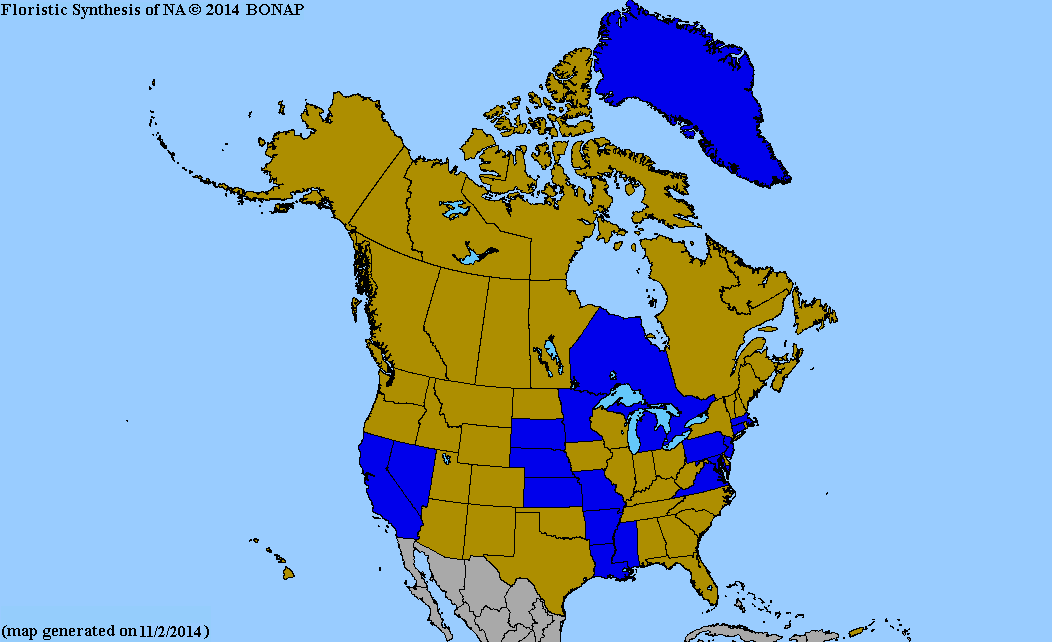
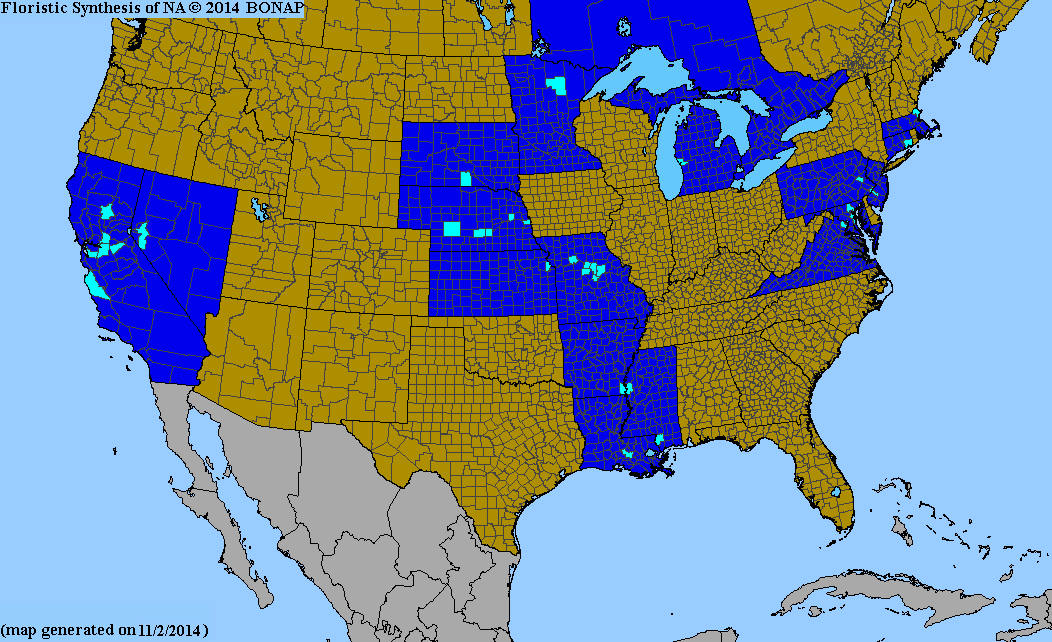
Cyperus fuscus was introduced into North America where it is naturalized in widely scattered locations in the United States and Canada.[6] European botanists were aware of its presence in North America as early as 1825.[7] It was first collected in Essex County, Massachusetts in 1877.[8] By 1998, it had spread to the following states and provinces: California, Connecticut, Maryland, Missouri, Nebraska, Nevada, New Jersey, Ontario, Pennsylvania, South Dakota, and Virginia.[9] Subsequently it was discovered in Arkansas, Mississippi, Michigan, Minnesota, and Quebec.[10] It grows in damp, disturbed soils along emergent shorelines.[11]
Conservation
In the UK, Cyperus fuscus is one of 100 species named as a priority for conservation by the conservation charity Plantlife.[12]
See also
References
- ↑ Lansdown, R.V. (2013). "Cyperus fuscus". https://www.iucnredlist.org/species/164079/13545918.
- ↑ 2.0 2.1 "Cyperus fuscus L.". International Plant Names Index (IPNI). Royal Botanic Gardens, Kew. https://www.ipni.org/n/330929-2.
- ↑ 3.0 3.1 3.2 "Cyperus fuscus L." (in en). Royal Botanic Gardens, Kew. http://www.plantsoftheworldonline.org/taxon/330929-2.
- ↑ "Cyperus fuscus L.". https://wfoplantlist.org/taxon/wfo-0000373976-2025-12.
- ↑ Dai, Lun-Kai; Tucker, Gordon C.; Simpson, David A., "Cyperus fuscus", Flora of China, 23, http://www.efloras.org/florataxon.aspx?flora_id=2&taxon_id=200026687, retrieved 4 February 2026
- ↑ "Cyperus fuscus", State-level distribution map from the North American Plant Atlas (NAPA) (Biota of North America Program (BONAP)), 2014, http://bonap.net/MapGallery/State/Cyperus%20fuscus.png, retrieved 4 February 2026
- ↑ Sprengel (1825), p. 223.
- ↑ Knowlton et al. (1911).
- ↑ McKenzie et al. (1998).
- ↑ Oldham & Bickel (2019).
- ↑ Tucker, Gordon C.; Marcks, Brian G.; Carter, J. Richard (2002), "Cyperus fuscus", in Flora of North America Editorial Committee, Flora of North America North of Mexico (FNA), 23, New York and Oxford, http://www.efloras.org/florataxon.aspx?flora_id=1&taxon_id=200026687, retrieved 4 February 2026
- ↑ "Species under our care". http://plantlife.org.uk/uk/plantlife-saving-species-under-our-care.html.
Bibliography
- Knowlton, C. H.; Cushman, J. A.; Deane, Walter; Harrison, A. K. (1911). "Reports on the flora of Boston District-VIII". Rhodora 13: 27–29. https://www.biodiversitylibrary.org/item/14484#page/29/mode/1up. Retrieved 4 February 2026.
- McKenzie, Paul M.; Jacobs, Brad; Bryson, Charles T.; Tucker, Gordon C.; Carter, Richard (1998). "Cyperus fuscus (Cyperaceae), new to Missouri and Nevada, with comments on its occurrence in North America". Sida 18 (1): 325–333. https://thekeep.eiu.edu/cgi/viewcontent.cgi?article=1151&context=bio_fac. Retrieved 5 February 2026.
- Oldham, Michael J.; Bickel, Grant (2019). "Cyperus fuscus, new to Renfrew County and the City of Ottawa". Trail & Landscape 53 (1): 24–28. https://www.researchgate.net/publication/330304518_Oldham_Bickel_2019_Cyperus_fuscus_new_to_Renfrew_County_and_the_City_of_Ottawa. Retrieved 4 February 2026.
- Sprengel, Curt Polycarp Joachim (1825). Systema vegetabilium. 1 (16th ed.). Gottingae, sumtibus Librariae Dieterichianae. https://www.biodiversitylibrary.org/bibliography/822. Retrieved 12 February 2026.
External links
- "Cyperus fuscus L.". http://www.worldfloraonline.org/taxon/wfo-0000373976.
- Tucker, Gordon C. (2012). "Cyperus fuscus". University of California, Berkeley. https://ucjeps.berkeley.edu/eflora/eflora_display.php?tid=21839.
- "Cyperus fuscus L. (Brown Galingale)". Botanical Society of Britain and Ireland. https://bsbi.org/taxa/2cd4p9h.xgq/cyperus-fuscus?q=cyperus%20fuscus.
- "Cyperus fuscus", County-level distribution map from the North American Plant Atlas (NAPA) (Biota of North America Program (BONAP)), 2014, http://bonap.net/MapGallery/County/Cyperus%20fuscus.png, retrieved 4 February 2026
- "Cyperus fuscus Linnaeus". https://fsus.ncbg.unc.edu/main.php?pg=show-taxon-detail.php&taxonid=1455.
- "Cyperus fuscus (Brown Flatsedge)". https://www.minnesotawildflowers.info/grass-sedge-rush/brown-flatsedge.
- Bryson, Charles T.; Carter, Richard (2010). "Spread, Growth Parameters, and Reproductive Potential for Brown Flatsedge (Cyperus fuscus)". Invasive Plant Science and Management 3: 240–245. doi:10.1614/IPSM-D-09-00037.1. https://www.researchgate.net/publication/48855079_Spread_Growth_Parameters_and_Reproductive_Potential_for_Brown_Flatsedge_Cyperus_fuscus. Retrieved 4 February 2026.
- Altervista Flora Italiana, Zigolo nero, Brown Flatsedge, Cyperus fuscus L.
- Photo gallery
Wikidata ☰ Q159151 entry
 |  |