Biology:Diphylleia grayi
| Skeleton flower | |
|---|---|
| Error creating thumbnail: Unable to save thumbnail to destination | |
Scientific classification 
| |
| Kingdom: | Plantae |
| Clade: | Tracheophytes |
| Clade: | Angiosperms |
| Clade: | Eudicots |
| Order: | Ranunculales |
| Family: | Berberidaceae |
| Genus: | Diphylleia |
| Species: | D. grayi
|
| Binomial name | |
| Diphylleia grayi F.Schmidt[1]
| |
Diphylleia grayi, also known as the skeleton flower, is a species of perennial plant in the family Berberidaceae. It is native to northern and central Japan.[2]
Other regions and languages have common names for this plant; In Japan, it is commonly referred to as Japanese: サンカヨウ, romanized: sankayō, lit. 'lotus of mountain'. In China, it is commonly referred to as Chinese: 冰莲, romanized: bīng lián, lit. 'ice lotus'.
Description
The plant grows up to 0.4 m (1.3 ft). The flowers are white, pedicellate, with six obovate petals and bloom from May to July.[3] After it flowers, it bears dark blue/purple fruit with a white powdery coating from June to August.[4] Its stems are terete and grow 30–60 cm (12–24 in) long. Its rhizomes are stout and knotty. The plant is known to have petals that become transparent when in contact with water, giving it its common name. After they dry, the petals return to their white coloration.[5]
Distribution and habitat
The plant is distributed from north to central Honshu, Hokkaido, Mount Daisen, and Sakhalin. It grows in slightly moist places in the woods of high mountains.[6][7]
Medical uses
In the 1960s, botanist Yanagi Kimura discovered that D. grayi crude extracts contain substances similar to but more powerful than podophyllin and colchicine. The extract had anti-tumor effects on transplantable animal tumors.[8]
Gallery
-
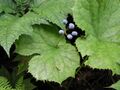 Fruit
Fruit -
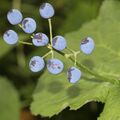 Close-up of fruit
 -
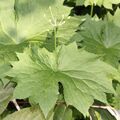 Young fruits
 -
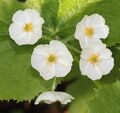 Flowers
 -
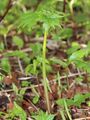 Bud
Bud -
Seeds in a split fruit
.jpg)
.JPG)
.JPG)
.JPG)
.JPG)
See also
References
- ↑ "Diphylleia grayi F.Schmidt — The Plant List". http://www.theplantlist.org/tpl/record/kew-2770855.
- ↑ "Diphylleia grayi F. Schmidt". https://eol.org/pages/5515614.
- ↑ "Diphylleia grayi - F.Schmidt.". https://pfaf.org/user/Plant.aspx?LatinName=Diphylleia+grayi.
- ↑ Citizen science observations for Diphylleia grayi at iNaturalist
- ↑ Sain, Todd. "Skeleton Flower". https://www.ourbreathingplanet.com/skeleton-flower/.
- ↑ 日本の高山植物. 山溪カラー名鑑. Yamakei. 1988. pp. 431. ISBN 4635090191.
- ↑ Ohwi, Jisaburo (1965) (in en). Flora of Japan. Washington: Smithsonian Institution. pp. 464. doi:10.5962/bhl.title.43786. OCLC 182709297. https://www.biodiversitylibrary.org/bibliography/43786.
- ↑ Yamamoto, Kohtaro; Kimura, Yanagi (December 1964). "Cytological Effects of Chemicals on Tumors, XXV. : Further Studies on the Effect of Diphylleia grayi Extracts on Tumor Cells (With 2 Text-figures and 2 Tables)". 北海道大學理學部紀要 (北海道大學) 15 (3): 347–352. http://hdl.handle.net/2115/27379.
Wikidata ☰ Q4156126 entry Lua error in package.lua at line 80: module 'Module:Portal/images/j' not found.
 |  |


(Diphylleia_grayi)-%E8%8A%B1_(6010492091).jpg)

.jpg)