Biology:Eastern amberwing
| Eastern amberwing | |
|---|---|
.jpg)
| |
| Male | |
| File:Eastern amberwing female (61011).jpg | |
| Female | |
Scientific classification 
| |
| Kingdom: | Animalia |
| Phylum: | Arthropoda |
| Class: | Insecta |
| Order: | Odonata |
| Infraorder: | Anisoptera |
| Family: | Libellulidae |
| Genus: | Perithemis |
| Species: | P. tenera
|
| Binomial name | |
| Perithemis tenera (Say, 1840) [2]
| |

| |
| Range of P. tenera[3][4] | |
| Synonyms[5] | |
|
List
| |
The eastern amberwing (Perithemis tenera) is a species of dragonfly in the family Libellulidae. It is very small, reaching a total length of no more than 25 millimetres (0.98 in). The males have orange or amber wings, which likely contain pheomelanin.[6] Both sexes have a red pterostigma.[7] It is found in eastern North America, from northern Mexico north to south-eastern Canada.[3][4]
The eastern amberwing dragonfly is one of the only types of dragonfly that actively mimics a wasp. The yellow and brown stripes on its abdomen encourage predators to stay away. When perched, they wiggle their abdomen and wings in a wasp-like fashion to deter other animals from eating it. Males have an elaborate courtship ritual. When a female approaches his territory, the male will lead her to his selected egg-laying site and hover above it with wings whirring and abdomen raised.[8]
The common name refers to its eastern range, although this dragonfly does extend westward well into the central part of the United States. The scientific name, tenera, means delicate and alludes to its small size.[9]
Gallery
-
Male
Lake Wales, Florida, US -
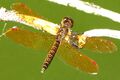 Male
Male -
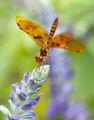 Male
Male -
Ovipositing Naperville, Illinois, US


References
- ↑ Paulson, D.R. (2017). "Perithemis tenera". IUCN Red List of Threatened Species 2017. doi:10.2305/IUCN.UK.2017-3.RLTS.T51279851A65836584.en. https://www.iucnredlist.org/species/51279851/65836584. Retrieved 22 May 2024.
- ↑ "Perithemis tenera". Integrated Taxonomic Information System. https://www.itis.gov/servlet/SingleRpt/SingleRpt?search_topic=TSN&search_value=101804.
- ↑ 3.0 3.1 "Perithemis tenera range map". USGS Northern Prairie Wildlife Research Center. https://www.npwrc.usgs.gov/resource/distr/insects/dfly/usa/405.htm.
- ↑ 4.0 4.1 "Distribution Viewer". OdonataCentral. http://www.odonatacentral.org/index.php/MapAction.windowed.
- ↑ "World Odonata List". https://www.odonatacentral.org/app/#/wol/.
- ↑ Cezário, Rodrigo Roucourt; Almeida, JGL de; Peixoto, PEC; Wilts, Bodo D.; Ferreira, Rhainer Guillermo (1 November 2024). "The mechanistic origin of amber pigmentation of Perithemis tenera (Say, 1840) wings (Odonata: Libellulidae) and its function in conspecific signalling". Zoology 167. doi:10.1016/j.zool.2024.126226. ISSN 0944-2006. https://www.sciencedirect.com/science/article/pii/S0944200624000850#sec0030. Retrieved 5 November 2025.
- ↑ Abbott, John C. (2005). Dragonflies and Damselflies of Texas and the South-Central United States. Princeton University Press. pp. 292–293. ISBN 0-691-11364-5.
- ↑ Silsby, Jill (2001). Dragonflies of the World. Csiro Publishing. p. 58. ISBN 978-0-643-10249-1. https://books.google.com/books?id=ddzwJiuRP48C&pg=PA58.
- ↑ Paulson, Dennis R.; Dunkle, Sidney W. (12 February 2021). "A Checklist of North American Odonata". Jim Johnson. p. 73. https://www.odonatacentral.org/public/media/uploads/files/NA_Odonata_Checklist_2021_update.pdf.
External links
- Perithemis tenera on BugGuide.Net
- Citizen science observations for Eastern amberwing at iNaturalist
Wikidata ☰ Q1939882 entry
 |


.jpg)
