Biology:Eastern dwarf tree frog
| Eastern dwarf tree frog | |
|---|---|

| |
| Calling male eastern dwarf tree frog - Sydney Olympic Park | |
Scientific classification 
| |
| Missing taxonomy template (fix): | Drymomantis |
| Species: | Template:Taxonomy/DrymomantisD. fallax
|
| Binomial name | |
| Template:Taxonomy/DrymomantisDrymomantis fallax Peters, 1880
| |

| |
| Eastern dwarf tree frog distribution | |
| Synonyms | |
| |
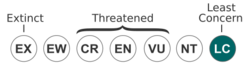
The eastern dwarf tree frog (Drymomantis fallax), also known as the eastern sedge frog, is a species of tree frog native to Australia. It is a small and very common frog found on the eastern coast of Australia, from approximately Cairns, Queensland to Ulladulla, New South Wales.[2] Individual frogs of this species are often found elsewhere, having been accidentally relocated by transported fruit or horticultural products.[3] Two naturalised populations are known outside of its native range: a population successfully established on Guam around 1968,[4] and breeding populations have established in multiple suburbs of Melbourne, Victoria.[5]
Description

The eastern dwarf tree frog is a small species of frog; females can reach a maximum size of 25–30 mm, while males may only reach 20 mm when fully grown. The dorsum is usually green in colour, but can range from brown to bright green, and occasionally has black flecks. The ventral surface is white with a granular texture. A distinct white line runs from under the eye to above the arm. A brown line begins from the nostril, continues across the eye, and can extend between the dorsal and ventral colours. This species' toe discs are only slightly larger than the toes, and toes are 75% webbed. Some individuals will have an orange posterior thigh, and the vocal sac of males is yellow.[6] The tadpoles are larger than the adult frogs reaching a total length of 48 mm.[2]
Taxonomy
D. fallax was first described in 1880 by Wilhelm Peters as Hylomantis fallax.[7][8] The Australian Faunal Directory also considers Hyla bicolor glauerti[9] to be a synonym, with the decision for synonymy being based on Cogger.[7][10]
Ecology and behaviour
The eastern dwarf tree frog lives in a wide variety of habitats, breeding in the still waters of coastal swamps, lagoons, dams, ditches, and garden ponds within forest, heathland, wallum country and human-altered farmland and suburban areas. It lives in reeds and similar plants both near and away from the water, and often inhabits banana, pandanus and pineapple plants.[6] Due to this habitation of farmland, eastern dwarf tree frogs are often accidentally shipped throughout Australia with fruit.

Breeding occurs at small ponds or dams, which have ample reeds or other emergent vegetation, in both permanent and temporary water sources. The males' call is a short, high pitched "wr-e-e-ek ip-ip" repeated three or four times. They emit their calls from a single submandibular vocal sac. The males call during the spring and summer seasons, often increasing the frequency of calls before and after heavy rain.
Calling males have been observed semaphoring using foot-flicking and leg waving behaviours, often preceding these males fighting. It is hypothesised that these behaviours are territorial and aid their calling behaviours in noisy environments. Most other Pelodryadids that exhibit these behaviours inhabit noisy stream environments, but it has been observed for the eastern dwarf tree frog and the related Cooloola sedge frog in lentic environments that are loud due to other calling frogs.[11]
During amplexus, a female lays a series of egg clusters that they attach to submerged vegetation. Each cluster contains a range of 2-35 eggs, reaching a total of 263-1363 eggs during each amplexus. Tadpole lifespan has been recorded as 10–19 weeks and metamorphosis occurs from January to April. The metamorphs resemble the adults but are very small, reaching only 14–16 mm in length when first emerging.[2]
Similar species

The eastern dwarf tree frog is a member of the dwarf tree frog complex. This species complex is composed of the northern dwarf tree frog (Carichyla bicolor), the Cooloola sedge frog (D. cooloolensis), and the wallum sedge frog (D. olongburensis). All of these species are similar in size and appearance and have a similar ratchet-like call. The Cooloola sedge frog is the most distinct with a highly mottled dorsum, whilst the wallum sedge frog can be distinguished by its sharper nose.
As a pet
In Australia, the frog may be kept in captivity with the appropriate permit.[12]

 |
Wikispecies has information related to Litoria fallax |
References
- ↑ IUCN SSC Amphibian Specialist Group (2022). "Litoria fallax". IUCN Red List of Threatened Species 2022. doi:10.2305/IUCN.UK.2022-2.RLTS.T41091A78448993.en. https://www.iucnredlist.org/species/41091/78448993. Retrieved 2 October 2024.
- ↑ 2.0 2.1 2.2 Anstis, Marion (2013). Tadpoles and Frogs of Australia. Sydney, NSW: Reed New Holland. pp. 200–203. ISBN 9781921517310.
- ↑ Rowley, Jodi J.L.; Callaghan, Corey T. (2023). "Tracking the spread of the eastern dwarf tree frog (Litoria fallax) in Australia using citizen science". Australian Journal of Zoology (ConnectSci) 70 (6): 204–210. doi:10.1071/ZO23012. https://connectsci.au/zo/article/70/6/204/43574/Tracking-the-spread-of-the-eastern-dwarf-tree-frog. Retrieved 2026-03-30.
- ↑ Christy, Michelle T.; Clark, Craig S.; Gee, David E.; Vice, Diane; Vice, Daniel S.; Warner, Mitchell P.; Tyrrell, Claudine L.; Rodda, Gordon H. et al. (2007). "Recent Records of Alien Anurans on the Pacific Island of Guam". Pacific Science (BioOne) 61 (4): 469–483. doi:10.2984/1534-6188(2007)61[469:RROAAO2.0.CO;2]. https://bioone.org/journals/pacific-science/volume-61/issue-4/1534-6188_2007_61_469_RROAAO_2.0.CO_2/Recent-Records-of-Alien-Anurans-on-the-Pacific-Island-of/10.2984/1534-6188(2007)61%5B469:RROAAO%5D2.0.CO;2.full. Retrieved 2026-03-30.
- ↑ Michael, Damian R.; Johnson, Glen (2016-12-01). "Notes on a naturalised population of the Eastern dwarf tree frog 'Litoria fallax' (Peters) (Anura: Hylidae) in North-east Victoria". Victorian Naturalist (Informit) 133 (6): 202–205. doi:10.3316/informit.674679700513761. https://search.informit.org/doi/abs/10.3316/informit.674679700513761. Retrieved 2026-03-30.
- ↑ 6.0 6.1 Cogger, Harold G. (2014). Reptiles & Amphibians of Australia. Collingwood, VIC: CSIRO Publishing. pp. 164–165. ISBN 0643109781.
- ↑ 7.0 7.1 "Australian Faunal Directory: Litoria fallax" (in en). https://biodiversity.org.au/afd/taxa/Litoria_fallax.
- ↑ Peters, W. (1880). "Mitteilung über neue oder weniger bekannte Amphibien des Berliner Zoologischen Museums". Monatsberichte der Königlichen Preussischen Akademie der Wissenschaften zu Berlin 1880: 217-224 [1881 on title page] [224, fig. 4]. https://www.biodiversitylibrary.org/page/36277423.
- ↑ Copland, S.J. (1957). "Presidential address. Australian tree frogs of the genus Hyla". Proceedings of the Linnean Society of New South Wales 82: 9–108 [16]. https://www.biodiversitylibrary.org/page/34928289.
- ↑ Cogger, H.G. (1983), Cogger, H.G.; Cameron, E.E.; Cogger, H.M., eds., "Amphibia and Reptilia", Zoological Catalogue of Australia (Canberra: Australian Government Publishing Service) 1: 43
- ↑ Meyer, E.; Murray, K.A.; Hines, H.B. (2012). "Further observations of visual signalling in Australo-Papuan hylid frogs of the genus Litoria (Tschudi)". Australian Zoologist (CSIRO Publishing) 36 (1): 55–58. doi:10.7882/AZ.2012.006. https://connectsci.au/az/article/36/1/55/267115/Further-observations-of-visual-signalling-in. Retrieved 2026-04-14.
- ↑ Department of Environment, Climate Change and Water, New South Wales: Amphibian Keeper's Licence: Species Lists
Other sources
- Article Road: List of All Frog Breeds: Things You Can Do to Ensure Your Frog Has a Long, Happy and Healthy Life: Eastern Dwarf Tree Frog
- Anstis, M. 2002. Tadpoles of South-eastern Australia. Reed New Holland: Sydney.
- Robinson, M. 2002. A Field Guide to Frogs of Australia. Australian Museum/Reed New Holland: Sydney.
- Frogs Australia Network
- Australian Frogs A Natural History, Michael J. Tyler (1994)
Wikidata ☰ Q979058 entry
 |  |


