Biology:Ehretia acuminata
| Ehretia acuminata | |
|---|---|

| |
| Ehretia acuminata trunk, at Booyong, Australia | |
Scientific classification 
| |
| Kingdom: | Plantae |
| Clade: | Tracheophytes |
| Clade: | Angiosperms |
| Clade: | Eudicots |
| Clade: | Asterids |
| Order: | Boraginales |
| Family: | Boraginaceae |
| Genus: | Ehretia |
| Species: | E. acuminata
|
| Binomial name | |
| Ehretia acuminata | |
| Synonyms[2] | |
| |

Ehretia acuminata is a deciduous tree native to regions from India to Japan and south to eastern Australia. It was first described in 1810 and has the conservation status of least concern. In Australia it is commonly known as koda.
Description
Ehretia acuminata is a medium to large tree, reaching 30 m (98 ft) in height. The bark is grey and smooth and the trunk may be fluted.[4][5]
Leaves, flowers and fruit
The leaves are alternate and simple, tapering to a tip, finely toothed, 8 to 13 cm (3.1 to 5.1 in) long. Smooth and green on both surfaces slightly hairy above. The midrib and lateral veins are distinct on both sides of the leaf, raised beneath.[citation needed]
Flowers are white, sweetly scented, in panicles. Individual flowers are without a stalk, about 4 mm (0.16 in) in diameter. Flowers appear in September to November in the southern hemisphere.[citation needed]
The fruit matures from January to April in Australia, in China in September, being a yellow or orange drupe, 4 to 5 mm (0.16 to 0.20 in) in diameter, containing four seeds. The fruit is edible to humans with a sweet taste. Fruit are eaten by many rainforest birds, including the Lewin's honeyeater, rose-crowned fruit-dove, brown cuckoo dove, wompoo fruit dove and Australasian figbird.[citation needed]
Distribution and habitat
It is native to the following regions as defined in the World Geographical Scheme for Recording Plant Distributions, and has been introduced to Mauritius, Pakistan and Réunion.[2][6]
- China: China South-Central, China Southeast
- Eastern Asia: Japan, Korea, Nansei-shoto, Taiwan
- Indian Subcontinent: Assam, Bangladesh, East Himalaya, India, Nepal, West Himalaya
- Indo-China: Laos, Myanmar, Thailand, Vietnam
- Malesia: Jawa, Lesser Sunda Islands, Malaya, Maluku, Philippines
- Papuasia: New Guinea
- Australia: New South Wales, Queensland
In China this plant occurs in open forests and thickets at altitudes from 100 to 1,700 m (330 to 5,580 ft).[7] In Australia it is found on the east coast, in and on the margins of rainforest and drier forest types, from the far south of New South Wales (around Bega) to northeast Queensland near Cairns. There, its altitudinal range is from sea level to about 800 m (2,600 ft).[4][7][8]
-
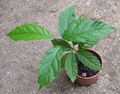 Ehretia acuminata - juvenile
 -
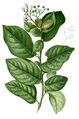 Koda
Koda -
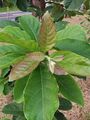 Aeneous-colored new leaves.
 -
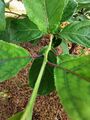 The red violet petioles and main veins of young leaves.


Uses
Ehretia acuminata is used for roadside plantings, building and furniture timber, as well as in Traditional Chinese medicine.[7]
References
- ↑ Botanic Gardens Conservation International (BGCI).; IUCN SSC Global Tree Specialist Group. (2019). "Ehretia acuminata". IUCN Red List of Threatened Species 2019. doi:10.2305/IUCN.UK.2019-2.RLTS.T144117916A149008975.en. https://www.iucnredlist.org/species/144117916/149008975. Retrieved 7 February 2026.
- ↑ 2.0 2.1 2.2 "Ehretia acuminata R.Br.". Royal Botanic Gardens, Kew. http://powo.science.kew.org/taxon/urn:lsid:ipni.org:names:115963-1.
- ↑ "Ehretia acuminata". Centre for Australian National Biodiversity Research, Australian Government. https://biodiversity.org.au/nsl/services/rest/name/apni/56350.
- ↑ 4.0 4.1 "Ehretia acuminata var. pyrifolia (D.Don) I.M.Johnst.". Centre for Australian National Biodiversity Research (CANBR), Australian Government. 2020. https://apps.lucidcentral.org/rainforest/text/entities/ehretia_acuminata_var._pyrifolia.htm.
- ↑ "Ehretia acuminata R.Br.". Royal Botanic Gardens and Domain Trust, Sydney. https://plantnet.rbgsyd.nsw.gov.au/cgi-bin/NSWfl.pl?page=nswfl&lvl=sp&name=Ehretia~acuminata.
- ↑ Brummitt, R.K. (2001). World Geographical Scheme for Recording Plant Distributions (2nd ed.). International Working Group on Taxonomic Databases For Plant Sciences (TDWG). https://raw.githubusercontent.com/tdwg/wgsrpd/master/109-488-1-ED/2nd%20Edition/TDWG_geo2.pdf. Retrieved 8 February 2026.
- ↑ 7.0 7.1 7.2 "Ehretia acuminata R. Brown, Prodr. 147. 1810". Missouri Botanical Garden, St. Louis, MO & Harvard University Herbaria, Cambridge, MA.. http://www.efloras.org/florataxon.aspx?flora_id=2&taxon_id=210000488.
- ↑ "Search: species: Ehretia acuminata | Occurrence records". Australian Government. https://avh.ala.org.au/occurrences/search?taxa=Ehretia%20acuminata#tab_mapView.
Further reading
 |
Wikispecies has information related to Ehretia acuminata |
- Floyd, A.G., Rainforest Trees of Mainland South-eastern Australia, Inkata Press 1989, ISBN 0-909605-57-2
Wikidata ☰ Q920691 entry
 |  |


