Biology:Endiandra discolor
| Endiandra discolor | |
|---|---|

| |
Scientific classification 
| |
| Kingdom: | Plantae |
| Clade: | Tracheophytes |
| Clade: | Angiosperms |
| Clade: | Magnoliids |
| Order: | Laurales |
| Family: | Lauraceae |
| Genus: | Endiandra |
| Species: | E. discolor
|
| Binomial name | |
| Endiandra discolor | |
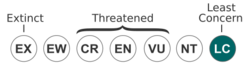
Endiandra discolor is a tree in the family Lauraceae, native to eastern Australia from central New South Wales to northeastern Queensland. Common names include rose walnut and domatia tree. It grows in tropical, subtropical or warm temperate rainforest, particularly on the poorer volcanic soil types, and alluvial soil near streams. It was first described in 1870, and has been given the conservation status of least concern.
Description
Endiandra discolor is a tree up to 25 m (82 ft) tall and very often buttressed. The bark is brown or brownish grey, smooth on younger trees. The bark of older trees is rougher, with small depressions in the bark which are sometimes inhabited by insects. Twigs and new shoots are covered with fine pale brown to white hairs, and twigs are fluted.[4][5][6]
The leaves are simple and arranged alternately on the twigs, measuring up to 10 cm (3.9 in) long and 5 cm (2.0 in) wide. They are glabrous above and dull grey-green to white below, and held on a petiole (leaf stalk) up to 10 mm (0.4 in) long. They are elliptic to ovate with 3–7 lateral veins either side of the midrib, and conspicuous foveoles at their junction with the midrib.[4][5][6][7][8]
Inflorescences are panicles produced in the Template:Botanygloss and are shorter than or as long as the leaves. The scented, creamy green flowers are small and Template:Botanygloss, measuring about 2 mm (0.1 in) long and 5 mm (0.2 in) wide, with three inner and three outer tepals.[4][5][6][7]
The fruit is a shiny black drupe, about 17 mm (0.7 in) long and 13 mm (0.5 in) wide, containing a single brown seed about 14 mm (0.6 in) long by 9 mm (0.4 in) wide. The thin flesh is green, the cut seed is cream to pink. Like many Australian laurels, the seed is slightly ribbed.[4][5][6][7]
Taxonomy
The species was first described by English botanist George Bentham in 1870, and published in his book Flora australiensis: a description of the plants of the Australian territory.[9]
Conservation
As of November 2024[update], this species has been assessed to be of least concern by the International Union for Conservation of Nature (IUCN) and by the Queensland Government under its Nature Conservation Act.[1][10]
Ecology
Fruit are eaten by many rainforest birds, including the wompoo fruit dove, catbird, rose crowned fruit dove, superb fruit-dove and topknot pigeon.[6] The leaves provide food for the larvae of the Macleay's swallowtail butterfly (Graphium macleayanum).[11] The plant is also a larval host for the fruit fly, Bactrocera endiandrae.[12]
Gallery
-
 Foliage
 -
 Underside of leaf showing conspicuous domatia
 -
 Trunk with buttrresses


References
- ↑ 1.0 1.1 IUCN SSC Global Tree Specialist Group & Botanic Gardens Conservation International (BGCI). (2019). "Endiandra discolor". IUCN Red List of Threatened Species 2019. doi:10.2305/IUCN.UK.2019-3.RLTS.T158690872A158690874.en. https://www.iucnredlist.org/species/158690872/158690874. Retrieved 15 November 2024.
- ↑ "Endiandra discolor". Centre for Australian National Biodiversity Research, Australian Government. https://biodiversity.org.au/nsl/services/rest/name/apni/111712.
- ↑ "Endiandra discolor Benth.". Royal Botanic Gardens, Kew. 2024. https://powo.science.kew.org/taxon/urn:lsid:ipni.org:names:464379-1.
- ↑ 4.0 4.1 4.2 4.3 Le Cussan, J.; Hyland, B.P.M. (2022). "Endiandra discolor". Australian Biological Resources Study, Department of Climate Change, Energy, the Environment and Water: Canberra. https://profiles.ala.org.au/opus/foa/profile/Endiandra%20discolor.
- ↑ 5.0 5.1 5.2 5.3 "PlantNET - FloraOnline". Royal Botanic Gardens and Domain Trust, Sydney. https://plantnet.rbgsyd.nsw.gov.au/cgi-bin/NSWfl.pl?page=nswfl&lvl=sp&name=Endiandra~discolor.
- ↑ 6.0 6.1 6.2 6.3 6.4 Cooper, Wendy; Cooper, William T. (June 2004). Fruits of the Australian Tropical Rainforest. Clifton Hill, Victoria, Australia: Nokomis Editions. p. 256. ISBN 978-0-9581742-1-3. https://www.nokomis.com.au/product/nokomis-published-books/fruits-australian-tropical-rainforest/.
- ↑ 7.0 7.1 7.2 "Endiandra discolor". Centre for Australian National Biodiversity Research (CANBR), Australian Government. 2020. https://apps.lucidcentral.org/rainforest/text/entities/Endiandra_discolor.htm.
- ↑ Jones, David L. (1986). Rainforest Plants of Australia. Bowgowlah, NSW, Australia: Reed Books. p. 165. ISBN 0-7301-0381-1.
- ↑ Bentham, G.; Mueller, F. von (1870). Flora australiensis: a description of the plants of the Australian territory. 5. London: L. Reeve and Co. https://www.biodiversitylibrary.org/page/26124215.
- ↑ "Species profile—Endiandra discolor". Queensland Government. 2024. https://apps.des.qld.gov.au/species-search/details/?id=17303.
- ↑ "Graphium macleayanum". http://lepidoptera.butterflyhouse.com.au/papi/macleayanum.html.
- ↑ "Bactrocera endiandrae (Perkins & May)". http://www.agric.nsw.gov.au/Hort/ascu/fruitfly/endiandr.htm.
External links
 |
Wikispecies has information related to Endiandra discolor |
- View a map of recorded sightings of this species at the Australasian Virtual Herbarium
- View observations of this species on iNaturalist
- See images of this species on Flickriver
Wikidata ☰ Q5376109 entry
 |  |


