Biology:Endiandra monothyra
| Endiandra monothyra | |
|---|---|
| Line drawing showing a twig with leaves and flowers, also detailed drawings of flowers and fruit | |
| Endiandra monothyra botanical sketch | |
Scientific classification 
| |
| Kingdom: | Plantae |
| Clade: | Tracheophytes |
| Clade: | Angiosperms |
| Clade: | Magnoliids |
| Order: | Laurales |
| Family: | Lauraceae |
| Genus: | Endiandra |
| Species: | E. monothyra
|
| Binomial name | |
| Endiandra monothyra | |
Endiandra monothyra is a species of plant in the family Lauraceae native to Queensland, Australia. It is a large rainforest tree capable of reaching up to 35 m (115 ft) in height. It occurs along the northeast coastal and sub-coastal areas from near Cooktown to about Townsville.[4]
Taxonomy
The species was first described in 1989 by Australian botanist Bernard Hyland, in his 367-page revision of the Lauraceae family in Australia.[5] He recognised two subspecies:
Conservation
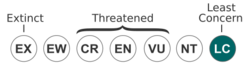
This species was assessed by the International Union for Conservation of Nature (IUCN) in 2018 and found to be of least concern.[1] In its statement, the IUCN cites the lack of any perceived threat to the species, as well as a wide distribution and large population, as the basis for the assessment.
References
- ↑ 1.0 1.1 IUCN SSC Global Tree Specialist Group; Botanic Gardens Conservation International (2019). "Endiandra monothyra". IUCN Red List of Threatened Species 2019. doi:10.2305/IUCN.UK.2019-3.RLTS.T158690559A158690561.en. https://www.iucnredlist.org/species/158690559/158690561.
- ↑ "Endiandra monothyra B.Hyland". Centre for Australian National Biodiversity Research, Australian Government. https://biodiversity.org.au/nsl/services/rest/name/apni/111957.
- ↑ "Endiandra monothyra B.Hyland". Royal Botanic Gardens, Kew. 2026. https://powo.science.kew.org/taxon/urn:lsid:ipni.org:names:938651-1.
- ↑ "Endiandra monothyra". National Collaborative Research Infrastructure Strategy (NCRIS), Australian Government. https://bie.ala.org.au/species/https://id.biodiversity.org.au/node/apni/2886214.
- ↑ Hyland, B. (1989). "A Revision of Lauraceae in Australia (excluding Cassytha)". Australian Systematic Botany 2 (2): 240–241. doi:10.1071/SB9890135.
- ↑ "Endiandra monothyra subsp. monothyra B.Hyland". Centre for Australian National Biodiversity Research, Australian Government. https://biodiversity.org.au/nsl/services/rest/name/apni/111960.
- ↑ "Endiandra monothyra subsp. monothyra B.Hyland". Royal Botanic Gardens, Kew. 2026. https://powo.science.kew.org/taxon/urn:lsid:ipni.org:names:159559-3.
- ↑ "Endiandra monothyra subsp. trichophylla B.Hyland". Centre for Australian National Biodiversity Research, Australian Government. https://biodiversity.org.au/nsl/services/rest/name/apni/111969.
- ↑ "Endiandra monothyra subsp. trichophylla B.Hyland". Royal Botanic Gardens, Kew. 2026. https://powo.science.kew.org/taxon/urn:lsid:ipni.org:names:951318-1.
External links
 |
Wikispecies has information related to Endiandra monothyra |
- Map of herbarium collections of this species at the Australasian Virtual Herbarium
- Observations of this species on iNaturalist
Wikidata ☰ Q15610207 entry
 |  |


