Biology:Ensete perrieri
| Ensete perrieri | |
|---|---|
Scientific classification 
| |
| Kingdom: | Plantae |
| Clade: | Tracheophytes |
| Clade: | Angiosperms |
| Clade: | Monocots |
| Clade: | Commelinids |
| Order: | Zingiberales |
| Family: | Musaceae |
| Genus: | Ensete |
| Species: | E. perrieri
|
| Binomial name | |
| Ensete perrieri (Claverie) Cheesman
| |
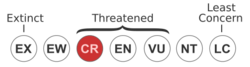
Ensete perrieri, or the Madagascar banana, is a species of banana exclusively found in western Madagascar. The Madagascar banana is listed as critically endangered because of deforestation and climate change. Some botanists believe that the Madagascar banana is a potential source of resistance to Panama disease, which wiped out the Gros Michel banana, and threatens the Cavendish banana, which is the main banana of international commerce.[2][3]
Description
The Madagascar banana is a tree-like herbaceous plant.[4] It loses all of its leaves in the dry season with only a pseudostem of leaf-sheaths remaining.[5]
A typical Madagascar banana tree is 5 to 6 metres (16 to 20 ft) high, with a trunk swollen at the base into a thick tuber 2.5 m (8 ft 2 in) in circumference. The roots are white, cylindrical and thick. The stem is surrounded by persistent leaf sheaths and thus takes on the appearance of a large trunk swollen at its base. It measures, on average, 2 m (6 ft 7 in) in circumference at the collar, 2.5 m (8 ft 2 in) a little higher (at a distance of 50 centimetres (20 in)), only 0.7 m (2 ft 4 in) at the level of the lower leaves.[6]
Uses
Because of its large seeds, it is not palatable to eat. However, it may be possible to breed edible bananas with it.[2] A traditional Malagasy use of the banana in southwest Madagascar is to grind the stems to a powder as a treatment for stomach-ache.[7]
Taxonomy
A specimen was collected in Betsiboka in 1905 by a French botanist named Pierre Claverie, and is kept in a herbarium in the National Museum of Natural History, France.[8] The Madagascar banana is named after a French botanist, Joseph Marie Henry Alfred Perrier de la Bâthie, and was originally classified in the genus Musa,[9] but was later reclassified as Ensete by Ernest Entwistle Cheesman.[10] The Madagascar banana is a relative of the Abyssinian banana (Ensete ventricosum).[3]
Habitat and cultivation
Madagascar bananas are native to the dry tropical forests of western Madagascar,[4] and in 2018, it was thought by botanists at Kew Gardens that there were only three known mature Madagascar banana trees left, but seedlings have been seen.[3] The Madagascar banana has a genetic trait that allows it to be resistant to diseases.[2][3] Madagascar bananas can be found within the Tsingy de Bemaraha Strict Nature Reserve.[3]
See also
- Red banana
- Blue Java banana
- Flora of Madagascar
References
- ↑ Allen, R. (2018). "Ensete perrieri (Madagascar Banana)" (in en). IUCN. doi:10.2305/IUCN.UK.2018-1.RLTS.T98249345A98249347.en. https://www.iucnredlist.org/species/98249345/98249347.
- ↑ 2.0 2.1 2.2 "Yes! We have no bananas: Why the song may come true again". Helen Briggs. 5 July 2018. https://www.bbc.com/news/science-environment-44712034.
- ↑ 3.0 3.1 3.2 3.3 3.4 Allen, Richard; Clarkson, James J; Ralimanana, Hélène (6 July 2018). "The critically endangered Madagascar Banana". Royal Botanic Gardens, Kew. https://www.kew.org/read-and-watch/madagascan-banana. "Only five mature individuals of E. perrieri have been previously identified in the whole of Madagascar, and a recent survey has suggested that now only three of these may be left (Analavelona, Ampefy and Maintirano areas)."
- ↑ 4.0 4.1 "Ensete perrieri (Claverie) Cheesman | Plants of the World Online | Kew Science" (in en). Royal Botanic Gardens, Kew. https://powo.science.kew.org/taxon/urn:lsid:ipni.org:names:584802-1.
- ↑ Jolly, Alison; Oberlé, Philippe; Albignac, Roland (2016-01-22) (in en). Key Environments: Madagascar (1st ed.). Oxford: Pergamon Press, IUCN. p. 42. ISBN 978-1-4832-8595-5. OCLC 756437768. https://books.google.com/books?id=lR0lBQAAQBAJ&dq=Ensete+perrieri+-ventricosum&pg=PA27.
- ↑ (in fr) Annales du Muśee colonial de Marseille. ser.2:v.7. Aix-Marseille University Faculty of Sciences. 1909. pp. 74–86. OCLC 731007973. https://www.biodiversitylibrary.org/item/161596#page/73/mode/1up.
- ↑ Randrianarivony, Tabita N. et al. (2016-12-23). "Value of useful goods and ecosystem services from Agnalavelo sacred forest and their relationships with forest conservation" (in en). Madagascar Conservation & Development 11 (2): 47. doi:10.4314/mcd.v11i2.1. ISSN 1662-2510. https://www.ajol.info/index.php/mcd/article/view/149654.
- ↑ "Occurrence Detail 4061008915" (in en). https://www.gbif.org/occurrence/4061008915.
- ↑ "Musa perrieri Bonnier" (in en). https://www.gbif.org/species/8412469.
- ↑ Cheesman, E. E. (1947). "Classification of the Bananas: The Genus Ensete Horan". Kew Bulletin 2 (2): 97–106. doi:10.2307/4109206. ISSN 0075-5974. Bibcode: 1947KewBu...2...97C. https://www.jstor.org/stable/4109206.
External links
Wikidata ☰ Q10484409 entry
 |  |


