Biology:Ephedra sinica
| Chinese ephedra (Cao Ma Huang—草麻黄) | |
|---|---|

| |
| Ephedra sinica | |
Scientific classification 
| |
| Kingdom: | Plantae |
| Clade: | Tracheophytes |
| Clade: | Gymnospermae |
| Division: | Gnetophyta |
| Class: | Gnetopsida |
| Order: | Ephedrales |
| Family: | Ephedraceae |
| Genus: | Ephedra |
| Species: | E. sinica
|
| Binomial name | |
| Ephedra sinica Stapf
| |
| Synonyms[1][2] | |
| |
Ephedra sinica (also known as Chinese ephedra or ma huang) is a species of Ephedra in the plant family Ephedraceae. Native to Mongolia, northern China, and Russia, it is a shrub found on arid highland slopes, dry river beds, steppes, fields or mountain sides.[1][2]
E. sinica contains alkaloids, including ephedrine, which have been a basis for using the plant in traditional medicine for thousands of years.[3][4] Due to concerns about alkaloid toxicity, ephedrine has been banned from the market in the European Union, United States, and many other countries.[4][5]
Description
E. sinica is a dioecious evergreen shrub, a gymnosperm closely related to conifers, with small leaves on green stems.[4][6] The plant grows on shrublands, forests, and mountainsides between elevations of 400–1,600 m (1,300–5,200 ft).[1]
The stems and leaves are collected and dried for use, whereas the roots, known as "ma huang gen", are used in Chinese traditional medicine.[4][6] E. sinica has a strong pine odor and its taste is astringent, accounting for its Chinese name, ma huang, meaning "yellow astringent" or "yellow hemp".[5]
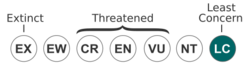
E. sinica is a common plant in a stable population listed as least concern on the IUCN Red List of Threatened Species.[1] It is widely cultivated, although the status of wild harvesting is unknown and a significant threat.[1]
Composition
Ephedra contains diverse alkaloids, among which ephedrine has a phenethylamine structure.[4] Ephedrine has sympathomimetic properties.[4][7]
Uses
Alkaloid extracts of the E. sinica plant contain ephedrine, which is the active ingredient for its intended therapeutic effects in traditional medicine, and for its adverse effects.[3][4][5][7]
Traditional medicine and dietary supplement
E. sinica is the primary source of ephedra as used in ma huang, a practice applied over many millenia in China since 2800 BC.[3][4][7] In traditional medicine, ephedra is intended to treat colds and other minor respiratory ailments, fever, and headaches.[3][4][5] As a dietary supplement, it has been used to aid athletic performance and to lose weight.[3][4][5][7]
Adverse effects
Even when used for short periods in low doses, ephedra has been linked to harmful effects, including sudden hypertension, heart attack, seizures, and stroke; it can be life-threatening or disabling.[3][4][5][7]
See also
References
- ↑ 1.0 1.1 1.2 1.3 1.4 1.5 Bell, A.; Bachman, S. (2011). "Ephedra sinica". IUCN Red List of Threatened Species 2011. doi:10.2305/IUCN.UK.2011-2.RLTS.T201702A9168958.en. https://www.iucnredlist.org/species/201702/9168958. Retrieved 10 February 2026.
- ↑ 2.0 2.1 "Ephedra sinica". Kew, Royal Botanic Gardens, Plants of the World Online. 2026. https://powo.science.kew.org/taxon/urn:lsid:ipni.org:names:383460-1/.
- ↑ 3.0 3.1 3.2 3.3 3.4 3.5 "Ephedra". National Center for Complementary and Integrative Health, US National Institutes of Health. November 2024. https://www.nccih.nih.gov/health/ephedra.
- ↑ 4.00 4.01 4.02 4.03 4.04 4.05 4.06 4.07 4.08 4.09 4.10 "Ephedra". Drugs.com. 14 July 2025. https://www.drugs.com/npp/ephedra.html.
- ↑ 5.0 5.1 5.2 5.3 5.4 5.5 "Ephedra". LiverTox, US National Library of Medicine. 10 February 2018. https://www.ncbi.nlm.nih.gov/books/NBK548711/.
- ↑ 6.0 6.1 "Ephedra sinica". eFlora, Flora of China, volume 4. 2026. p. 99. http://www.efloras.org/florataxon.aspx?flora_id=2&taxon_id=200005521.
- ↑ 7.0 7.1 7.2 7.3 7.4 Anderson, Rebecca J. (2026). "The Good, the Bad, & the Banned". The Pharmacologist, American Society for Pharmacology and Experimental Therapeutics. https://thepharmacologist.org/ephedra/.
Wikidata ☰ Q2602813 entry
 |  |


