Biology:Eryopidae
Eryopidae are an extinct family of medium to large sized amphibious temnospondyls that lived from the latest Carboniferous (Pennsylvanian) to the early Permian period and inhabited North America and Europe.[1] They were apex predators in the stream and lake habitats they inhabited. Their life cycle (exemplified by Onchiodon) consist of a small larvae that grows into a heavily ossified adult. This group are unusual in their variability in their morphology and development.[2]
They have interpterygoid vacuities (spaces in the interpterygoid bone) that are rounded at the front and large external nares.
Clamorosaurus and Syndyodosuchus appear to be amongst the last members of Eryopidae.[3]
Not all of the genera previously included in the Eryopidae (Carroll 1988) are retained under the cladistic revisions.
Distribution
They had a broad geographic range inhabiting much of the northern regions of the supercontinent Pangea in what would become North America and the eastern margins of Europe.[3]
In Texas, many fossils of Eryops have been found. There are also a few genera of European Eryopsids distributed through out. Fossils have been found in France (Actinodon), Germany (Onchiodon and Stenokranio), Czech Republic (Onchiodon), Poland (Osteophorus) and in Pechora Basin, Russia (Clamorosaurus).[3]
Taxonomy
Eryopidae is a member of Eryopiformes along with Stereospondylomorpha. Below is a list of genera that belongs to this family and the subfamily Eryopinae:
- Actinodon
- ?Chelydosaurus
- ?Syndyodosuchus (possibly a Actinodontid)
- Stenokranio[4]
Eryopinae
- Clamorosaurus
- Eryops
- Glaukerpeton
- Onchiodon
- Osteophorus
Gallery
-
 Eryops megacephalus, of the late Carboniferous to early Permian of North America
 -
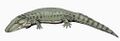 Onchiodon, of the late Carboniferous to early Permian of Europe and North America
 -
 Actinodon frossardi, of the early Permian of France
 -
 Clamorosaurus nocturnis, of the early Permian of Russia


References
- ↑ R. R. Schoch (January 2013). "The evolution of major temnospondyl clades: An inclusive phylogenetic analysis". Journal of Systematic Palaeontology 11 (6): 673–705. doi:10.1080/14772019.2012.699006. Bibcode: 2013JSPal..11..673S.
- ↑ Schoch, Rainer R. (2021-09-30). "The life cycle in late Paleozoic eryopid temnospondyls: developmental variation, plasticity and phylogeny" (in English). Fossil Record 24 (2): 295–319. doi:10.5194/fr-24-295-2021. ISSN 2193-0066. Bibcode: 2021FossR..24..295S. https://fr.copernicus.org/articles/24/295/2021/.
- ↑ 3.0 3.1 3.2 Werneburg, Ralf; Witzmann, Florian (2024-12-30). "The last eryopids: Clamorosaurus and Syndyodosuchus from the late Kungurian (Cisuralian, Permian) of Russia revisited" (in en). Fossil Record 27 (3): 353–380. doi:10.3897/fr.27.125460. ISSN 2193-0074. https://fr.pensoft.net/article/125460/.
- ↑ Werneburg, Ralf; Witzmann, Florian; Rinehart, Larry; Fischer, Jan; Voigt, Sebastian (November 2023). "A new eryopid temnospondyl from the Carboniferous–Permian boundary of Germany" (in en). Journal of Paleontology 97 (6): 1251–1281. doi:10.1017/jpa.2023.58. ISSN 0022-3360. Bibcode: 2023JPal...97.1251W. https://www.cambridge.org/core/journals/journal-of-paleontology/article/abs/new-eryopid-temnospondyl-from-the-carboniferouspermian-boundary-of-germany/992657993894BEF3C1F7E964C87709DF.
Further reading
- Carroll, R. L. (1988), Vertebrate Paleontology and Evolution, W.H. Freeman & Co.
- Laurin. M and Steyer, J-S, (2000), Phylogeny and Apomorphies of Temnospondyls - Tree of Life project
External links
- "Eryopoidea". http://www.helsinki.fi/~mhaaramo/metazoa/deuterostoma/chordata/amphibia/euskelia/eryopoidea.html.
Template:Temnospondyli Wikidata ☰ Q2295521 entry
 |  |


