Biology:Euptelea polyandra
From HandWiki
Short description: Species of plant
| Euptelea polyandra | |
|---|---|

| |
| Flowers | |

| |
| Botanical illustration | |
Scientific classification 
| |
| Kingdom: | Plantae |
| Clade: | Tracheophytes |
| Clade: | Angiosperms |
| Clade: | Eudicots |
| Order: | Ranunculales |
| Family: | Eupteleaceae |
| Genus: | Euptelea |
| Species: | E. polyandra
|
| Binomial name | |
| Euptelea polyandra Siebold & Zucc.
| |
| Synonyms[2] | |
|
Euptelea polyandra f. hypoleuca M.Mizush. & Yokouchi | |
Euptelea polyandra is a species of flowering plant in the family Eupteleaceae, native to wet areas of central and southern Japan.[2] A suckering small tree, occasionally a many-stemmed shrub, it is used as a street tree in a number of European cities.[3][4]
-
Flowers and stems
-
Young leaves
-
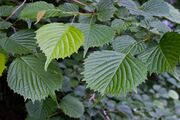 Leaves
 -
Older leaves

References
- ↑ Botanic Gardens Conservation International (BGCI).; IUCN SSC Global Tree Specialist Group. (2019). "Euptelea polyandra". IUCN Red List of Threatened Species 2019: e.T143486314A143486316. doi:10.2305/IUCN.UK.2019-1.RLTS.T143486314A143486316.en. https://www.iucnredlist.org/species/143486314/143486316. Retrieved 7 July 2023.
- ↑ 2.0 2.1 "Euptelea polyandra Siebold & Zucc." (in en). Royal Botanic Gardens, Kew. http://www.plantsoftheworldonline.org/taxon/554480-1.
- ↑ Johnson, O. (2023). "Euptelea polyandra Sieb. & Zucc.". International Dendrology Society. https://www.treesandshrubsonline.org/articles/euptelea/euptelea-polyandra.
- ↑ Ossola, Alessandro; Hoeppner, Malin J.; Burley, Hugh M.; Gallagher, Rachael V.; Beaumont, Linda J.; Leishman, Michelle R. (2020). "The Global Urban Tree Inventory: A database of the diverse tree flora that inhabits the world's cities". Global Ecology and Biogeography 29 (11): 1907–1914. doi:10.1111/geb.13169.
Wikidata ☰ Q4533175 entry
 |  |


.jpg)

