Biology:Eutatus
Eutatus is an extinct genus of large armadillos of the family Chlamyphoridae. It was endemic to South America from the Early Miocene to Late Pleistocene, living from 17.5 Ma-11,000 years ago, with possible survival into the early Holocene (~ 7,500 BP)[1] and existing for approximately 17.49 million years.[2]
Taxonomy
Eutatus was named by Gervais (1867). The type species is E. seguini. It was assigned to Dasypodidae by Carroll (1988).[3]
Fossil distribution
The fossil remains are confined to Argentina and have been found in the Santacrucian Santa Cruz Formation,[4] Ensenadan Miramar Formation,[5] and the Lujanian Luján Formation.[6]
Palaeobiology
The overall masticatory apparatus morphology of Eutatus suggests that it was adapted for browsing.[7] Based on carbon isotope ratios, however, it is thought to have been an herbivore that fed on grasses.[1]
Gallery
-
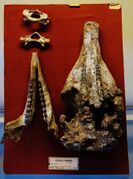 Skull
Skull -
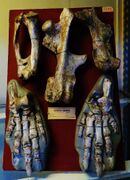 Limbs
Limbs


References
- ↑ 1.0 1.1 Prado, J. L.; Martinez-Maza, C.; Alberdi, M. T. (2015). "Megafauna extinction in South America: A new chronology for the Argentine Pampas". Palaeogeography, Palaeoclimatology, Palaeoecology 425: 41–49. doi:10.1016/j.palaeo.2015.02.026. Bibcode: 2015PPP...425...41P.
- ↑ Eutatus at Fossilworks.org
- ↑ R. L. Carroll. 1988. Vertebrate Paleontology and Evolution. W.H. Freeman and Company
- ↑ Coy Inlet at Fossilworks.org
- ↑ Punta Hermengo at Fossilworks.org
- ↑ Paso Otero-Pardo at Fossilworks.org
- ↑ Vizcaíno, Sergio F.; Fariña, Richard A.; Bargo, M. Susana; Iullis, Gerardo De (2004). "Functional and phylogenetic assessment of the masticatory adaptations in Cingulata (Mammalia, Xenarthra)" (in es). Ameghiniana 41 (4): 651–664. ISSN 1851-8044. https://ameghiniana.org.ar/index.php/ameghiniana/article/view/862. Retrieved 5 October 2025.
Template:Cingulata Genera Wikidata ☰ Q5414384 entry
 |  |


