Biology:Excoecaria cochinchinensis
| Excoecaria cochinchinensis | |
|---|---|
| File:Excoecaria cochinchinensis along Jalan Cecawi 6-29 in Seksyen 6 Kota Damansara 20231208 142327.jpg | |
| Excoecaria cochinchinensis "Firestorm" | |
Scientific classification 
| |
| Kingdom: | Plantae |
| Clade: | Tracheophytes |
| Clade: | Angiosperms |
| Clade: | Eudicots |
| Clade: | Rosids |
| Order: | Malpighiales |
| Family: | Euphorbiaceae |
| Genus: | Excoecaria |
| Species: | E. cochinchinensis
|
| Binomial name | |
| Excoecaria cochinchinensis Lour.
| |
| Synonyms[2] | |
| |
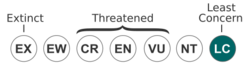
Excoecaria cochinchinensis is a species of flowering plant in the spurge family, Euphorbiaceae.[2][3] It is sometimes referred to by the common names Chinese croton, blindness tree, buta buta, and jungle fire plant. It is native to Southeast China, Hainan, Laos, Malaysia, Myanmar, Taiwan, Thailand, and Vietnam.[2]
It is a subtropical evergreen shrub with a woody stem, growing up to 1–2 meters (3.3–6.6 ft) high. Its leaves are opposite, their texture shiny and papery, the upper surface dark green or variegated and the underside a deep maroon. The leaves measure 6–14 cm by 2–4 cm (2.4–5.5 in by 0.8–1.6 in).[4] It is dioecious.[5]
Etymology
The common name of blindness tree comes from Latin, "excoecaria", to make blind. Sap in the eyes is reported to causes blindness. The Latin name cochinchinensis derives from Cochinchina, an old name for Vietnam.[6]
Uses
Excoecaria cochinchinensis is cultivated as an ornamental tropical plant, greenhouse plant, or houseplant. A popular colorful cultivar is "Firestorm."[6]
Precautions
As with many of the Euphorbiaceae, the sap is toxic and can cause skin eczema in some people. It is also toxic if eaten, though in small quantities, it has been used in herbal medicine to treat gastric ulcers.
Though the plant is considered poisonous, it has beneficial uses as an antiparasitic, antipruritic, and haemostatic treatment.[7]
References
- ↑ Botanic Gardens Conservation International (BGCI) & IUCN SSC Global Tree Specialist Group (2018). "Excoecaria cochinchinensis". IUCN Red List of Threatened Species 2018. doi:10.2305/IUCN.UK.2018-2.RLTS.T136140927A136140929.en. https://www.iucnredlist.org/species/136140927/136140929. Retrieved July 6, 2025.
- ↑ 2.0 2.1 2.2 "Excoecaria cochinchinensis Lour.". The Trustees of the Royal Botanic Gardens, Kew. n.d.. https://powo.science.kew.org/taxon/urn:lsid:ipni.org:names:348839-1.
- ↑ "Excoecaria cochinchinensis Lour.". Species 2000. n.d.. https://www.catalogueoflife.org/data/taxon/3DJYP.
- ↑ Hong Kong Flora and Vegetation Excoecaria cochinchinensis
- ↑ Zhou, Yubing; Wu, Wei; Ning, Zulin; Zhou, Renchao (2018). "Identification and characterization of sex-specific markers in the milky mangrove Excoecaria agallocha using double digest restriction site-associated DNA sequencing". Aquatic Botany 144: 54–60. doi:10.1016/j.aquabot.2017.11.004.
- ↑ 6.0 6.1 Landscape Plants For South Florida Excoecaria cochinchinensis
- ↑ Global Information Hub On Integrated Medicine Excoecaria cochinchinensis
Wikidata ☰ Q3336409 entry
 |  |


