Biology:Golbaengi-muchim
Golbaengi-muchim (골뱅이무침) or moon snail salad is a type of muchim (salad) made by mixing moon snails with vegetables.[1][2] In South Korea, it is a classic "quintessential" snack eaten with alcoholic drinks[3] (anju), typically made with red, spicy sauce and served with boiled somyeon (wheat noodles).[3][4] Like other anju, it is sold in pojangmacha (street stalls).[5]
Preparation
Whelks are washed, boiled, and shelled.[6] (Or precooked canned whelk may be used[3][4][7]). Bigger ones are halved,[6] and the snail meat is mixed with vegetables (most commonly julienned scallions, carrots, onions, and sliced cucumber), and seasonings (most commonly chili paste, chili powder, soy sauce, minced garlic, vinegar, and sesame oil).[6][3][4][7] It is served with toasted sesame seeds sprinkled on top.[6][3][4][7] As an additional ingredient, shredded dried pollock (hwangtae-po, 황태; 黄太[lower-alpha 1]) that has been reconstituted and soften by soaking may be tossed in the salad as well.[6][7][lower-alpha 2]
Adding boiled somyeon (wheat noodles) in the mix the spicy salad is typical,[6][3][lower-alpha 3] though one might call the dish golbaengi-muchim-guksu (골뱅이무침국수, lit. moon snail seasoned, with noodles) to be specific.[3]
Gallery
-
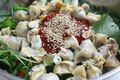 Preparing golbaengi-muchim
 -
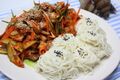 Golbaengi-muchim served with somyeon


See also
Explanatory notes
References
- ↑ National Institute of Korean Language (30 July 2014). "Error: no
|title=specified when using {{Cite web}}" (in ko). http://www.korean.go.kr/common/download.do?file_path=notice&c_file_name=140730_%ED%95%9C%EC%8B%9D%EB%AA%85_%EB%A1%9C%EB%A7%88%EC%9E%90_%ED%91%9C%EA%B8%B0_%EB%B0%8F_%ED%91%9C%EC%A4%80_%EB%B2%88%EC%97%AD_%ED%99%95%EC%A0%95%EC%95%88_.pdf&o_file_name=140730_%ED%95%9C%EC%8B%9D%EB%AA%85_%EB%A1%9C%EB%A7%88%EC%9E%90_%ED%91%9C%EA%B8%B0_%EB%B0%8F_%ED%91%9C%EC%A4%80_%EB%B2%88%EC%97%AD_%ED%99%95%EC%A0%95%EC%95%88_.pdf.- 주요 한식명 로마자 표기 및 표준 번역 확정안 공지. National Institute of Korean Language (Press release) (in 한국어). 2014-05-02.
- ↑ Zapana, Victor (26 November 2012). "Shaken". The New Yorker. http://www.newyorker.com/magazine/2012/11/26/shaken. Retrieved 8 May 2017.
- ↑ 3.0 3.1 3.2 3.3 3.4 3.5 3.6 Maangchi (2019). "Golbaengi-muchim-guksu". Maangchi's Big Book of Korean Cooking. With Martha Rose Shulman. Houghton Mifflin Harcourt. p. 440. ISBN 9781328988126. https://www.google.com/books/edition/Maangchi_s_Big_Book_of_Korean_Cooking/pSO1DwAAQBAJ?gbpv=1&pg=PA440.
- ↑ 4.0 4.1 4.2 4.3 4.4 Hong, Deuki; Rodbard, Matt (2016). "Golbaengi muchi". Koreatown: A Cookbook. Clarkson Potter/Ten Speed. p. 269. ISBN 9780804186148. https://www.google.com/books/edition/Koreatown/MAxsCQAAQBAJ?gbpv=1&dq=%22Golbaengi-muchim%22&pg=PA269.
- ↑ Montgomery, Charles (26 October 2016). "Why Pojangmacha Street Food Is What You Need". 10 Magazine. https://www.10mag.com/why-pojangmacha-street-food-is-what-you-need/.
- ↑ 6.0 6.1 6.2 6.3 6.4 6.5 "golbaengi-muchim" (in ko). Doosan Corporation. http://www.doopedia.co.kr/doopedia/master/master.do?_method=view&MAS_IDX=161028001542320.
- ↑ 7.0 7.1 7.2 7.3 7.4 The Korean Food Promotion Institute (2021). "Golbaengi-muchim". Food of Korea: 200 Recipes. Hollym. p. 278. ISBN 9781565915060. https://www.google.com/books/edition/Food_of_Korea/rSxJEAAAQBAJ?gbpv=1&dq=%22Golbaengi-muchim%22&pg=PA278.
 |  |


