Biology:Hakea acuminata
| Hakea acuminata | |
|---|---|
Scientific classification 
| |
| Kingdom: | Plantae |
| Clade: | Tracheophytes |
| Clade: | Angiosperms |
| Clade: | Eudicots |
| Order: | Proteales |
| Family: | Proteaceae |
| Genus: | Hakea |
| Species: | H. acuminata
|
| Binomial name | |
| Hakea acuminata Haegi[1]
| |
Hakea acuminata is a shrub of the family Proteaceae native to Western Australia. A restricted species bearing clusters of white flowers with a green or pinkish tinge in late autumn to winter.
Description
Hakea acuminata is a multi-branched shrub growing to 0.5 to 1.8 metres (1.6 to 5.9 ft) high, with smooth grey bark. Its leaves are shiny, rich green with a yellow tinge at the base, almost flat and partially whorled in the higher flowering branches. The leaves are concave, narrowly oval to egg-shaped 3 to 12 centimetres (1.2 to 4.7 in) long and 9 to 38 millimetres (0.354 to 1.496 in) wide. There are up to three prominent longitudinal veins on both sides of the leaves. The inflorescence has 16 to 24 flowers appearing in racemes in leaf axils. The perianth is a cream-yellow and the style is long and prominent. The pistil is 34–37 mm (1–1 in) long. Egg-shaped woody fruit grow singly or in pairs 25 to 31 mm (1.0 to 1.2 in) long and 16 to 21 mm (0.63 to 0.83 in) wide. The fruit become corky as they age and have little or no beak. The seeds are blackish-brown, obliquely egg-shaped 18 to 21 mm (0.71 to 0.83 in) long and 9 to 10 mm (0.354 to 0.394 in) wide with a wing extending down both sides of body. From May to October clusters of cream to pale yellow, ageing to pale pink blooms appear.[2][3][4][5]
Taxonomy and naming
Hakea acuminata was first formally described in 1999 by Laurence Haegi in the Flora of Australia from specimens collected on the north slope of One Tree Hill, south of Ravensthorpe in 1979.[5][6] The specific epithet (acuminata) means 'pointed', referring to the leaves.[7]
Distribution and habitat
This species is endemic to the area between Ravensthorpe and Jerramungup in the Esperance Plains bioregion, where it grows on undulating plains of shrub-mallee or heath in deep white sand or loamy soils over granite.[2][8] The species has been only been discovered in recent years, and is only known from five localities.[5]
Conservation status
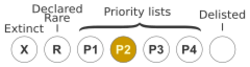
Hakea acuminata is classified as "Priority Two" by the Government of Western Australia Department of Biodiversity, Conservation and Attractions,[8] meaning that it is poorly known and from one or a few locations.[9]
References
- ↑ Haegi, Laurence A.. "Hakea acuminata". APNI. https://biodiversity.org.au/nsl/services/search?product=APNI&tree.id=&name=Hakea+acuminata&inc._scientific=&inc.scientific=on&inc._cultivar=&inc._other=&max=100&display=apni&search=true.
- ↑ 2.0 2.1 "Hakea acuminata". Electronic Flora of South Australia. Government of South Australia. http://www.flora.sa.gov.au/efsa/lucid/Hakea/key/Australian%20Hakea%20species/Media/Html/Hakea_acuminata.htm.
- ↑ Young, J A (2006). "Hakeas of Western Australia:A Field and Identification Guide". J A Young. ISBN 0-9585778-2-X.
- ↑ Holliday, Ivan (2005). "Hakeas a Field and Garden Guide". Reed New Holland. ISBN 1-877069-14-0.
- ↑ 5.0 5.1 5.2 Barker, Robyn Mary; Haegi, Laurence Arnold Robert; Wilson, Annette Jane Gratton. "Hakea acuminata". Flora of Australia. Australian Biological Resources Study, Department of Climate Change, Energy, the Environment and Water: Canberra.. https://profiles.ala.org.au/opus/foa/profile/Hakea%20acuminata.
- ↑ "Hakea acuminata". Australian Plant Name Index. https://biodiversity.org.au/nsl/services/rest/instance/apni/558819.
- ↑ George, Alex S.; Sharr, Francis A. (2023). Western Australian Plant Names and Their Meanings - A Glossary (fifth ed.). Kardinya: Four Gables Press. p. 126. ISBN 9780645629538.
- ↑ 8.0 8.1 "Hakea acuminata". FloraBase. Western Australian Government Department of Parks and Wildlife. https://florabase.dpaw.wa.gov.au/browse/profile/16920.
- ↑ "Conservation codes for Western Australian Flora and Fauna". Government of Western Australia Biodiversity, Conservation and Attractions. https://www.epa.wa.gov.au/sites/default/files/Referral_Documentation/DWERDT480152%20%20App%206%20-%202020%20Western%20Australian%20and%20Commonwealth%20of%20Australia%20Conservation%20Codes%282%29.pdf. Retrieved 28 December 2025.
Wikidata ☰ Q18083437 entry
 |  |


