Biology:Helicia australasica
| Austral oak | |
|---|---|

| |
| Inflorescence | |
Scientific classification 
| |
| Kingdom: | Plantae |
| Clade: | Tracheophytes |
| Clade: | Angiosperms |
| Clade: | Eudicots |
| Order: | Proteales |
| Family: | Proteaceae |
| Genus: | Helicia |
| Species: | H. australasica
|
| Binomial name | |
| Helicia australasica | |

Helicia australasica, also known as Austral oak or creek silky oak, is a species of rainforest tree in the macadamia family Proteaceae, native to New Guinea and northern and northeastern Australia.
Description
Helicia australasica is a shrub or small tree up to about 20 m (66 ft) tall with a trunk that rarely exceeds 30 cm (12 in) diameter. Twigs are terete (rounded) in cross-section, and younger parts – i.e. the soft non-woody parts – may be covered in fine rusty brown hairs. Older parts of twigs and branches are hairless and more or less smooth and grey. The leaf shape is variable and may be elliptic, oblong or lanceolate. Leaves are up to 23 cm (9.1 in) long by 8.5 cm (3.3 in) wide, and held on a petiole up to 10 mm (0.39 in) long. They have 6–10 pairs of lateral veins that curve throughout their length, and the leaf margin is irregularly toothed.[4][5][6][7][8]
The inflorescences are produced in the Template:Botanygloss or directly from the branches (a process called ramiflory) and may reach 17 cm (6.7 in) in length. Flowers are numerous, paired, each pair sharing a branched pedicel arising from the main axis of the inflorescence. The fruit is a drupe, blue to black in colour with a smooth skin. They grow up to 15 mm (0.59 in) long by 11 mm (0.43 in) wide and contain a single seed up to 12 mm (0.47 in) long.
Taxonomy
This plant was first described by Ferdinand von Mueller, and published in Hooker's Journal of Botany & Kew Garden Miscellany in 1857. The type species was collected in 1855 near the Macadam Range, southwest of Darwin in the Northern Territory.[9]
Synonymy
Helicia glabrescens C.T.White (1944), and Helicia dentellata Sleumer (1939), were both placed in synonymy with H. australasica by the Australian botanist Donald Bruce Foreman in 1983,[4] a position that is accepted by the Australian Plant Name Index.[10] However Plants of the World Online still recognises both as distinct species.[11][12] No other synonyms or infraspecies have been proposed.
Indigenous names
In the language of the Dyirbal people of northeast Queensland, this plant was known as miyabur, though the more general word gurruŋun – "oak tree" – was used in the taboo, or Dyalŋuy, vocabulary.[13]
Distribution and habitat
This species is naturally widespread in the "Top End" of the Northern Territory, along the east coast of Cape York Peninsula, and in south-central New Guinea.[14][15] It grows alongside watercourses in drier rainforest types, at altitudes from sea level to about 1,100 m (3,600 ft) altitude.[4][5][7]
Conservation
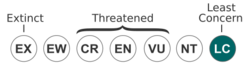
There are no significant threats identified for the species, and it has been assessed as least concern under the Northern Territory's TPWCA legislation, Queensland's NCA legislation, and by the International Union for Conservation of Nature.[1][16][17]
Cultural
The fruit was eaten raw by indigenous Australians.[7]
References
- ↑ 1.0 1.1 Benwell, A.; Ford, A.; Forster, P.; Griffith, S. (2020). "Helicia australasica". IUCN Red List of Threatened Species 2020. doi:10.2305/IUCN.UK.2020-2.RLTS.T38142A123114975.en. https://www.iucnredlist.org/species/38142/123114975. Retrieved 16 November 2021.
- ↑ "Helicia australasica". Centre for Australian National Biodiversity Research, Australian Government. https://id.biodiversity.org.au/name/apni/114512.
- ↑ "Helicia australasica F.Muell.". Royal Botanic Gardens, Kew. 2024. https://powo.science.kew.org/taxon/urn:lsid:ipni.org:names:704374-1.
- ↑ 4.0 4.1 4.2 Foreman, Donald Bruce (1983). "A Review of the Genus Helicia Lour. (Proteaceae) in Australia". Brunonia 6 (1): 63. doi:10.1071/BRU9830059.
- ↑ 5.0 5.1 "Helicia australasica". Centre for Australian National Biodiversity Research (CANBR), Australian Government. 2020. https://apps.lucidcentral.org/rainforest/text/entities/Helicia_australasica.htm.
- ↑ Cooper, Wendy; Cooper, William T. (June 2004). Fruits of the Australian Tropical Rainforest. Clifton Hill, Victoria, Australia: Nokomis Editions. p. 412. ISBN 978-0-9581742-1-3. https://www.nokomis.com.au/product/nokomis-published-books/fruits-australian-tropical-rainforest/.
- ↑ 7.0 7.1 7.2 Foreman, D.B. (2022). "Helicia australasica". Australian Biological Resources Study, Department of Climate Change, Energy, the Environment and Water: Canberra. https://profiles.ala.org.au/opus/foa/profile/Helicia%20australasica.
- ↑ Foreman, D.B. (1995). "Proteaceae". in Conn, Barry J.. Handbook of the Flora of PNG - Vol 3. Melbourne: Melbourne University Press. pp. 242–243. ISBN 0-522-84582-7. https://png-data.sprep.org/system/files/HandbooksPNG_3.pdf.
- ↑ Mueller, Ferdinand von (1857). Hooker, William Jackson. ed. "Continuation of Notes on North Australian Botany". Hooker's Journal of Botany & Kew Garden Miscellany 9: 22. https://www.biodiversitylibrary.org/page/784905. Retrieved 19 August 2024.
- ↑ "Helicia australasica". Centre for Australian National Biodiversity Research, Australian Government. https://biodiversity.org.au/nsl/services/search/names?product=APNI&tree.id=&name=Helicia+australasica+F.Muell.&inc.scientific=on&max=100&display=apni&search=true.
- ↑ "Helicia glabrescens C.T.White". Royal Botanic Gardens, Kew. 2024. https://powo.science.kew.org/taxon/urn:lsid:ipni.org:names:704414-1.
- ↑ "Helicia dentellata Sleumer". Royal Botanic Gardens, Kew. 2024. https://powo.science.kew.org/taxon/urn:lsid:ipni.org:names:704401-1.
- ↑ Dixon, Robert M. W. (1990). "The Origin of "Mother-in-Law Vocabulary" in Two Australian Languages". Anthropological Linguistics 32 (1/2): 2.
- ↑ "Search: species: Helicia australasica | Occurrence records". Australian Government. https://avh.ala.org.au/occurrences/search?taxa=Helicia%20australasica#tab_mapView.
- ↑ "Helicia australasica". 2024. https://www.gbif.org/species/5637775.
- ↑ "Helicia australasica". Northern Territory Government, Darwin.. https://eflora.nt.gov.au/factsheet?id=5077.
- ↑ "Species profile—Helicia australasica". Queensland Government. 2024. https://apps.des.qld.gov.au/species-search/details/?id=16976.
External links
- View a map of herbarium records of this species at the Australasian Virtual Herbarium
- View observations of this species on iNaturalist
- See images of this species on Flickriver.com
Wikidata ☰ Q5704990 entry
 |  |


