Biology:Hemipilia capitata
From HandWiki
Short description: Species of orchid
| Hemipilia capitata | |
|---|---|
Scientific classification 
| |
| Kingdom: | Plantae |
| Clade: | Tracheophytes |
| Clade: | Angiosperms |
| Clade: | Monocots |
| Order: | Asparagales |
| Family: | Orchidaceae |
| Subfamily: | Orchidoideae |
| Genus: | Hemipilia |
| Species: | H. capitata
|
| Binomial name | |
| Hemipilia capitata (Tang & F.T.Wang) Y.Tang & H.Peng
| |
| Synonyms | |
| |
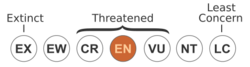
Hemipilia capitata is a species of plant in the family Orchidaceae.[2] It is endemic to China, where it is known from Sichuan and Hubei.[3][1] It produces white flowers.[4]
Taxonomy
The species was first described in 1936 by Tsin Tang and Fa Tsuan Wang, as Amitostigma capitatum.[2] A molecular phylogenetic study in 2014 found that species of Amitostigma, Neottianthe and Ponerorchis were mixed together in a single clade, making none of the three genera monophyletic as then circumscribed. Amitostigma and Neottianthe were subsumed into Ponerorchis, with this species then becoming Ponerorchis capitata.[5] The genus Ponerorchis has since been synonymized with the genus Hemipilia, resulting in the present name.
References
- ↑ 1.0 1.1 China Plant Specialist Group (2004). "Amitostigma capitatum". IUCN Red List of Threatened Species 2004. doi:10.2305/IUCN.UK.2004.RLTS.T46630A11072286.en. https://www.iucnredlist.org/species/46630/11072286. Retrieved 17 November 2021.
- ↑ 2.0 2.1 "Hemipilia capitata (Tang & F.T.Wang) Y.Tang & H.Peng | Plants of the World Online | Kew Science" (in en). http://powo.science.kew.org/taxon/urn:lsid:ipni.org:names:77206822-1.
- ↑ Flora of China v 25 p 128, 头序无柱兰 tou xu wu zhu lan, Amitostigma capitatum
- ↑ Amitostigma capitatum. Flora of China.
- ↑ Jin, Wei-Tao; Jin, Xiao-Hua; Schuiteman, André; Li, De-Zhu; Xiang, Xiao-Guo; Huang, Wei-Chang; Li, Jian-Wu; Huang, Lu-Qi (2014), "Molecular systematics of subtribe Orchidinae and Asian taxa of Habenariinae (Orchideae, Orchidaceae) based on plastid matK, rbcL and nuclear ITS", Molecular Phylogenetics and Evolution 77: 41–53, doi:10.1016/j.ympev.2014.04.004, PMID 24747003
Wikidata ☰ {{{from}}} entry
 |  |


