Biology:Homalocephala parryi
| Homalocephala parryi | |
|---|---|

| |
Scientific classification 
| |
| Missing taxonomy template (fix): | Homalocephala (plant) |
| Species: | |
| Binomial name | |
| Template:Taxonomy/Homalocephala (plant)Homalocephala parryi | |
| File:Echinocactus parryi range.svg | |
| Synonyms[2] | |
| |
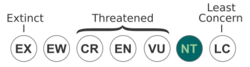
Homalocephala parryi, synonym Echinocactus parryi, also known as the horse crippler or devil's pincushion, is a cactus in the subfamily Cactoideae. It is endemic to Mexico ( northern Chihuahua).[2] H. parryi is thought to be quite similar to H. polycephala, but they differ in their branching habits, average number of ribs per stem, flower color and more.
Description
This barrel cactus, belonging to the Cactaceae family and Caryophyllales order, is a simple plant with globose to cylindrical stems that reach 16 to 25 cm in height and 21 to 30 cm in diameter. Its stems feature 13 to 21 tuberculate ribs marked by constrictions and transverse grooves. The areoles are circular in the vegetative areas and oval in the reproductive regions. The cactus bears 8 to 11 radial spines, which are white and vary in thickness and curvature; the upper spines are thin, the lateral ones are thicker, and the lower ones spread outwards. Four central spines are present, which are thick and ringed, with the upper and lower spines being the thickest, longest, and hooked. Its yellow flowers have a red throat, and the succulent woolly fruit eventually dries. The seeds are black.[3][4]
Distribution
This species is endemic to northern Chihuahua, Mexico, specifically found in the Samalayuca dunes, near Laguna Guzmán, and close to La Noria. It thrives at elevations between 1100 and 1300 meters in rocky soils within xerophytic scrublands and grasslands growing on rocky slopes.[5]
Taxonomy
Originally described as Echinocactus parryi by George Engelmann in 1856, the species name honors botanist Dr. Charles Parry.[6][7] In 2018, Mario Daniel Vargas-Luna and Rolando T. Bárcenas reclassified it into the genus Homalocephala.[8]
References
- ↑ Corral-Díaz, R. (2017). "Echinocactus parryi". IUCN Red List of Threatened Species 2017. doi:10.2305/IUCN.UK.2017-3.RLTS.T152737A121486632.en. https://www.iucnredlist.org/species/152737/121486632. Retrieved 13 November 2021.
- ↑ 2.0 2.1 2.2 "Homalocephala parryi (Engelm.) Vargas & Bárcenas" (in en). Royal Botanic Gardens, Kew. http://www.plantsoftheworldonline.org/taxon/60477372-2.
- ↑ Chamberland, Michael (1997). "Systematics of Echinocactus polycephalus complex (Cactaceae)". Systematic Botany 22 (2): 303–313. doi:10.2307/2419459.
- ↑ Anderson, Edward F.; Eggli, Urs (2005) (in de). Das grosse Kakteen-Lexikon. Stuttgart (Hohenheim): Ulmer. p. 189. ISBN 3-8001-4573-1.
- ↑ Vallicelli, Valentino (2013-08-04). "Echinocactus parryi". https://llifle.com/Encyclopedia/CACTI/Family/Cactaceae/938/Echinocactus_parryi.
 This article incorporates text from this source, which is available under the CC BY-SA 3.0 license.
- ↑ Eggli, Urs; Newton, Leonard E. (2010-11-30). Etymological Dictionary of Succulent Plant Names. Berlin, [Germany] ; Heidelberg, [Germany]: Springer. p. 178. ISBN 978-3-642-05597-3.
- ↑ Arts, American Academy of (1852). "Proceedings of the American Academy of Arts and Sciences". Metcalf and Co. https://www.biodiversitylibrary.org/page/3101116.
- ↑ Vargas-Luna, Mario Daniel; Hernández-Ledesma, Patricia; Majure, Lucas Charles; Puente-Martínez, Raúl; Hernández Macías, Héctor Manuel; Bárcenas Luna, Rolando Tenoch (2018-11-13). "Splitting Echinocactus: morphological and molecular evidence support the recognition of Homalocephala as a distinct genus in the Cacteae". PhytoKeys 111: 31–59. doi:10.3897/phytokeys.111.26856. ISSN 1314-2003. PMID 30483031.
External links
 Data related to Homalocephala parryi at Wikispecies

Wikidata ☰ {{{from}}} entry
 |  |


