Biology:Jamal Garhi
| File:300px View of Jamal Garhi ruins from the Graeco-Buddhist era. | |
| Lua error in Module:Location_map at line 522: Unable to find the specified location map definition: "Module:Location map/data/Gandhara" does not exist. | |
| Location | Khyber Pakhtunkhwa, Pakistan |
|---|---|
| Coordinates | [ ⚑ ] : 34°19′N 72°04′E / 34.317°N 72.067°E |
| Type | Settlement |


Jamal Garhi is a small town located 13 kilometers from Mardan at Katlang-Mardan road in Khyber Pakhtunkhwa province in northern Pakistan. Jamal Garhi was a Buddhist monastery from the first until the fifth century AD at a time when Buddhism flourished in this part of the Indian subcontinent. The monastery and main stupa are surrounded by chapels closely packed together.[1] The site is called "The Jamal Garhi Kandarat or Kafiro Kote" by the locals.
Discovery
The ruins of Jamal Garhi were first discovered by the British explorer and archaeologist Sir Alexander Cunningham in 1848. The stupa at the site was opened by Colonel Lumsden in 1852 but little of value was found at the time.[2] In 1871, the site was excavated by Lieutenant Cromten, who unearthed a large number of Buddhist sculptures which are now part of the collections of the British Museum[3] and the Indian Museum in Calcutta. At the monastery a Kharoshti inscription was also discovered which is now kept in Peshawar Museum.
Ruins
-
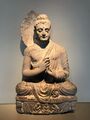 The Seated Buddha, dating from 300 to 500 CE, was found near Jamal Garhi, and is now on display at the Asian Art Museum in San Francisco
 -
 Road to Buddhist remains at Jamal Garhi.
 -
 Side view of the Buddhist remains.
 -
 The main (round) Stupa
 -
 The Monastery and Water Tank.
 -
 Jamal Garhi Buddhist ruins
 -
 Court of Votive Stupas.
 -
 Jamal Garhi Buddhist ruins.
 -
 Some of the Buddhist Ruins.


_Stupa_of_Jamal_Garhi-2.jpg)

.jpg)

.jpg)

Sculptural remains
-
 Stair friezes at Jamal Garhi.
 -
 Sculptures at Jamal Garhi.
 -
 Hunting scene.
 -
 Revelers.
 -
 The Buddha and nude Vajrapani.
 -
 Wedding scene.
 -
 Base of pillar, Indo-Corinthian capitals and elephants from base of stupa.
 -
 Series of Indo-Corinthian capitals from Jamal Garhi.
 -
 Indo-Corinthian capitals from Jamal Garhi.


See also
- Seated Buddha from Gandhara, which was also found at the site.[4]
- Ranigat a historical site in Buner near Swabi.
- Takht-i-Bahi
- The frieze of the Buddha and the nude Vajrapani at Jamal Garhi - [5]
References
- ↑ "Jamal Garhi". http://www.tourism.gov.pk/.
- ↑ Cunningham, Alexander (1875). Jamal Garhi, Archaeological Survey of India 5, Report for the year 1872-73. pp. 46-53. https://archive.org/details/archaeologicalsu05arch.
- ↑ British Museum Collection
- ↑ British Museum Collection
- ↑ Perera, Sathsara (2018). "The frieze of the Buddha and the nude Vajrapani at Jamal Garhi (Special focus on the mix of Hellenistic and Indian elements in the particular relief of the Buddhist Kushan art)". https://www.researchgate.net/publication/341323186.
Template:Gandhara Template:Archaeological sites around Mardan
 |


