Biology:Kumonga exleyi
From HandWiki
Short description: Species of crustacean
| Cape Range remipede | |
|---|---|
Critically Endangered (Biodiversity Conservation Act 2016 (WA))[1]
| |
Scientific classification 
| |
| Missing taxonomy template (fix): | Kumonga |
| Species: | Template:Taxonomy/KumongaK. exleyi
|
| Binomial name | |
| Template:Taxonomy/KumongaKumonga exleyi (Yager & Humphreys, 1996)[2]
| |
| Synonyms[2] | |
| |
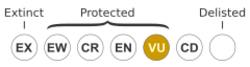
Kumonga exleyi, also known as the Cape Range remipede,[5] is a species of remipede in the monospecific genus Kumonga and the monotypic family Kumongidae.[2][3][4] It was described in 1996 from specimens collected during the years of 1993 to 1995,[1] and was originally assigned to the genus Lasionectes, but was moved to its own genus, Kumonga, in 2013.[2][6][7] It is listed as a vulnerable species under the Environment Protection and Biodiversity Conservation Act 1999 and as a critically endangered species under the Biodiversity Conservation Act 2016 (WA).[1]
It is named after Kumonga, a kaiju from the 1967 kaiju film Son of Godzilla[7] and the cave diver Sheck Exley.
References
- ↑ 1.0 1.1 1.2 1.3 "Kumonga exleyi — Cape Range Remipede" (in en). https://www.environment.gov.au/cgi-bin/sprat/public/publicspecies.pl?taxon_id=86875.
- ↑ 2.0 2.1 2.2 2.3 "Kumonga exleyi (Yager & Humphreys, 1996)". World Remipedia Database. World Register of Marine Species. 2026. http://www.marinespecies.org/aphia.php?p=taxdetails&id=740648.
- ↑ 3.0 3.1 "Kumonga Hoenemann, Neiber, Schram & Koenemann in Hoenemann, Neiber, Humphreys, Iliffe, Li, Schram & Koenemann, 2013". World Remipedia Database. World Register of Marine Species. 2026. http://www.marinespecies.org/aphia.php?p=taxdetails&id=740647.
- ↑ 4.0 4.1 "Kumongidae Hoenemann, Neiber, Schram & Koenemann in Hoenemann, Neiber, Humphreys, Iliffe, Li, Schram & Koenemann, 2013". World Remipedia Database. World Register of Marine Species. 2026. http://www.marinespecies.org/aphia.php?p=taxdetails&id=740646.
- ↑ Kearney, Stephen (11 February 2022). "National parks are not enough: We need landholders to protect threatened species on their property" (in en). phys.org. https://phys.org/news/2022-02-national-landholders-threatened-species-property-1.html.
- ↑ Yager, J.; Humphreys, W. F. (1 February 1996). "Lasionectes exleyi, sp, nov., the first remipede crustacean recorded from Australia and the Indian Ocean, with a key to the world species". Invertebrate Taxonomy 10 (1): 171–187. doi:10.1071/it9960171. ISSN 0818-0164.
- ↑ 7.0 7.1 Humphreys, William F.; Li, Difei; Neiber, Marco T.; Koenemann, Stefan; Iliffe, Thomas M.; Schram, Frederick R.; Hoenemann, Mario (1 January 2013). "Phylogenetic analysis and systematic revision of Remipedia (Nectiopoda) from Bayesian analysis of molecular data". Journal of Crustacean Biology 33 (5): 603–619. doi:10.1163/1937240x-00002179. ISSN 0278-0372. Bibcode: 2013JCBio..33..603H.
Wikidata ☰ {{{from}}} entry
 |  |


