Biology:Larix mastersiana
| Larix mastersiana | |
|---|---|
Scientific classification 
| |
| Kingdom: | Plantae |
| Clade: | Tracheophytes |
| Clade: | Gymnospermae |
| Division: | Pinophyta |
| Class: | Pinopsida |
| Order: | Pinales |
| Family: | Pinaceae |
| Genus: | Larix |
| Species: | L. mastersiana
|
| Binomial name | |
| Larix mastersiana Rehder & E.H.Wilson
| |
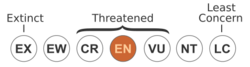
Larix mastersiana is a species of larch in the family Pinaceae. It is found only in western China in west-central Sichuan around Guanxian (now Dujiangyan City) west of the Min River, where it grows at 2,000–3,500 metres altitude. It is threatened by timber harvest and habitat loss. It is a deciduous coniferous tree growing to 20–25 metres tall, with yellow-brown bark on young trees, becoming grey on older trees. The leaves are 12–35 mm (mostly 20–30 mm) long. The cones are 2.5–4.5 cm long, with exserted bracts.[2]
Its status as a distinct species has recently been questioned, as it is genetically nested within the very similar Larix potaninii which occurs in the same area; it may be better treated as a synonym of that species, or a variety of it.[3]
References
- ↑ Thomas, P.; Zhang, D (2013). "Larix mastersiana". IUCN Red List of Threatened Species 2013. doi:10.2305/IUCN.UK.2013-1.RLTS.T31288A2803532.en. https://www.iucnredlist.org/species/31288/2803532. Retrieved 14 November 2021.
- ↑ Farjon, Aljos (1990). Pinaceae: drawings and descriptions of the genera Abies, Cedrus, Pseudolarix, Keteleeria, Nothotsuga, Tsuga, Cathaya, Pseudotsuga, Larix and Picea. Königstein Champaign: Koeltz scientific books. pp. 214–215. ISBN 3-87429-298-3.
- ↑ Qiu, Xiu-Fei; Liu, Yan-Yan; Wu, Ge; Xu, Cong-Hui; Liu, Xin-Quan; Xiang, Xiao-Yan; Wei, Xiao-Xin; Wang, Xiao-Quan (2025). "Phylogenomic analyses shed new light on the spatiotemporal evolution of global larches: Implications for the dynamics of boreal forests". Molecular Phylogenetics and Evolution 202. doi:10.1016/j.ympev.2024.108240. https://linkinghub.elsevier.com/retrieve/pii/S105579032400232X. Retrieved 2025-06-05.
External links
Wikidata ☰ Q148751 entry
 |  |


