Biology:Lindera obtusiloba
| Japanese spicebush | |
|---|---|

| |
Scientific classification 
| |
| Kingdom: | Plantae |
| Clade: | Tracheophytes |
| Clade: | Angiosperms |
| Clade: | Magnoliids |
| Order: | Laurales |
| Family: | Lauraceae |
| Genus: | Lindera |
| Species: | L. obtusiloba
|
| Binomial name | |
| Lindera obtusiloba | |
| Varieties[2] | |
| |
| Synonyms[2][3][4] | |
synonyms of var. heterophylla:
synonyms of var. obtusiloba:
| |

Lindera obtusiloba, the blunt-lobed spice bush,[5] is a species of flowering plant in the laurel family (Lauraceae). It is native to the Himalayas, northeastern India, Myanmar, China, Korea and Japan.[2] It is a spreading deciduous shrub or small tree growing to 6 m (20 ft) tall and wide, with glossy aromatic leaves and deep yellow flowers which appear in spring before the leaves.[5] Juvenile leaves are lobed (as the name suggests) and are deep purple. The leaves often turn yellow in autumn.
-
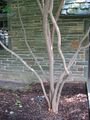 Closeup of trunks

The species was described by Carl Ludwig Blume in 1851. Two varieties are accepted.[2]
- Lindera obtusiloba var. heterophylla (Meisn.) H.P.Tsui – Bhutan, Tibet, northeastern India, Myanmar, China, Korea, and Japan[3]
- Lindera obtusiloba var. obtusiloba – Himalayas, northestern India, Myanmar, China, Korea, and Japan[4]
This plant has gained the Royal Horticultural Society's Award of Garden Merit.[6][7]
Uses
A Lindera obtusiloba water extract inhibited mast-cell-derived allergic inflammation in vitro and vivo, suggesting it may have possible uses in allergic diseases such as allergic rhinitis, asthma and atopic dermatitis.[8]
The plant contains the anti-histamine compound koaburaside and also a source of valuable obtusilic acid.
References
- ↑ Botanic Gardens Conservation International (BGCI).; IUCN SSC Global Tree Specialist Group. (2019). "Lindera obtusiloba" (in en). IUCN Red List of Threatened Species 2019. doi:10.2305/IUCN.UK.2019-1.RLTS.T136775422A136775424.en. https://www.iucnredlist.org/species/136775422/136775424. Retrieved 8 May 2026.
- ↑ 2.0 2.1 2.2 2.3 "Lindera obtusiloba Blume". Royal Botanic Gardens, Kew. https://powo.science.kew.org/taxon/urn:lsid:ipni.org:names:465417-1.
- ↑ 3.0 3.1 "Lindera obtusiloba var. heterophylla (Meisn.) H.P.Tsui". Royal Botanic Gardens, Kew. https://powo.science.kew.org/taxon/urn:lsid:ipni.org:names:921095-1.
- ↑ 4.0 4.1 "Lindera obtusiloba var. obtusiloba". Royal Botanic Gardens, Kew. https://powo.science.kew.org/taxon/urn:lsid:ipni.org:names:77223271-1.
- ↑ 5.0 5.1 RHS A-Z encyclopedia of garden plants. United Kingdom: Dorling Kindersley. 2008. p. 1136. ISBN 978-1-4053-3296-5.
- ↑ "RHS Plant Selector - Lindera obtusiloba". http://apps.rhs.org.uk/plantselector/plant?plantid=3388.
- ↑ "AGM Plants - Ornamental". Royal Horticultural Society. July 2017. p. 60. https://www.rhs.org.uk/plants/pdfs/agm-lists/agm-ornamentals.pdf.
- ↑ Suh WM, Park SB, Lee S, Kim HH, Suk K, Son JH, Kwon TK, Choi HG, Lee SH, Kim SH.,"Suppression of mast-cell-mediated allergic inflammation by Lindera obtusiloba." Exp Biol Med (Maywood). 2011 Feb;236(2):240-6
External links
- Dong Wook Lim; Mi-Sook Lee; Song Her; Suengmok Cho; Chang-Ho Lee; In-Ho Kim; Daeseok Han (2016). "Antidepressant-like effects of Lindera obtusiloba extracts on the immobility behavior of rats in the forced swim test". Molecules 21 (3): 277. doi:10.3390/molecules21030277. PMID 26927055.
Wikidata ☰ Q909285 entry
 |  |


