Biology:Lithocarpus hatusimae
| Lithocarpus hatusimae | |
|---|---|
Scientific classification 
| |
| Kingdom: | Plantae |
| Clade: | Tracheophytes |
| Clade: | Angiosperms |
| Clade: | Eudicots |
| Clade: | Rosids |
| Order: | Fagales |
| Family: | Fagaceae |
| Genus: | Lithocarpus |
| Species: | L. hatusimae
|
| Binomial name | |
| Lithocarpus hatusimae Soepadmo[2]
| |
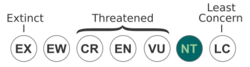
Lithocarpus hatusimae is a tree in the family Fagaceae. It is endemic to western Borneo.
Description
Lithocarpus hatusimae grows as a tree up to 20 metres (70 ft) tall with a trunk diameter of up to 35 cm (10 in). The greyish brown bark is smooth or fissured. Its coriaceous leaves measure up to 18 cm (7 in) long. The dark brown acorns are ovoid to conical and measure up to 2.2 cm (1 in) across.[3]
Taxonomy
Lithocarpus hatusimae was first described by Engkik Soepadmo in Reinwardtia in 1970.[2] The type specimen was collected on Mount Kinabalu, in Sabah. The species is named for the Japanese botanist Sumihiko Hatusima.[3]
Distribution and habitat
Lithocarpus hatusimae is endemic to Borneo.[2][3] Its habitat is mixed dipterocarp (including kerangas) to montane forests from 800 m (3,000 ft) to 2,200 m (7,000 ft) elevation.[3]
Conservation
Lithocarpus hatusimae has been assessed as near threatened on the IUCN Red List. It is threatened by logging and by conversion of land for farming and urban development. However the species is in a number of protected areas in Sarawak and Sabah.[1]
References
- ↑ 1.0 1.1 Strijk, J.S.; Julia, S.; Khoo, E. (2025). "Lithocarpus hatusimae" (in en). IUCN Red List of Threatened Species 2025. doi:10.2305/IUCN.UK.2025-2.RLTS.T138595670A225150396.en. https://www.iucnredlist.org/species/138595670/225150396. Retrieved 11 April 2026.
- ↑ 2.0 2.1 2.2 "Lithocarpus hatusimae Soepadmo". Royal Botanic Gardens, Kew. https://powo.science.kew.org/taxon/urn:lsid:ipni.org:names:358785-1.
- ↑ 3.0 3.1 3.2 3.3 Soepadmo, E.; Julia, L.; Go, Rusea (2000). "Lithocarpus hatusimae (Seemen) A.Camus". in Soepadmo, E.; Saw, L. G.. Tree Flora of Sabah and Sarawak. 3. Forest Research Institute Malaysia. pp. 61. ISBN 983-2181-06-2. http://www.chm.frim.gov.my/backup/TFSSvol1_3.pdf. Retrieved 22 March 2018.
Wikidata ☰ Q15317738 entry
 |  |


