Biology:Lysimachia nummularia
| Lysimachia nummularia | |
|---|---|

| |

| |
Scientific classification 
| |
| Kingdom: | Plantae |
| Clade: | Tracheophytes |
| Clade: | Angiosperms |
| Clade: | Eudicots |
| Clade: | Asterids |
| Order: | Ericales |
| Family: | Primulaceae |
| Genus: | Lysimachia |
| Species: | L. nummularia
|
| Binomial name | |
| Lysimachia nummularia | |
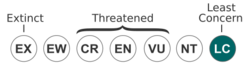
Lysimachia nummularia is a species of flowering plant in the primrose family Primulaceae. Its common names include moneywort, creeping jenny,[lower-alpha 1] herb twopence and twopenny grass.[2]
Description
It is a vigorous, prostrate, evergreen perennial growing to 5 cm (2 in) in height and spreading rapidly and indefinitely by stem-rooting. It has rounded leaves arranged in opposite pairs, and cup-shaped yellow flowers 2 cm in diameter, in summer. It is particularly associated with damp or even wet areas, though in cultivation it will tolerate drier conditions.[3] It is hardy, surviving lows of −15 °C (5 °F) (RHS H5).[2]
Distribution
It is native to Europe, but has been introduced to North America, where it is considered an invasive species in some areas.[4] It aggressively spreads in favorable conditions, such as low wet ground or near ponds. It can be weeded by hand, if all stems and stem fragments are removed, to prevent the stems from rooting and regrowing.[4]
Etymology
The Latin specific epithet nummularia means "like a coin",[5] referring to the shape of the leaves; hence the common names, such as "moneywort", which also references coins.
Cultivation
The cultivar 'Aurea' (golden creeping Jenny) has yellow leaves, and is somewhat less aggressive than the undomesticated species. It is cultivated as an ornamental plant, for groundcover where the range of its growth can be limited. It is also suitable as a bog garden or aquatic marginal plant.[6] It has gained the Royal Horticultural Society's Award of Garden Merit.[7]
Chemistry
The plant contains a number of phenolic acids.[8]
Notes
- ↑ This name also sometimes refers to Lysimachia congestiflora.
References
- ↑ Lansdown, R.V. (2014). "Creeping-Jenny, Lysimachia nummularia". IUCN Red List of Threatened Species 2014. doi:10.2305/IUCN.UK.2014-1.RLTS.T167913A42403938.en. https://www.iucnredlist.org/species/167913/42403938. Retrieved 15 February 2022.
- ↑ 2.0 2.1 "Lysimachia nummularia". RHS. https://www.rhs.org.uk/Plants/10632/Lysimachia-nummularia/Details.
- ↑ RHS A-Z encyclopedia of garden plants. United Kingdom: Dorling Kindersley. 2008. pp. 1136. ISBN 978-1-4053-3296-5.
- ↑ 4.0 4.1 "Weed of the Week: Moneywort". https://www.invasive.org/weedcd/pdfs/wow/monewart.pdf.
- ↑ Harrison, Lorraine (2012). RHS Latin for gardeners. United Kingdom: Mitchell Beazley. pp. 224. ISBN 978-1-84533-731-5.
- ↑ "Lysimachia nummularia 'Aurea'". Missouri Botanical Garden. http://www.missouribotanicalgarden.org/PlantFinder/PlantFinderDetails.aspx?kempercode=t120.
- ↑ "Lysimachia nummularia 'Aurea'". RHS. https://www.rhs.org.uk/Plants/47321/Lysimachia-nummularia-Aurea/Details.
- ↑ Luczak, S; Swiatek, L; Daniewski, M (1989). "Phenolic acids in herbs Lysimachia nummularia L. And L. Vulgaris L". Acta Poloniae Pharmaceutica 46 (4): 381–5. PMID 2635807.
External links
Wikidata ☰ Q147305 entry
 |  |


