Biology:Magnolia champaca
| Magnolia champaca | |
|---|---|

| |
Scientific classification 
| |
| Kingdom: | Plantae |
| Clade: | Tracheophytes |
| Clade: | Angiosperms |
| Clade: | Magnoliids |
| Order: | Magnoliales |
| Family: | Magnoliaceae |
| Genus: | Magnolia |
| Subgenus: | Magnolia subg. Yulania |
| Section: | Magnolia sect. Michelia |
| Subsection: | Magnolia subsect. Michelia |
| Species: | M. champaca
|
| Binomial name | |
| Magnolia champaca | |
| Varieties[2] | |
| |
| Synonyms[2] | |
|
List
| |

Magnolia champaca, known in English as champak (/ˈtʃʌmpək/),[3] is a large evergreen tree in the family Magnoliaceae.[4] It was previously classified as Michelia champaca.[4][5] It is known for its fragrant flowers, and its timber used in woodworking.
Description
In its native range Magnolia champaca grows to 50 metres (160 ft) or taller. Its trunk can be up to 1.9 metres (6.2 ft) in diameter. The tree has a narrow umbelliform crown.[4]
It has strongly fragrant flowers in varying shades of cream to yellow-orange which bloom during June to September.[4] The obovoid-ellipsoid carpels produce 2−4 seeds during September to October.[4]
-
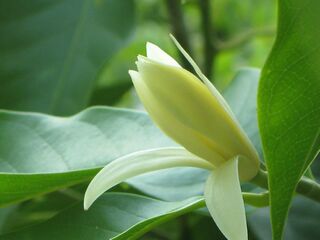 White champak flower
 -
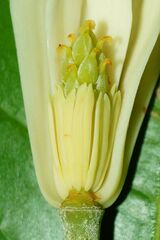 Base of champak flower
 -
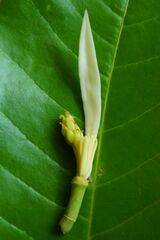 Single champak petal


Taxonomy
Etymology
The species epithet, champaca, comes from the Sanskrit word "चम्पक" campaka (sa).[6]
Varieties and hybrids

Magnolia champaca varieties and hybrids include:
- Magnolia (Michelia) champaca var. champaca — Huang lan (yuan bian zhong), (黄兰(原变种)) in Chinese. To 30 metres (98 ft) tall, documented in China.[7]
- Magnolia (Michelia) champaca var. pubinervia — Mao ye mai huang lan (毛叶脉黄兰) in Chinese. To 50 metres (160 ft) tall or taller, documented in China.[8]
- Magnolia × alba — white-flowered hybrid of Magnolia champaca and Magnolia montana.[5]
Distribution and habitat
The tree is native to the Indomalayan realm, consisting of South Asia, Southeast Asia−Indochina, and southern China.[9]
It is found in tropical and subtropical moist broadleaf forests ecoregions, at elevations of 200–1,600 metres (660–5,250 ft).[4] It is native to the Maldives, Bangladesh, Cambodia, China, India, Indonesia, Malaysia, Myanmar, Nepal, the Philippines, Thailand, and Vietnam.[4] In China it is native to southern Tibet and southern/southwestern Yunnan Provinces.[4][10] In 2021, an isolated, presumably native population of M. champaca was identified in Yemen, making M. champaca the only species in the Magnoliaceae known to inhabit the Arabian Peninsula.[11]
Ecology
The fragrant flowers attract butterflies and hummingbirds.[12] Its aril-covered seeds are highly attractive to birds.[13]
Uses
Fragrance
The flowers are used in South Asia, especially India, for several purposes. They are primarily used in worship ceremonies, whether at home or out in temples, they are also more generally worn in hair by girls and women as a means of beauty ornament as well as a natural perfume. Flowers are floated in bowls of water to scent the room, as a fragrant and colourful decoration for bridal beds, and for garlands.[14]
The tree was traditionally used to make fragrant hair and massage oils. Jean Patou's famous perfume, 'Joy', the second best selling perfume in the world after Chanel No. 5, is derived in part from the essential oils of champaca flowers. The vernacular name "Joy perfume tree" comes from this.[5]
A scent similar to the scent of this plant is said to be emitted by a civet in Sri Lanka, Paradoxurus montanus. Because all the other civets are known to emit very unpleasant odours, this species is renowned for emitting a pleasant odour similar to this plant's scent.[15]
Timber

In its native India and Southeast Asia, champaca is logged for its valuable timber.[5] It has a finely textured, dark brown and olive-colored wood, which is used in furniture making, construction, and cabinetry.[5]
The species is protected from logging in some states of India, especially in the Southwestern region, where certain groves are considered sacred by Hindus and Buddhists.[5]
Cultivation
Alkaloids
Ushinsunine (aka Micheline A) [3175-89-1] is an aporphine alkaloid contained in Magnolia champaca.[16]
Cultural significance


In Theravada Buddhism, champaca is said to have been used as the tree for achieving enlightenment, or Bodhi, by the fourteenth Buddha called "Aththadassi – අත්ථදස්සි". According to Tibetan beliefs, the Buddha of the next era will find enlightenment under the white flower canopy of the champaca tree.[12] It also has importance in Hindu culture. In the province of Aceh, Indonesia, the champak flower (Acehnese: bungong jeumpa) is highly revered in Acehnese culture, being seen as the flower of Aceh as a whole.[17][18] It's used as a symbol of beauty,[19] commonly seen in rituals or used as ornaments.[18][20][21] An Acehnese folk song titled Bungong Jeumpa (lit. Champak Flower) sings about its beauty and characteristics.
Common names
Other vernacular names in English include joy perfume tree,[5] yellow jade orchid tree and fragrant Himalayan champaca.[22][12]
References
- ↑ Khela, S. (2014). "Magnolia champaca". IUCN Red List of Threatened Species 2014. doi:10.2305/IUCN.UK.2014-3.RLTS.T191869A15267603.en. https://www.iucnredlist.org/species/191869/15267603. Retrieved 19 November 2021.
- ↑ 2.0 2.1 2.2 "Magnolia champaca (L.) Baill. ex Pierre". Royal Botanical Gardens, Kew. 2023. https://powo.science.kew.org/taxon/urn:lsid:ipni.org:names:554657-1.
- ↑ CHAMPAK (3rd ed.), Oxford University Press, September 2005, http://oed.com/search?searchType=dictionary&q=CHAMPAK (Subscription or UK public library membership required.)
- ↑ 4.0 4.1 4.2 4.3 4.4 4.5 4.6 4.7 "Michelia champaca Linnaeus". eFloras. n.d.. http://www.efloras.org/florataxon.aspx?flora_id=2&taxon_id=200008479.
- ↑ 5.0 5.1 5.2 5.3 5.4 5.5 5.6 Pacific Horticulture Society: "Striving for Diversity: Fragrant Champaca" . accessed 7.12.2015
- ↑ Monier-Williams, Monier (1981). "चम्प campa". चम्प campa. Delhi, Varanasi, Patna: Motilal Banarsidass. p. 388. https://www.sanskrit-lexicon.uni-koeln.de/scans/csl-apidev/servepdf.php?dict=MW&page=388.
- ↑ efloras.org: Flora of China treatment of Michelia (Magnolia) champaca var. champaca
- ↑ "Flora of China FOC Vol. 7 pg 51, 80. — Michelia (Magnolia) champaca var. pubinervia". http://www.efloras.org/florataxon.aspx?flora_id=2&taxon_id=242332307.
- ↑ {{citation | mode = cs1 | title = Magnolia champaca | work = Germplasm Resources Information Network (GRIN) | url = | publisher = [[Organization:Agricultural Research ServAgricultural Research Service (ARS), United States Department of Agriculture (USDA) | access-date = 15 December 2017 }}
- ↑ efloras.org: Annotated Checklist of the Flowering Plants of Nepal − Michelia (Magnolia) champaca
- ↑ Al-Sagheer, Nageeb A. (2021-05-01). "Magnolia champaca (L.) Baill. ex Pierre (Magnoliaceae): A first report and a new record in the Arabian Peninsula (Yemen)" (in en). Journal of the Saudi Society of Agricultural Sciences 20 (4): 243–247. doi:10.1016/j.jssas.2021.02.003. ISSN 1658-077X.
- ↑ 12.0 12.1 12.2 "Fragrant Himalayan Champaca". Monrovia Nurseries. http://www.monrovia.com/plant-catalog/plants/1850/fragrant-himalayan-champaca/.
- ↑ FRISCH, J.D. & FRISCH, C.D. - Aves Brasileiras e Plantas que as atraem, São Paulo, Dalgas Ecotec, 3rd. edition, 2005, ISBN 85-85015-07-1, page 374
- ↑ Minter, Sue (2005). "Fragrant Plants". The Cultural History of Plants. London, England, UK: Routledge. p. 242. ISBN 978-0-415-92746-8. https://books.google.com/books?id=8ejo63Wk5rgC.
- ↑ "Sri Lankan Brown Palm Civets (Paradoxurus montanus): Non-Ringtails of Sri Lanka". http://wizzley.com/sri-lankan-brown-palm-civets-paradoxurus-montanus-non-ringtails-of-sri-lanka/.
- ↑ "Studies on the Alkaloids of Magnoliaceous Plants. XXXVI: Alkaloids of Michelia champaca LINN". Yakugaku Zasshi 83 (2): 216–218. 1963. doi:10.1248/yakushi1947.83.2_216.
- ↑ Redaksi (2022-12-26). "Bungong Jeumpa dalam Budaya Aceh" (in id). https://leughok.com/bungong-jeumpa-aceh/.
- ↑ 18.0 18.1 Serambi, Wahana News (2021-11-26). "Cempaka Kuning Flora Khas dari Provinsi Aceh" (in id). https://serambi.wahananews.co/khas/cempaka-kuning-flora-khas-dari-provinsi-aceh/1.
- ↑ Lissafrina (28 June 2024). "Mengenal Bungong Jeumpa yang Jadi Kebanggaan Masyarakat Aceh". https://rri.co.id/daerah/786512/mengenal-bungong-jeumpa-yang-jadi-kebanggaan-masyarakat-aceh.
- ↑ "Tari Bungong Jeumpa: Asal-usul, Makna, Lirik, dan Gerakan". 2 September 2023. https://www.cnnindonesia.com/edukasi/20230824143207-569-990018/tari-bungong-jeumpa-asal-usul-makna-lirik-dan-gerakan.
- ↑ LindungiHutan, Magang Alam (2023-07-31). "Bunga Cempaka: Tanaman Hijau Abadi Khas Aceh" (in en-US). https://lindungihutan.com/blog/mengenal-bunga-cempaka/.
- ↑ "PlantFiles". http://davesgarden.com/guides/pf/go/53529/.
Further reading
- Fernando, M. Thilina R., et al. "Identifying dormancy class and storage behaviour of champak (Magnolia champaca) seeds, an important tropical timber tree." Journal of the National Science Foundation of Sri Lanka 41.2 (2013): 141–146.
External links
Wikidata ☰ Q167027 entry
 |  |


