Biology:Malus angustifolia
| Malus angustifolia | |
|---|---|
| File:Malus angustifolia in October.jpg | |
| Malus angustifolia (southern crabapple) in October | |
Scientific classification 
| |
| Kingdom: | Plantae |
| Clade: | Tracheophytes |
| Clade: | Angiosperms |
| Clade: | Eudicots |
| Clade: | Rosids |
| Order: | Rosales |
| Family: | Rosaceae |
| Genus: | Malus |
| Species: | M. angustifolia
|
| Binomial name | |
| Malus angustifolia (Aiton) Michx. 1803 not Rehder 1940
| |

| |
| Natural range | |
| Synonyms[2] | |
| |
Malus angustifolia, or southern crabapple,[3] is a species of crabapple native to the eastern and south-central United States.
Description
M. angustifolia is a tree sometimes attaining a height of 10 meters (33 feet). The trunk can have a diameter up to 25 centimeters (10 inches). The flowers are pink, with a pleasant scent. The fruits are up to 3 cm (1 1⁄4 in) in diameter, and have an aromatic scent and a pear-like shape;[4][5] yellow-green in color, with some red when ripe.[6]
Taxonomy
The following two varieties are known:[2]
- Malus angustifolia var. angustifolia
- Malus angustifolia var. puberula (Rehder) Rehder
Distribution and habitat
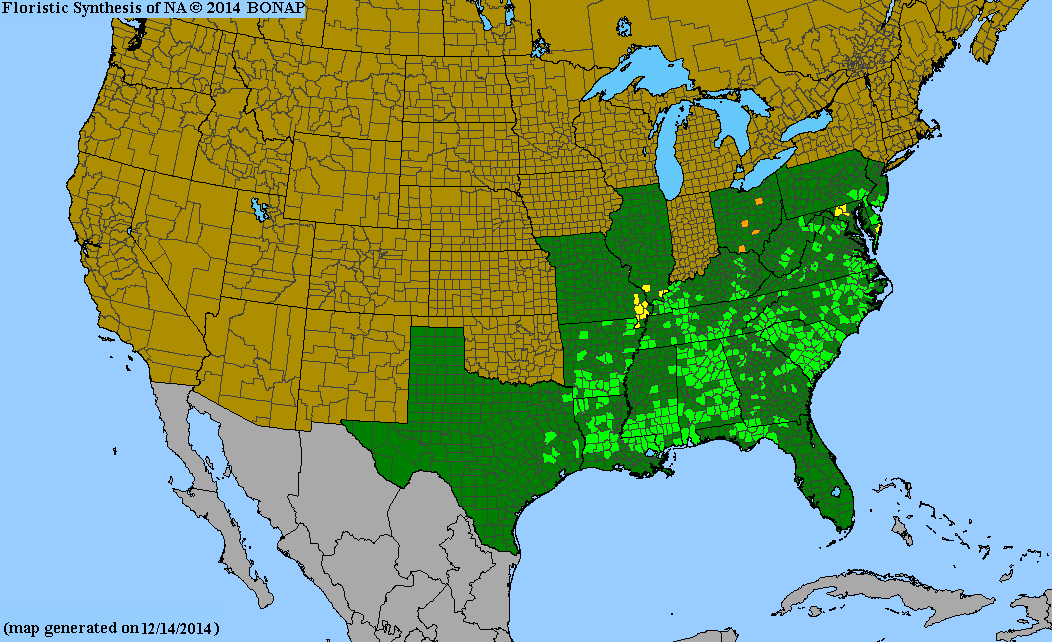
The species can be found from Florida west to eastern Texas and north to New Jersey, Pennsylvania, Illinois and Missouri.[7]
M. angustifolia prefers habitats that are moist but well-drained. For inflorescence to occur, full sunlight is required.[8] The species has been observed in habitat types such as dry hammocks, xeric flatwoods, mesic woodlands, floodplains, and pine woods.[9][10]
Ecology
The fruits are eaten by various wildlife.[11]
Uses
Although the fruits are astringent, acidic, and unpalatable when raw, they can be used to make jellies, jams, and food preserves.[4][5]
The tree is grown as an ornamental plant.[12]
References
- ↑ IUCN SSC Global Tree Specialist Group.; Botanic Gardens Conservation International (2020). "Malus angustifolia". IUCN Red List of Threatened Species 2020. doi:10.2305/IUCN.UK.2020-1.RLTS.T64134490A152906529.en. https://www.iucnredlist.org/species/64134490/152906529. Retrieved 19 November 2021.
- ↑ 2.0 2.1 The Plant List, Malus angustifolia (Aiton) Michx.
- ↑ "Search results for: Malus". http://hortiplex.gardenweb.com/plants/nph-ind.cgi?name=Malus&f=d&gl=1&p=1.
- ↑ 4.0 4.1 Flora of North America, Malus angustifolia (Aiton) Michaux, 1803. Southern or narrow-leaved crabapple
- ↑ 5.0 5.1 Malus angustifolia at Plants for a Future
- ↑ "Virginia Tech Dendrology Fact Sheet". https://dendro.cnre.vt.edu/dendrology/syllabus/factsheet.cfm?ID=1142.
- ↑ Biota of North America Program, 2014 county distribution map
- ↑ "USDA Plants Database". https://plants.usda.gov/plant-profile/MAAN3.
- ↑ Weakley, A.S. 2020. Flora of the Southeastern United States. Edition of 20 October 2020. University of North Carolina at Chapel Hill, Chapel Hill, North Carolina.
- ↑ Florida State University Robert K. Godfrey Herbarium database. URL: http://herbarium.bio.fsu.edu. Last accessed: June 2018. Collectors: Loran C. Anderson, R.K. Godfrey, Patricia Elliot, John C. Ogden, R L Lazor, L R Fox, K Craddock Burks, Gary R Knight, R A Norris, M R Darst, R Komarek, H Roth, M Jenkins, Elmar C Prichard. States and counties: Florida (Wakulla, Leon, Gadsden, Jefferson, Liberty, Washington), Georgia (Thomas, Grady), North Carolina (Cumberland).
- ↑ Little, Elbert L. (1980). The Audubon Society Field Guide to North American Trees: Eastern Region. New York: Knopf. p. 489. ISBN 0-394-50760-6.
- ↑ "Southern crabapple" (in en-US). Florida Wildflower Foundation. March 17, 2017. https://www.flawildflowers.org/flower-friday-malus-angustifolia/.
External links
- Carolina Nature
- Lady Bird Johnson Wildflower Center, University of Texas
- Louisiana Plant Identification
- Leafsnap.com: Images of the Southern Crabapple (Malus angustifolia)
Template:Crabapple Wikidata ☰ Q4535958 entry
 |  |