Biology:Mesagrion leucorrhinum
| Mesagrion leucorrhinum | |
|---|---|

| |
Scientific classification 
| |
| Kingdom: | Animalia |
| Phylum: | Arthropoda |
| Class: | Insecta |
| Order: | Odonata |
| Suborder: | Zygoptera |
| Superfamily: | Calopterygoidea Kalkman & Sanchez-Herrera, 2021[3] |
| Genus: | Mesagrion Selys, 1885[2] |
| Species: | M. leucorrhinum
|
| Binomial name | |
| Mesagrion leucorrhinum Selys, 1885[2]
| |
Mesagrion leucorrhinum is a species of damselfly endemic to the Andes of central Colombia. It is the sole species in the genus Mesagrion, which in turn is the only genus in the family Mesagrionidae.[3][4]
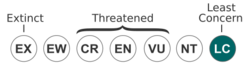
Mesagrion leucorrhinum inhabits small waterfalls and forest streams in subtropical and tropical montane forests.[1][3] Adults are medium-sized damselflies with clear wings, a black body marked with yellow, and a largely red abdomen.[3] The species is assessed as being of least concern on the IUCN Red List.[1]
The genus was described by Selys in 1885 and was traditionally placed within the broad family Megapodagrionidae.[2] A phylogenomic study of damselfly relationships published in 2021 found it to represent a distinct evolutionary lineage, leading Kalkman and Sanchez-Herrera to establish the family Mesagrionidae.[3]
Mesagrionidae remains one of the smallest damselfly families, containing a single genus and species.[4]
Taxonomic history
Mesagrion was described by Selys in 1885 for the species Mesagrion leucorrhinum.[2] For much of its history the genus was placed within Megapodagrionidae, usually among the flatwing damselflies of the subfamily Argiolestinae.[5] Molecular studies later showed that it represents a distinct lineage. As a result, Kalkman and Sanchez-Herrera established the monotypic family Mesagrionidae in 2021.[3]
References
- ↑ 1.0 1.1 1.2 Bota-Sierra, C.; Palacino, F.; Rache, L.; Ellenrieder, N.; Paulson, D. (2016). "Mesagrion leucorrhinum". IUCN Red List of Threatened Species 2016. doi:10.2305/IUCN.UK.2016-1.RLTS.T60294A66887433.en. https://www.iucnredlist.org/species/60294/66887433.
- ↑ 2.0 2.1 2.2 2.3 Sélys-Longchamps, Edmond (1885). "Programme d'une révision des Agrionines". Comptes-rendus des séances de la Société entomologique de Belgique: 141–145 [144]. https://www.biodiversitylibrary.org/page/61456969.
- ↑ 3.0 3.1 3.2 3.3 3.4 3.5 Bybee, S. M.; Kalkman, V. J.; Erickson, R. J.; Frandsen, P. B.; Breinholt, J. W.; Suvorov, A.; Ware, J. L. (2021). "Phylogeny and classification of Odonata using targeted genomics". Molecular Phylogenetics and Evolution 160: 1–15. doi:10.1016/j.ympev.2021.107115. PMID 33609713. Bibcode: 2021MolPE.16007115B.
- ↑ 4.0 4.1 "World Odonata List". University of Puget Sound. https://www.pugetsound.edu/academics/academic-resources/slater-museum/biodiversity-resources/dragonflies/world-odonata-list2/.
- ↑ Bridges, Charles A. (1994). Catalogue of the family-group, genus-group and species-group names of the Odonata of the world (3rd ed.). Urbana, Illinois: Charles A. Bridges. p. II.1. doi:10.5962/bhl.title.15291. https://www.biodiversitylibrary.org/page/15106020.
Template:Odonata Wikidata ☰ {{{from}}} entry
 |  |


