Biology:Mespilus canescens
| Mespilus canescens | |
|---|---|

| |
Scientific classification 
| |
| Kingdom: | Plantae |
| Clade: | Tracheophytes |
| Clade: | Angiosperms |
| Clade: | Eudicots |
| Clade: | Rosids |
| Order: | Rosales |
| Family: | Rosaceae |
| Genus: | Mespilus |
| Species: | M. canescens
|
| Binomial name | |
| Mespilus canescens J.B.Phipps
| |
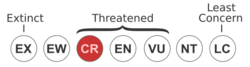
Mespilus canescens, commonly known as Stern's medlar,[2] is a large shrub or small tree, recently discovered in Prairie County, Arkansas, United States, and formally named in 1990. It is a critically endangered endemic species, with only 25 plants known, all in one small (9 ha) wood, now protected as the Konecny Grove Natural Area.[3]
Originally discovered by Jane Stern (hence "Stern's medlar") in 1968–69, the plant was difficult to identify, and at times placed in the genus Crataegus, and even Aronia. J.B. Phipps first described it as belonging to the genus Mespilus in 1990.[4]
It has been shown by genetic analysis to be closely related to the common medlar Mespilus germanica, which was previously the only known species in the genus. Subsequent molecular analyses suggest that Stern's medlar is likely a hybrid between cultivated M. germanica and one or two native North American species of Crataegus, in which case it should be referred to as × Crataemespilus canescens.[5]
Description
Thorns are sparse, 2–3 cm (0.8–1.2 in) long.[6] The leaves are 2–4 cm (0.8–1.6 in) long.[6] The five-petalled white flowers are produced in late spring. The fruit is an almost spherical pome, 8–12 mm (0.3–0.5 in) diameter; it differs from common medlar fruit in being deep glossy red when ripe (not brown).[6]
Uses
While Stern's medlar has been noted for its great horticultural potential,[7][8][9] the plant is cultivated mainly for botanical purposes.[10][11]
See also
- Flora of Arkansas
References
- ↑ Treher, A. (2023). "Crataegus x canescens". IUCN Red List of Threatened Species 2023. doi:10.2305/IUCN.UK.2023-1.RLTS.T200290940A200291542.en. https://www.iucnredlist.org/species/200290940/200291542. Retrieved 31 May 2024.
- ↑ "Stern's Medlar" (in en-US). https://encyclopediaofarkansas.net/entries/sterns-medlar-6875/.
- ↑ "Konecny Grove Natural Area" (in en). Division of Arkansas Heritage. https://www.arkansasheritage.com/arkansas-natural-heritage/naturalareas/find-a-natural-area/konecny-grove-natural-area. "The natural area protects the only known population of the rare Stern's medlar."
- ↑ Enzenbacher, Tiffany (2019). "A Medlar by Any Other Name". Arnoldia 77 (1): 16–25. doi:10.5962/p.333368. https://arboretum.harvard.edu/wp-content/uploads/2020/06/2019-77-1-Arnoldia.pdf.
- ↑ Lo, E.Y.Y., Stefanovic, S., Dickinson, T.A., 2007. Molecular reappraisal of relationships between Crataegus and Mespilus (Rosaceae, Pyreae) – two genera or one? Systematic Botany 32: 596–616.
- ↑ 6.0 6.1 6.2 Phipps, J.B. 1990. Mespilus canescens, a new rosaceous endemic from Arkansas. Systematic Botany 15: 26-32.
- ↑ "Mespilus in Flora of North America @ efloras.org". http://www.efloras.org/florataxon.aspx?flora_id=1&taxon_id=120360.
- ↑ Sutton, Julian (2023). "× Crataemespilus canescens". International Dendrology Society. https://www.treesandshrubsonline.org/articles/xcrataemespilus/x-crataemespilus-canescens/.
- ↑ Phipps, J.B.; O'Kennon, R.J.; Lance, R.W. (2003) (in en). Hawthorns and Medlars. Royal Horticultural Society Plant Collector Guides. Portland, Oregon: Royal Horticultural Society/Timber Press. pp. 104–107.
- ↑ "Plant of the Week: xCrataemespilus canescens: Stern's Medlar". Arkansas Cooperative Extension Service. https://www.uaex.uada.edu/yard-garden/resource-library/plant-week/Crataemespilus-canescens-Sterns-Medlar-09-20-2019.aspx.
- ↑ "Mespilus canescens - Plant Finder". https://www.missouribotanicalgarden.org/PlantFinder/PlantFinderDetails.aspx?taxonid=291667.
Further reading
- Enzenbacher, T. 2019. A Medlar by Any Other Name. Arnoldia, 77(1): 16–25.
- Phipps, J.B., Weeden, N.F., & Dickson, E.E. 1991. Isozyme evidence for the naturalness of Mespilus L. (Rosaceae, subfam. Maldoideae). Systematic Botany 16: 546-552.
External links
- Center for Plant Conservation: Mespilus canescens
- × Crataemespilus canescens – Trees and Shrubs Online
Wikidata ☰ Q151069 entry
 |  |


