Biology:Metallic ringtail
| Metallic ringtail | |
|---|---|

| |
| Male | |

| |
| Female | |
Scientific classification 
| |
| Kingdom: | Animalia |
| Phylum: | Arthropoda |
| Class: | Insecta |
| Order: | Odonata |
| Suborder: | Zygoptera |
| Family: | Lestidae |
| Genus: | Austrolestes |
| Species: | A. cingulatus
|
| Binomial name | |
| Austrolestes cingulatus (Burmeister, 1839)[2]
| |

| |
| Synonyms[3] | |
| |
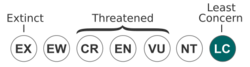
The metallic ringtail (Austrolestes cingulatus) is an Australian damselfly in the family Lestidae,[4][5] It is widely distributed in Tasmania, Victoria and eastern New South Wales.[6] It is a thin, medium-sized damselfly with a green and gold or bluish green and gold coloration. Each abdominal segment is marked by a pale "ring"; this, combined with its glossy metallic coloration, give it its common name of metallic ringtail.
It is active through October to March in still-water bodies such as rivers, lakes, ponds, swamps, and alpine bogs, being usually found amongst vegetation.
Etymology
The genus name Austrolestes combines the prefix austro- (from Latin auster, meaning “south wind”, hence “southern”) with Lestes, a genus name derived from Greek λῃστής (lēstēs, “robber”).[7]
The species name cingulatus is derived from the Latin cingulum ("girdle" or "sword-belt") and the suffix -atus ("provided with"), referring to rings at the bases of the abdominal segments.[8]
Gallery
-
 Mating pair
-
 Female wings
-
 Male wings


See also
- List of Odonata species of Australia
References
- ↑ Dow, R.A. (2017). "Austrolestes cingulatus". IUCN Red List of Threatened Species 2017. doi:10.2305/IUCN.UK.2017-1.RLTS.T87534172A87539929.en. https://www.iucnredlist.org/species/87534172/87539929. Retrieved 20 November 2021.
- ↑ Burmeister, Hermann (1839) (in la, de). Handbuch der Entomologie. Berlin: T.C.F. Enslin. pp. 805–862 [823]. https://www.biodiversitylibrary.org/page/8223183.
- ↑ "World Odonata List". University of Puget Sound. https://www.pugetsound.edu/academics/academic-resources/slater-museum/biodiversity-resources/dragonflies/world-odonata-list2/.
- ↑ "Species Austrolestes cingulatus (Burmeister, 1839)". Australian Biological Resources Study. 2012. https://biodiversity.org.au/afd/taxa/Austrolestes_cingulatus.
- ↑ Theischinger, Günther; Hawking, John (2006). The Complete Field Guide to Dragonflies of Australia. Collingwood, Victoria, Australia: CSIRO Publishing. p. 34. ISBN 978-0-64309-073-6.
- ↑ Theischinger, Gunther; Endersby, Ian (2009). Identification Guide to the Australian Odonata. Department of Environment, Climate Change and Water NSW. p. 205. ISBN 978-1-74232-475-3. http://www.environment.nsw.gov.au/resources/publications/09730AustOdonata.pdf.
- ↑ Endersby, Ian (2012). "Etymology of the Dragonflies (Insecta: Odonata) named by R.J. Tillyard, F.R.S.". Proceedings of the Linnean Society of New South Wales 134: 1-16. https://openjournals.library.sydney.edu.au/LIN/article/view/5941.
- ↑ Endersby, Ian; Fliedner, Heinrich (2015). The Naming of Australia's Dragonflies. Eltham, Victoria, Australia: Busybird Publishing. ISBN 9781925260625. https://www.researchgate.net/publication/283318421_The_Naming_of_Australia's_Dragonflies.
 |
Wikispecies has information related to Austrolestes cingulatus |
Wikidata ☰ Q1908497 entry
 |  |


