Biology:Mimosa quadrivalvis
| Mimosa quadrivalvis | |
|---|---|

| |
Scientific classification 
| |
| Kingdom: | Plantae |
| Clade: | Tracheophytes |
| Clade: | Angiosperms |
| Clade: | Eudicots |
| Clade: | Rosids |
| Order: | Fabales |
| Family: | Fabaceae |
| Subfamily: | Caesalpinioideae |
| Clade: | Mimosoid clade |
| Genus: | Mimosa |
| Species: | M. quadrivalvis
|
| Binomial name | |
| Mimosa quadrivalvis L.
| |
| Varieties[1] | |
| |
| Synonyms[1] | |
|
List
| |
Mimosa quadrivalvis, known as fourvalve mimosa, sensitive briar and cat's claw, is a trailing vine native to North America, Central America, and the Caribbean.[1][2][3] It is known as sensitive briar because the leaves fold when they are touched or disturbed.[4]
Description
It is a sprawling, herbaceous plant with alternate leaves. Each leaf is compound with up to 16 pairs of leaflets that fold together when touched. The stem is covered with small recurved prickles. The flowerheads comprise round clusters of numerous pink flowers, each flower only 3 mm (0.12 in) long with exserted stamens. The fruits are also prickly. Flowering occurs from May through September.[4]
Varieties
Five varieties are accepted.[1]
- Mimosa quadrivalvis var. diffusa (Rose) Beard ex Barneby – western Mexico
- Mimosa quadrivalvis var. jaliscensis (J.F.Macbr.) Beard ex Barneby – southwestern Mexico
- Mimosa quadrivalvis var. paucijuga (Britton & Rose) Beard ex Barneby – northeastern Mexico
- Mimosa quadrivalvis var. quadrivalvis – Mexico (Veracruz) and Belize
- Mimosa quadrivalvis var. urbaniana Barneby – Puerto Rico
-
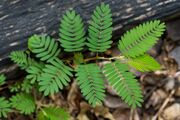 Leaves
-
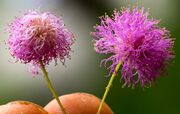 Flowers


Distribution and habitat
Mimosa quadrivalvis is native to Mexico, Belize, and Puerto Rico.[1]
Its habitat includes glades, open woods, thickets, prairies, and roadsides.[4]
Ecology
Mimosa quadrivalvis is insect pollinated and is recorded to have been visited in northern Florida by Agapostemon splendens, Augochloropsis metallica, Augochloropsis sumptuosa, Bombus griseocollis, Ceratina, Halictus poeyi/ligatus, Lasioglossum apopkense, Lasioglossum hitchensi, Lasioglossum illinoense, Lasioglossum imitatum, Lasioglossum pectorale, Lasioglossum reticulatum, Lasioglossum tegulare/puteulanum, Lasioglossum trigeminum, Lasioglossum vierecki, Lasioglossum weemsi/leviense, Melissodes communis.[5]
References
- ↑ 1.0 1.1 1.2 1.3 1.4 "Mimosa quadrivalvis L." (in en). Royal Botanic Gardens, Kew. http://www.plantsoftheworldonline.org/taxon/508578-1.
- ↑ "Mimosa quadrivalvis". Natural Resources Conservation Service PLANTS Database. USDA. https://plants.usda.gov/core/profile?symbol=MIQU2. Retrieved 4 August 2019.
- ↑ "natureserve.org". http://explorer.natureserve.org/servlet/NatureServe?searchName=Mimosa+quadrivalvis.
- ↑ 4.0 4.1 4.2 "missouriplants.com". http://www.missouriplants.com/Pinkalt/Mimosa_quadrivalvis_var_nuttallii_page.html.
- ↑ Ulyshen, M. D., K. Robertson, S. Horn, and C. Dixon. 2024. Characterization of the bee community and pollination network in a southeastern U.S. pine savanna. Frontiers in Ecology and Evolution 12:1403602.
Wikidata ☰ Q15454136 entry
 |  |


