Biology:Morus serrata
| Morus serrata | |
|---|---|
Scientific classification 
| |
| Kingdom: | Plantae |
| Clade: | Tracheophytes |
| Clade: | Angiosperms |
| Clade: | Eudicots |
| Clade: | Rosids |
| Order: | Rosales |
| Family: | Moraceae |
| Genus: | Morus |
| Species: | M. serrata
|
| Binomial name | |
| Morus serrata Roxb.
| |
| Synonyms[2] | |
| |
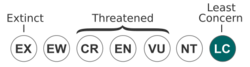
Morus serrata, known as Himalayan mulberry, is a species of mulberry native to the Himalaya from northern Pakistan through northwestern and northeastern India, Nepal, Bhutan, and Tibet,[2] in temperate forests at elevations of up to 3,000 metres (9,800 feet).[1]
It is a deciduous tree growing to 15 m (49 ft) tall. The leaves are 10–14 centimetres (4–5 1⁄2 inches) long and 6–10 cm (2 1⁄4–4 in) broad and are densely hairy on the veins underneath, with the upper surface hairless. The edible fruit[3] is a 2–3 cm (3⁄4–1 1⁄4 in) long compound cluster of several drupes that are red when ripe.
It is considered by some authorities[who?] to be a variety or subspecies of white mulberry (M. alba) and is also similar to black mulberry (M. nigra).
References
- ↑ 1.0 1.1 IUCN SSC Global Tree Specialist Group.; Botanic Gardens Conservation International (BGCI). (2026). "Morus serrata" (in en). IUCN Red List of Threatened Species 2026. doi:10.2305/IUCN.UK.2026-1.RLTS.T150222456A250197769.en. https://www.iucnredlist.org/species/150222456/250197769. Retrieved 10 September 2026.
- ↑ 2.0 2.1 "Morus serrata Roxb." (in en). Royal Botanic Gardens, Kew. http://www.plantsoftheworldonline.org/taxon/854715-1.
- ↑ "Morus serrata Himalayan Mulberry PFAF Plant Database". https://pfaf.org/user/Plant.aspx?LatinName=Morus+serrata.
External links
- Flora of China: Morus serrata – eFloras.org
Wikidata ☰ Q6915153 entry
 |  |


