Biology:Myrtus communis
| Myrtus communis | |
|---|---|

| |
Scientific classification 
| |
| Kingdom: | Plantae |
| Clade: | Tracheophytes |
| Clade: | Angiosperms |
| Clade: | Eudicots |
| Clade: | Rosids |
| Order: | Myrtales |
| Family: | Myrtaceae |
| Genus: | Myrtus |
| Species: | M. communis
|
| Binomial name | |
| Myrtus communis | |
| Synonyms[2] | |
|
List
| |

Myrtus communis, the common myrtle or true myrtle, is a species of flowering plant in the myrtle family Myrtaceae. It is an evergreen shrub native to southern Europe, North Africa, Western Asia, Macaronesia, and the Indian subcontinent, and also cultivated.[3]
The plant is an evergreen shrub or small tree, growing to 5 metres (16 ft) tall.[4] The leaves are 2–5 centimetres (1–2 in) long, with a fragrant essential oil.[4]
The flowers are white or tinged with pink, with five petals and many stamens that protrude from the flower.[4] The fruit is an edible berry, blue-black when ripe.[4]
The essential oils derived from this plant have anti-proliferative and anti-quorum sensing properties, helping against food spoilage.[5] The berries are also macerated in alcohol to make Mirto liqueur.
This species[6] and the more compact M. communis subsp. tarentina[7] have won the Royal Horticultural Society's Award of Garden Merit.[8] They are hardy but prefer a sheltered position in full sun.
The plant can be propagated with seeds stratified for 3 months.[9] Also, one can use a cutting with a short heel (small part of the bark), keeping it in moistened rooting mix.[10]
-
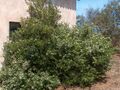 Myrtle plant
 -
 Foliage
 -
 Inflorescence
 -
 Berries
 -
 Myrtle pot
 -
 Berries macerated in alcohol to make Mirto liqueur


.jpg)


References
- ↑ Chadburn, H.; Wilson, B. (2018). "Myrtus communis". IUCN Red List of Threatened Species 2018. doi:10.2305/IUCN.UK.2018-1.RLTS.T203365A119997141.en. https://www.iucnredlist.org/species/203365/119997141. Retrieved 29 August 2024.
- ↑ The Plant List: A Working List of All Plant Species, http://www.theplantlist.org/tpl1.1/record/kew-132410, retrieved 13 August 2016
- ↑ USDA GRIN Taxonomy, https://npgsweb.ars-grin.gov/gringlobal/taxonomydetail.aspx?id=24898, retrieved 13 August 2016
- ↑ 4.0 4.1 4.2 4.3 Cretan Flora: An illustrated guide to the flora of Crete, http://www.cretanflora.com/myrtus_communis.html, retrieved 13 August 2016
- ↑ Myszka, Kamila; Sobieszczańska, Natalia; Olejnik, Anna; Majcher, Małgorzata; Szwengiel, Artur; Wolko, Łukasz; Juzwa, Wojciech (June 2020). "Studies on the anti-proliferative and anti-quorum sensing potentials of Myrtus communis L. essential oil for the improved microbial stability of salmon-based products". LWT 127. doi:10.1016/j.lwt.2020.109380.
- ↑ "RHS Plantfinder – Myrtus communis". https://www.rhs.org.uk/Plants/11311/i-Myrtus-communis-i/Details.
- ↑ "RHS Plantfinder – Myrtus communis subsp. tarentina". https://www.rhs.org.uk/Plants/59207/i-Myrtus-communis-i-subsp-i-tarentina-i/Details.
- ↑ "AGM Plants – Ornamental". Royal Horticultural Society. July 2017. p. 64. https://www.rhs.org.uk/plants/pdfs/agm-lists/agm-ornamentals.pdf.
- ↑ "Myrtus communis L.". http://www.lebanon-flora.org/docs/germination/myrtus_communis.pdf.
- ↑ "RNZIH - Plant Doctor - Myrtle cuttings". https://www.rnzih.org.nz/Plant_Doctor/Myrtle_cuttings.htm.
Wikidata ☰ Q6122027 entry
 |  |


