Biology:Vaccinium corymbosum
| Vaccinium corymbosum | |
|---|---|
.jpg)
| |
| Leaves and berries | |
Scientific classification 
| |
| Kingdom: | Plantae |
| Clade: | Tracheophytes |
| Clade: | Angiosperms |
| Clade: | Eudicots |
| Clade: | Asterids |
| Order: | Ericales |
| Family: | Ericaceae |
| Genus: | Vaccinium |
| Section: | Vaccinium sect. Cyanococcus |
| Species: | V. corymbosum
|
| Binomial name | |
| Vaccinium corymbosum L. 1753
| |
| Synonyms[1] | |
| |
Vaccinium corymbosum is a North American species of blueberry with several common names, including highbush blueberry and rabbiteye blueberry.[2][3]
The species became commonly cultivated as a fresh fruit crop in the 20th century, with dozens of commercial cultivars. It can be used as an ornamental hedge as well a food source for humans and wildlife.
Description
Vaccinium corymbosum is a deciduous shrub growing to 1.8–3.7 metres (6–12 ft) tall and wide. It is often found in dense thickets. The dark glossy green leaves are elliptical and up to 5 centimetres (2 in) long. In autumn, the leaves turn to a brilliant red, orange, yellow, and/or purple.[4][5]
The flowers are long bell- or urn-shaped white to very light pink, 8.5 mm (1⁄3 in) long.[4][5] The fruit is a blue-black berry with a 6.4–12.7 mm (1⁄4–1⁄2 in) diameter.[4]
The species is tetraploid and does not self-pollinate.[6] Most cultivars have a chilling requirement greater than 800 hours. Cytology is 2n = 48.[7]
-
 Foliage
 -
 Young shrub with fruit
 -
 Mature shrub
 -
 Flowers
 -
 Berries, ripe and unripe
 -
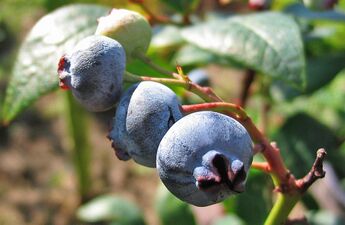 Berry close-up
 -
 Autumn leaves


Distribution and habitat
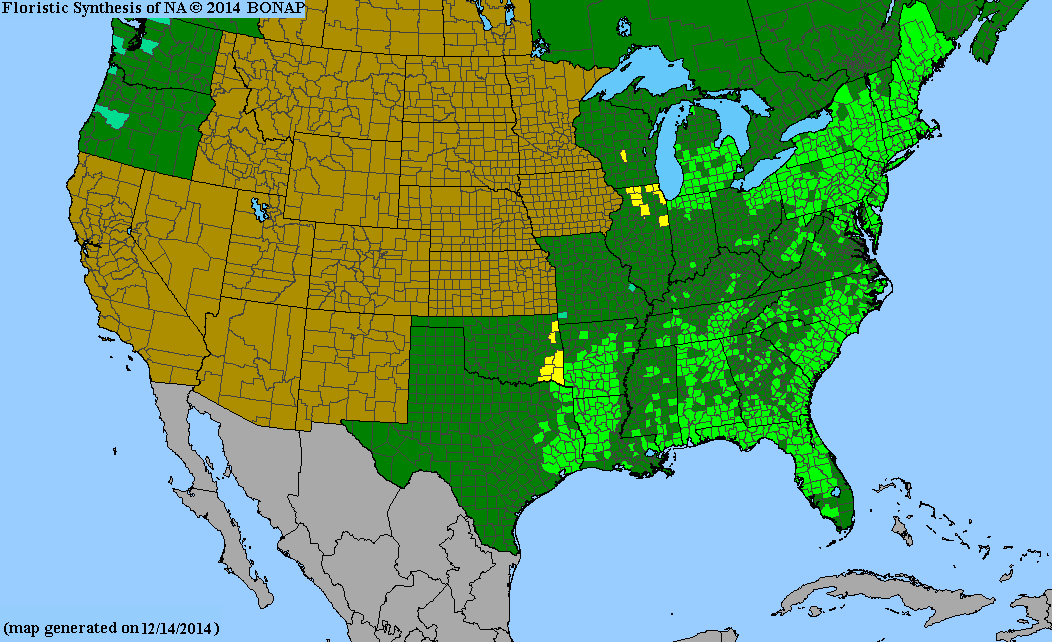
It is native to eastern Canada and the eastern and southern United States, from Ontario east to Nova Scotia and south as far as Florida and eastern Texas. It is also naturalized in other places, including Europe, Japan, New Zealand, and the North American Pacific Northwest.[8][9][4][10]
The plant is found in wooded or open habitats with moist acidic soils.[5][3]
Ecology
In natural habitats, the berries are a food source for native and migrating birds, bears, and small mammals. The foliage is browsed by deer and rabbits.[11][3]
Cultivation
Many wild species of Vaccinium are thought to have been cultivated by Native Americans for thousands of years, with intentional crop burnings in northeastern areas being apparent from archeological evidence.[6] V. corymbosum, being one of the species likely used by these peoples, was later studied and domesticated in 1908 by Elizabeth Coleman White and Frederick Vernon Coville. It became commonly cultivated as a fresh fruit crop in the 20th century[12][2] and the most common commercially grown blueberry in North America.{{Citation needed|date=August 2024} It is also cultivated as an ornamental plant for home and wildlife gardens and natural landscaping projects.[3][13] The soil pH must be very acidic (4.5 to 5.5).[4] It can be used as an ornamental hedge.[3]
Cultivars
Dozens of commercial cultivars exist.[2][3] Some common examples are listed here, grouped by approximate start of the harvest season:[14]
|
|
|
The cultivars Duke[15] and Spartan[16] have gained the Royal Horticultural Society's Award of Garden Merit.
Southern highbush blueberry
Some plants named southern highbush blueberry are hybridized forms derived from crosses between V. corymbosum and V. darrowii, a native of the Southeastern US. These hybrids and other cultivars of V. darrowii (southern highbush blueberry) have been developed for cultivation in warm southern and western regions of North America.[17][18]
Uses
The edible berries[3] were collected and used in Native American cuisine in areas where V. corymbosum grew natively.[19]
See also
References
- ↑ The Plant List, Vaccinium corymbosum L.
- ↑ 2.0 2.1 2.2 "Vaccinium corymbosum". North Carolina State University, Extension Cooperative. 2026. https://plants.ces.ncsu.edu/plants/vaccinium-corymbosum/.
- ↑ 3.0 3.1 3.2 3.3 3.4 3.5 3.6 Missouri Botanical Garden: Kemper Center for Home Gardening — Vaccinium corymbosum. accessed 3.23.2013
- ↑ 4.0 4.1 4.2 4.3 4.4 Vaccinium corymbosum. accessed 3.23.2013
- ↑ 5.0 5.1 5.2 Flora of North America, Vaccinium corymbosum Linnaeus, 1753. High-bush blueberry, bleuet en corymbe
- ↑ 6.0 6.1 Retamales, Jorge B.; Hancock, James F. (2012). Blueberries: Volume 21 of Crop production science in horticulture (1st ed.). Cambridge, MA: Centre for Agriculture and Bioscience International (CABI). pp. 2 & 39–42. ISBN 9781845938260. https://books.google.com/books?id=22aW1z1klDMC.
- ↑ Redpath, Lauren E.; Aryal, Rishi; Lynch, Nathan; Spencer, Jessica A.; Hulse-Kemp, Amanda M.; Ballington, James R.; Green, Jaimie; Bassil, Nahla et al. (2022). "Nuclear DNA contents and ploidy levels of North American Vaccinium species and interspecific hybrids". Scientia Horticulturae (Elsevier BV) 297. doi:10.1016/j.scienta.2022.110955. ISSN 0304-4238. Bibcode: 2022ScHor.29710955R.
- ↑ Biota of North America Program 2014 county distribution map
- ↑ Taxonomic account from Integrated Taxonomic Information System (ITIS) — for Vaccinium corymbosum (highbush blueberry)
- ↑ {{citation | mode = cs1 | title = Vaccinium corymbosum | work = Germplasm Resources Information Network (GRIN) | url = | publisher = [[Organization:Agricultural Research ServAgricultural Research Service (ARS), United States Department of Agriculture (USDA) | access-date = 2017-12-15 }}
- ↑ Niering, William A.; Olmstead, Nancy C. (1985). The Audubon Society Field Guide to North American Wildflowers, Eastern Region. Knopf. p. 509. ISBN 0-394-50432-1.
- ↑ Gough, Robert Edward (1994). The highbush blueberry and its management. Psychology Press. pp. 3. ISBN 978-1-56022-021-3. https://books.google.com/books?id=_wqfvwUy_oAC. Retrieved 2011-04-29.
- ↑ Hort.uconn.edu: Vaccinium corymbosum; Landscape use section . accessed 3.23.2013
- ↑ Hort.uconn.edu: Vaccinium corymbosum; Cultivars/varieties section . accessed 3.23.2013
- ↑ "RHS Plant Selector – Vaccinium corymbosum 'Duke'". https://www.rhs.org.uk/Plants/57014/Vaccinium-corymbosum-Duke-(F)/Details.
- ↑ "RHS Plant Selector – Vaccinium corymbosum 'Spartan'". https://www.rhs.org.uk/Plants/80821/Vaccinium-corymbosum-Spartan-(F)/Details.
- ↑ eXtension: Southern Highbush Blueberry Varieties
- ↑ Four Winds Growers: Care of southern highbush blueberries
- ↑ University of Michigan at Dearborn — Native American Ethnobotany of Vaccinium corymbosum . accessed 9.9.2015
External links
- United States Department of Agriculture Plants Profile for Vaccinium corymbosum (highbush blueberry)
- Species account and photographs from Lady Bird Johnson Wildflower Center Native Plant Information Network (NPIN)
Template:Blueberries Wikidata ☰ Q468695 entry
 |  |