Biology:Nymphaea ampla
| Nymphaea ampla | |
|---|---|

| |
| In bloom in Guatemala | |
_(8410609659).jpg)
| |
| Botanical illustration | |
Scientific classification 
| |
| Kingdom: | Plantae |
| Clade: | Tracheophytes |
| Clade: | Angiosperms |
| Order: | Nymphaeales |
| Family: | Nymphaeaceae |
| Genus: | Nymphaea |
| Subgenus: | Nymphaea subg. Brachyceras |
| Species: | N. ampla
|
| Binomial name | |
| Nymphaea ampla (Salisb.) DC.
| |
| Synonyms[2] | |
| |
Nymphaea ampla, also known as the dotleaf waterlily,[3] is a species of flowering plant in the family Nymphaeaceae.[4] It is native to Texas, Florida, Mexico, Central America, the Caribbean, and northern and western South America.[2]
It is depicted in Mayan art alongside jaguars and kings, held cultural significance as a symbol of life, fertility, and birth, with its opiate-like effects used for calming and inducing mild trances.[5]
Description
Vegetative characteristics
Nymphaea ampla is a perennial herb[6] with dark brown,[7] ovoid, unbranched rhizomes without stolons.[8] The coriaceous,[7] ovate to orbiculate floating leaves[8] with a dentate margin[9] are 15–45 cm long, and 15–45 cm wide.[8]
Generative characteristics
The yellowish white, fragrant, diurnal,[7] 7–18 cm wide flowers[8] extend well beyond the water surface.[7]
Cytology
The chromosome count is n = 14. The genome size is 772.62 Mb.[10] The chloroplast genome is 159879 bp long.[11]
Taxonomy
It was first described as Castalia ampla Salisb. by Richard Anthony Salisbury in 1805. It was moved to the genus Nymphaea L. as Nymphaea ampla (Salisb.) DC. by Augustin Pyramus de Candolle in 1821.[2] It is placed in the subgenus Nymphaea subg. Brachyceras.[12][3]
Habitat
It occurs in ponds, canals,[3][1] open freshwater lagoons, and drainage ditches.[1]
Cultural significance
Nymphaea ampla is widely represented in Mayan art, especially in its depictions with jaguars and Mayan kings. Its cultural importance can be seen in one of the Mayan names of the plant; nikte’ha’ (The Maya term nikte’ha’ literally means “flower of the water”, but has also been interpreted symbolically as “vulva of the water”) as it would have represented life, sexual activity, fertility, and birth. The plant causes opiate-like effects on the user and is known to have been used as a calmative and mild trance inducer.[13]
Conservation
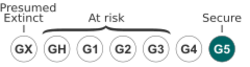
In Guadeloupe it has been classified as near threatened (NT) in the France red list.[14] The NatureServe conservation status is G5 Secure.[1]
Gallery
-
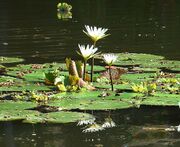 In Lake Nicaragua
 -
 At the Bergianska trädgården
 -
 Close-up of flower
.jpg)


References
- ↑ 1.0 1.1 1.2 1.3 Nymphaea ampla. (n.d.). NatureServe. Retrieved May 25, 2025, from https://explorer.natureserve.org/Taxon/ELEMENT_GLOBAL.2.150154/Nymphaea_ampla
- ↑ 2.0 2.1 2.2 "Nymphaea ampla (Salisb.) DC." (in en). Royal Botanic Gardens, Kew. http://www.plantsoftheworldonline.org/taxon/605494-1.
- ↑ 3.0 3.1 3.2 Weakley, A.S., and Southeastern Flora Team. 2025. Flora of the southeastern United States Web App. University of North Carolina Herbarium, North Carolina Botanical Garden, Chapel Hill, U.S.A. https://fsus.ncbg.unc.edu/main.php?pg=show-taxon-detail.php&lsid=urn:lsid:ncbg.unc.edu:taxon:{A9C9AAA6-A0E2-4F56-87D9-0BA746CDAB0C}. Accessed May 25, 2025.
- ↑ "Nymphaea ampla". Lady Bird Johnson Wildflower Center. 13 July 2020. https://www.wildflower.org/plants/result.php?id_plant=NYAM2.
- ↑ Emboden, W.A. (1979) "Nymphaea ampla and Other Mayan Narcotic Plants." Mexicon 1:50–52.
- ↑ Nymphaea ampla. (2024, April 1). Leon Levy Native Plant Preserve. Retrieved May 25, 2025, from https://levypreserve.org/plant-listings/nymphaea-ampla/
- ↑ 7.0 7.1 7.2 7.3 Henkel, F., Rehnelt, F., Dittmann, L. (1907). Das Buch der Nymphaeaceen oder Seerosengewächse. pp. 57–58. Deutschland: Henkel.
- ↑ 8.0 8.1 8.2 8.3 Nymphaea ampla in Flora of North America @ efloras.org. (n.d.). Retrieved May 25, 2025, from http://www.efloras.org/florataxon.aspx?flora_id=1&taxon_id=233500822
- ↑ Breukel, H. (2010). Nymphaea ampla de Candolle. Seerosenforum.de Das Portal Der Seerose. Retrieved May 25, 2025, from https://www.seerosenforum.de/gattung/Brachyceras/Ampla/Ampla.aspx
- ↑ Chen, F., Liu, X., Yu, C., Chen, Y., Tang, H., & Zhang, L. (2017). "Water lilies as emerging models for Darwin’s abominable mystery." Horticulture research, 4.
- ↑ Gruenstaeudl, M., Nauheimer, L., & Borsch, T. (2017). Plastid genome structure and phylogenomics of Nymphaeales: conserved gene order and new insights into relationships. Plant systematics and evolution, 303, 1251-1270.
- ↑ USDA, Agricultural Research Service, National Plant Germplasm System. 2025. Germplasm Resources Information Network (GRIN Taxonomy). National Germplasm Resources Laboratory, Beltsville, Maryland. URL: https://npgsweb.ars-grin.gov/gringlobal/taxon/taxonomydetail?id=25431. Accessed 25 May 2025.
- ↑ Emboden, W.A. (1979) "Nymphaea ampla and Other Mayan Narcotic Plants." Mexicon 1:50–52.
- ↑ Nymphaea ampla (Salisb.) DC., 1821. (n.d.). Inventaire National Du Patrimoine Naturel. Retrieved July 3, 2023, from https://inpn.mnhn.fr/espece/cd_nom/630229?lg=en
Wikidata ☰ Q3346672 entry
 |  |


