Biology:Ocotea cuneifolia
| Ocotea cuneifolia | |
|---|---|
Scientific classification 
| |
| Kingdom: | Plantae |
| Clade: | Tracheophytes |
| Clade: | Angiosperms |
| Clade: | Magnoliids |
| Order: | Laurales |
| Family: | Lauraceae |
| Genus: | Ocotea |
| Species: | O. cuneifolia
|
| Binomial name | |
| Ocotea cuneifolia (Ruiz & Pav.) Mez
| |
| Synonyms[2] | |
| |
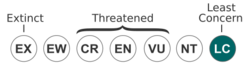
Ocotea cuneifolia is a species of tree in the family Lauraceae that is native to Colombia, Ecuador, and Peru.[3]
Distribution and habitat
In Colombia it is known from Quindío,[3] in Ecuador it is known from Bolívar, Carchi, Esmeraldas, Imbabura, Napo, and Zamora-Chinchipe,[3][4] and in Peru it is known from Amazonas, Cajamarca, Cusco, Huánuco, and San Martín.[3][5][6] It can be found at elevations of 250–3,000 m (820–9,840 ft) above sea level.[3]
Description
O. cuneifolia is a variable species growing to 35 m (115 ft) tall. The papery leaves are elliptic to obovate-elliptic in shape with a pointed tip and cuneate base, measuring 9–14 cm (3.5–5.5 in) by 3.5–4.5 cm (1.4–1.8 in). The leaf veins are raised, with pit-shaped domatia along the secondary veins. The inflorescence measures 4–9 cm (1.6–3.5 in) long and is somewhat hairy. The staminate flowers measure 5 mm (0.20 in) in diameter and bear nine stamens, while the pistillate flowers measure 2.5 mm (0.098 in) in diameter with a 1.5 mm (0.059 in) long pistil. The flowers may be reddish or yellow-green in colour. The fruits measure 2.5 cm (0.98 in) by 2.2 cm (0.87 in).[3]
References
- ↑ Hills, R. (2021). "Ocotea cuneifolia". IUCN Red List of Threatened Species 2021. doi:10.2305/IUCN.UK.2021-2.RLTS.T203657499A138510133.en. https://www.iucnredlist.org/species/203657499/138510133. Retrieved 19 August 2024.
- ↑ "Ocotea cuneifolia (Ruiz & Pav.) Mez". Royal Botanic Gardens, Kew. https://powo.science.kew.org/taxon/urn:lsid:ipni.org:names:171607-2.
- ↑ 3.0 3.1 3.2 3.3 3.4 3.5 van der Werff, Henk (2017). "Studies in Andean Ocotea (Lauraceae) IV. Species with Unisexual Flowers and Densely Pubescent Leaves, or with Erect Pubescence or Domatia, Occurring above 1000 m in Altitude". Novon: A Journal for Botanical Nomenclature 25 (3): 360–361. doi:10.3417/2016021. https://www.biodiversitylibrary.org/page/61460622.
- ↑ Jørgensen, Peter Møller; León-Yánez, Susana; González, Amada Pedroni et al., eds (1999). Catalogue of the vascular plants of Ecuador (Catalogo de las plantas vaculares del Ecuador). Monographs in Systemic Botany from the Missouri Botanical Garden. 75. Missouri Botanical Garden. p. 530. ISBN 0-915279-60-6. https://www.biodiversitylibrary.org/page/62681575.
- ↑ Brako, Lois; Zarucchi, James L. (1996). Catalogue of the flowering plants and gymnosperms of Peru (Catálogo de las angiospermas y gimnospermas del Perú). Monographs in Systemic Botany from the Missouri Botanical Garden. 45. Missouri Botanical Garden. p. 598. ISBN 0-915279-19-3. https://www.biodiversitylibrary.org/page/62031740.
- ↑ Vega, Isidoro Sanchez; Vela, Gustavo Iberico; Cruz, Mario Zapata; Kawasaki, Maria Lucia; Dillon, Michael O. (2001). "Nuevos registros para la flora de San Martin, Peru" (in es). Arnaldoa: Revista del Museo de Historia Natural 8 (1): 48. https://www.biodiversitylibrary.org/page/40626626.
Wikidata ☰ {{{from}}} entry
 |  |


